CustomGPT
Curated ToolThis tool is part of our curated AI directory. We only include tools that meet our standards for relevance, usability and real-world value.

CustomGPT

CustomGPT is an AI platform for building GPT-powered chatbots from an organization’s own websites, documents, and knowledge bases. It supports internal search and customer-facing Q&A by retrieving answers from uploaded or connected business content.
Customer Support BotsKnowledge Base Bots

CustomGPT

FYAI Score

8.1 / 10

Based on 6 reviews + FYAI product analysis

Pricing:

Paid

Best for:

Support and ops teams automating answers from internal knowledge

Score Breakdown

  • Ease of use8.0 / 10
  • Features8.3 / 10
  • Pricing7.3 / 10
  • Integrations9.1 / 10
  • Support7.7 / 10

PRODUCT PREVIEW

What this AI tool does

CustomGPT
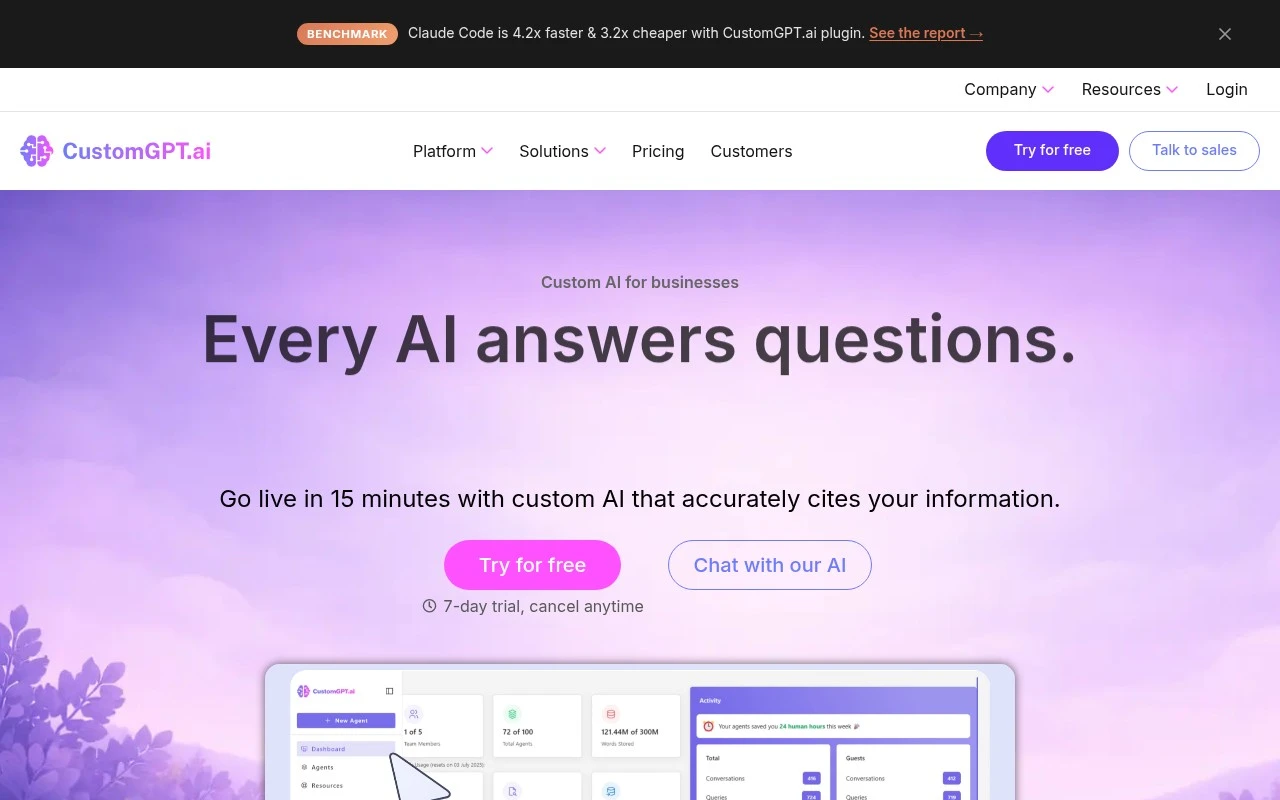
CustomGPT is a no-code AI agent platform for organizations that want GPT-style assistants trained on their own business content rather than on generic web knowledge. CustomGPT is built for teams that need business-specific answers for employees, customers, partners, or site visitors, with responses grounded in approved source material and supported by citations. For teams dealing with large volumes of documentation, the main value is making institutional knowledge easier to access. Instead of asking users to browse folders, search a website, or open multiple knowledge base articles, the platform lets them ask natural-language questions and receive direct answers. This makes it especially relevant for internal search, knowledge base search, and customer support automation. At its core, the platform turns existing content into a conversational interface. Organizations can upload files, ingest web pages, connect content sources, and shape how the agent responds, all without needing to build a retrieval system from scratch. The experience is closer to configuring a business assistant than developing a custom chatbot application. A major part of the product’s positioning is trust in the answer. The agent can cite the documents or pages it used, which helps users verify information instead of treating the response as a black box. For companies with policy manuals, product documentation, HR resources, help centers, or compliance-sensitive material, that citation layer is central to whether the tool is useful in real work. Compared with generic AI chatbots, CustomGPT is best at creating controlled, company-specific AI agents that answer from a defined knowledge base. The platform is not mainly about open-ended creative generation, brainstorming, or general internet research. Its stronger fit is when an organization already has reliable content and wants an AI layer that can retrieve, summarize, and explain it in context. Security-conscious businesses are also part of the intended audience. The platform emphasizes controls around business data and states that customer data is not used to train large language models. That distinction matters for organizations evaluating AI tools for internal search or support workflows, where private documents, customer information, or proprietary processes may be involved. Deployment is designed to fit common business channels rather than requiring a separate AI product strategy. An agent can be branded, tuned for tone and behavior, and made available to employees or customers through chatbot deployment on a website or other connected surfaces. This makes the tool relevant both for public-facing support and private internal knowledge access. For buyers comparing CustomGPT alternatives, the key question is usually not whether an AI chatbot can answer questions, but whether it can answer from the right material with enough accuracy, traceability, and administrative control. A practical CustomGPT review should focus on content ingestion, answer quality, citation reliability, security requirements, integrations, and how easily non-technical teams can maintain the agent over time. CustomGPT pricing is therefore best considered in relation to the size of the knowledge base, the number of users or conversations, and the role the agent will play in operations. A small team may use it to reduce repetitive support questions, while a larger organization may treat it as part of a broader knowledge management or customer experience stack. In both cases, the value depends on how well the underlying content is organized and how clearly the agent’s scope is defined. The broader story of the platform is agent building for organizations that want AI to speak with their own knowledge and constraints. It gives business teams a way to package documents, websites, and internal resources into an assistant that can answer consistently, cite sources, and stay aligned with approved information. CustomGPT is most compelling when the problem is not generating more content, but helping people find and understand the content a business already trusts.

Use cases

Best for

Agent Building

Build a branded AI agent by uploading docs, crawling sites, and connecting knowledge sources with no code behavior settings.

Internal Search

Use CustomGPT to answer employee questions by searching your uploaded content and linked sources and returning cited passages.

Customer Support Automation

Automate support replies by deploying a CustomGPT agent that answers from your help content and includes citations to sources.

ANALYSIS

Strengths & limitations

Strengths
  • Best suited to organizations with existing documents, websites, and knowledge bases because it can turn owned content into a no-code AI assistant quickly.
  • Useful for customer support and internal knowledge teams because answers can include citations to source material, making responses easier to verify.
  • Strong fit for branded business deployments because teams can customize the agent’s behavior, appearance, access controls, and data-use settings.

Limitations
  • Less suitable for teams that need a broad autonomous workflow platform because its core strength is grounded question answering over business content.
  • Paid-only pricing makes it a weaker fit for hobby projects or very small teams that need a free long-term assistant.
  • Requires clean, current, and well-structured source content because outdated or fragmented knowledge will limit the usefulness of the assistant’s answers.

Evaluation

FYAI score breakdown

Our structured evaluation across five key criteria

8.1 / 10

Overall score

Based on 6 reviews + FYAI product analysis

  • Ease of use8.0 / 10
  • Features8.3 / 10
  • Pricing7.3 / 10
  • Integrations9.1 / 10
  • Support7.7 / 10

What users say

Findings from public reviews, documentation and community sources.

  • Ease of use

    CustomGPT says users can “Go live in 15 minutes” and launch in “3 streamlined steps”: “Connect data,” “Customize,” and “Deploy.”

  • Features

    CustomGPT describes custom AI agents built from business content, citations for “every response,” customization of appearance/behavior/LLMs, and “1,400+ supported file types.” CustomGPT also references “100+ integrations,” SOC-2 Type II, GDPR, and encryption.

  • Pricing

    The CustomGPT pricing page lists Standard at “$99 /mo” with “500 credits / month,” Premium at “$499 /mo” with “2,500 credits / month,” and Enterprise as custom, “Typically $2,000–$6,000/mo.”

  • Integrations

    The CustomGPT pricing page lists auto-sync sources including Google Drive, SharePoint, OneDrive, and WordPress. The CustomGPT pricing page also lists deployment options such as embed, link, WordPress, and API-accessible Slack/Telegram/Chrome extension.

  • Support

    The CustomGPT pricing page links to Documentation and FAQ resources. The CustomGPT pricing page says Enterprise includes a “Dedicated account team” and “Forward-deployed engineering.”

Who is this for?

Best for teams that need a no-code chatbot built from business content, CustomGPT says users can “Go live in 15 minutes” through “Connect data,” “Customize,” and “Deploy.” Best for teams that need answer traceability because CustomGPT describes citations for “every response.” Less suited to budget-sensitive teams or high-volume pilots, the CustomGPT pricing page lists Standard at “$99 /mo” with “500 credits / month,” while Enterprise is custom, “Typically $2,000–$6,000/mo.”

PRODUCT PREVIEW

Feature highlights

Your content, ready

Upload docs, crawl sites, and connect sources to power your agent.

Cited answers

Replies include citations so users can verify the source material.

Secure by design

Enterprise controls and your data isn’t used to train LLMs.

COMPARE

Discover curated alternatives worth comparing

Compare similar AI tools based on features, pricing and use cases

8.1/ 10FYAI score

Helply

Customer Support BotsKnowledge Base Bots
Answers tickets, drafts replies, flags gaps and churn risks
Best for:
Customer support teams
Pricing
Freemium

8.7/ 10Based on 7,757 reviews

Zoho Desk

Customer Support BotsKnowledge Base Bots
Handles routine tickets, flags issues, and drafts replies
Best for:
Customer support teams
Pricing
Freemium

7.8/ 10Based on 31,824 reviews

Zoho

Customer Support Bots
Runs business apps for sales, finance, HR, and support teams
Best for:
Operations teams
Pricing
Freemium

CustomGPT

Turn shoppers into buyers with a personalized AI agent that answers fast and recommends the right products. Start building with CustomGPT today.

FAQ

Frequently asked
questions

Everything you need to know about this AI tool,
its features, pricing, use cases, and limitations.

Who is CustomGPT best suited for?
CustomGPT is best suited for organizations that want a branded AI assistant grounded in their own approved content. It fits customer support, employee knowledge access, associations, knowledge management teams, and businesses that need answers from websites, documents, knowledge bases, videos, podcasts, or connected systems without building an AI agent from scratch.
Is CustomGPT free or paid?
CustomGPT is a paid platform, so buyers should expect a commercial subscription rather than a purely free chatbot tool. It is aimed more at business use cases than casual experimentation, especially where teams need source citations, secure content ingestion, branding, integrations, and deployment options for support or internal search.
How does CustomGPT compare with other AI chatbot builders?
CustomGPT differs from many general chatbot builders by focusing on business knowledge Q&A using an organization’s existing content with cited sources. The right alternative depends on budget, content sources, required integrations, security needs, and whether the team mainly needs support automation, internal knowledge search, or broader AI workflow building.
How quickly can a team set up CustomGPT?
CustomGPT’s main trade-off is that answer quality depends heavily on the accuracy, completeness, and freshness of the connected source content. It is also focused on business knowledge assistants rather than training proprietary foundation models or creating broader AI media outputs such as images, audio, or video.
How should teams evaluate CustomGPT for privacy and compliance?
Teams evaluating CustomGPT for sensitive business content should review its security, data handling, access control, and compliance documentation before deployment. CustomGPT makes business-oriented security claims including SOC 2 Type II, GDPR alignment, encryption, branding controls, and API availability, which are relevant for customer support and internal knowledge use cases.