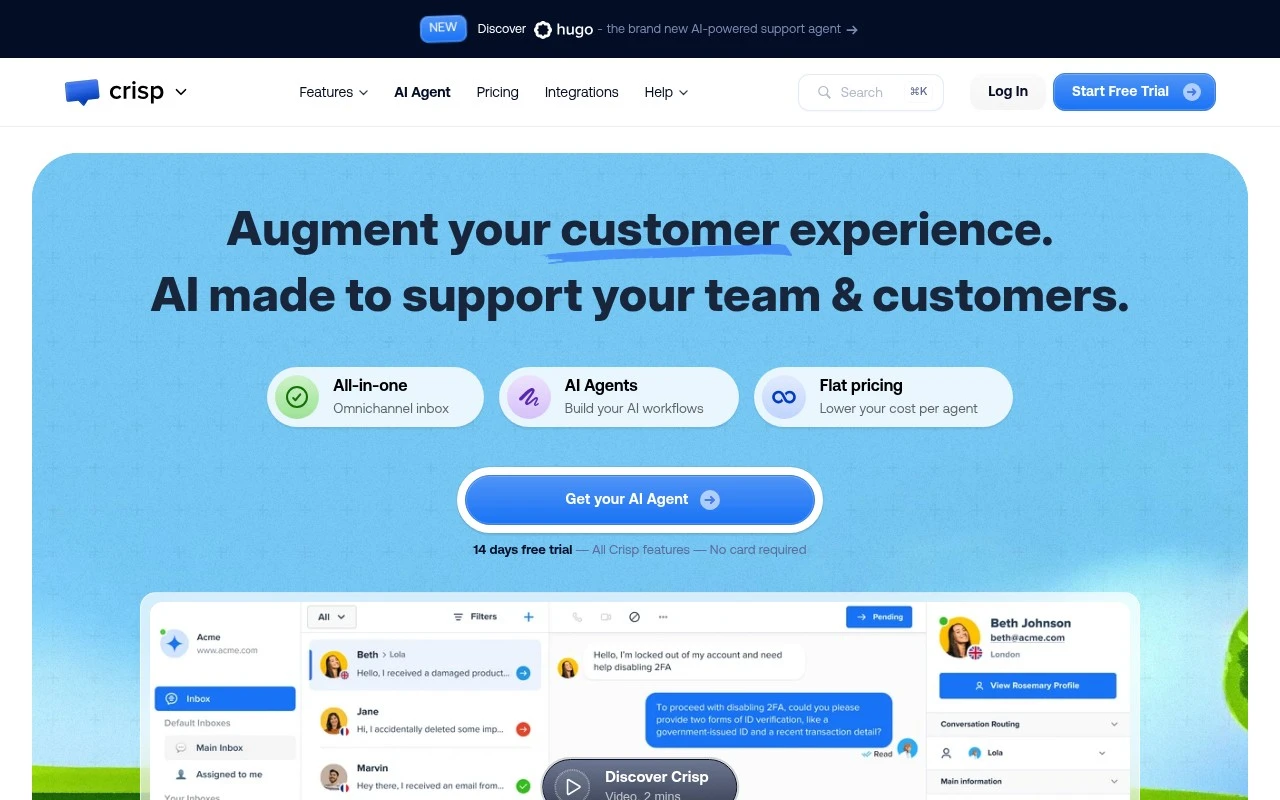
Crisp
Curated ToolThis tool is part of our curated AI directory. We only include tools that meet our standards for relevance, usability and real-world value.

Crisp

Crisp is a customer messaging platform that combines website live chat, a shared inbox, chatbots, and knowledge base tools for managing customer support and sales conversations.
Customer Support BotsChatbots

FYAI Score

9.0 / 10

Based on 396 reviews

Pricing:

Freemium

Best for:

Support and sales teams managing high-volume customer messaging

Score Breakdown

  • Ease of use8.7 / 10
  • Features8.8 / 10
  • Pricing9.3 / 10
  • Integrations9.1 / 10
  • Support9.3 / 10

PRODUCT PREVIEW

What this AI tool does

Crisp
Crisp is a customer communication platform for businesses that want to manage support, sales, and customer messaging from one system. Crisp is built for teams that need live chat, AI-assisted support, automation, customer context, and self-service content to work together instead of sitting in separate tools. Its strongest fit is customer support automation for companies that want faster replies without losing the continuity of a human support experience. For customer-facing teams, the platform acts as a central workspace for conversations coming from a website chat widget, mobile app chat, email, and connected messaging channels. Instead of forcing agents to switch between inboxes, it brings conversations into a shared inbox where teams can assign, prioritize, and follow up with customers in one place. This makes it useful for support teams, sales teams, and founders who need a practical communication hub rather than a standalone chatbot. AI is part of the product story, but it is positioned around service quality rather than novelty. Teams can train AI agents on existing help content, product documentation, and previous answers so the system can respond with contextually relevant support. Over time, conversations can be reviewed and improved, allowing the AI layer to become more accurate as the business learns which questions customers ask most often. A major strength of Crisp is how it connects automation with human handoff. No-code workflows can route conversations, collect customer details, trigger replies, or guide users toward the right article before an agent steps in. This gives smaller teams a way to scale support coverage, while larger teams can use the same automation layer to standardize repetitive processes across departments. The knowledge base is not treated as a separate help center sitting outside the support workflow. It works alongside chat and AI, giving customers access to answers through knowledge base search while also giving support agents and AI systems a source of approved information. That connection matters because self-service content becomes more valuable when it directly reduces repeated questions inside live conversations. Beyond chat, the built-in support CRM gives teams a clearer view of the customer behind each message. Conversation history, profile details, and company context help agents understand whether they are speaking with a new visitor, an active customer, or a high-value account. This customer context is especially useful for businesses where support and sales overlap, such as SaaS companies, online services, and subscription-based products. Analytics add another layer by showing how communication performance changes over time. Teams can look at response patterns, workload, customer activity, and the effectiveness of automation to identify gaps in the support process. In that sense, Crisp is not only a messaging tool, but also a feedback system for improving how a business communicates with its users. For growing companies, Crisp offers a balance between accessibility and breadth. It is approachable enough for teams that need to launch chatbot deployment and live chat quickly, but broad enough to support more structured operations through AI agents, automations, shared ownership, and reporting. The result is a platform shaped around the full customer conversation lifecycle, from first website question to ongoing support relationship.

Use cases

Best for

Omnichannel Support

Route website chat, email, and social messages into a shared Crisp inbox so agents reply with one conversation history.

Customer Support Automation

Deploy Crisp AI agents trained on your docs to answer common questions, suggest replies, and hand off to humans when needed.

Knowledge Base Search

Let customers search your Crisp knowledge base from the chat widget to surface relevant articles before creating a ticket.

ANALYSIS

Strengths & limitations

Strengths
  • Best suited to teams that want support, sales, and customer messaging in one workspace because it combines chat, shared inbox, CRM, knowledge base, automations, analytics, and AI assistance.
  • Useful for scaling inbound support because AI agents can be trained on existing content, deployed across messaging channels, and refined from real conversations over time.
  • Accessible for growing teams because the freemium model lets businesses start with core messaging workflows before committing to broader paid capabilities.

Limitations
  • Less suitable for phone-first or traditional contact center operations because Crisp is strongest around chat, web, app, and messaging-based customer communication.
  • Teams with complex support processes should expect setup work because AI agents, no-code automations, knowledge base content, and routing rules need ongoing configuration and maintenance.
  • The freemium model can limit growing teams because advanced automation, AI-assisted support, or broader team workflows are likely to require a paid plan as usage matures.

Evaluation

FYAI score breakdown

Our structured evaluation across five key criteria

9.0 / 10

Overall score

Based on 396 reviews

  • Ease of use8.7 / 10
  • Features8.8 / 10
  • Pricing9.3 / 10
  • Integrations9.1 / 10
  • Support9.3 / 10

What users say

Findings from public reviews, documentation and community sources.

  • Ease of use

    G2 reports that users “consistently praise the product for its excellent customer support and ease of use.” Crisp’s own onboarding emphasizes a “14 days free trial” with “No card required.”

  • Features

    Crisp’s site describes an all-in-one platform with “Omnichannel inbox,” “AI Agents,” “AI workflows,” and “Knowledge Base.” Crisp’s site also references smart replies, auto-summaries, and a support copilot trained on company content.

  • Pricing

    Crisp’s pricing page publishes a “Free Forever” plan, Mini at “$45 per month, per workspace,” Essentials at “$95,” and Plus at “$295.” Crisp’s pricing page states a “flat pricing per workspace” model with included seats and AI credits.

  • Integrations

    Crisp’s pricing page lists e-commerce integrations including “Shopify, Adobe, WooCommerce, and Prestashop,” omnichannel connections such as “WhatsApp Business, Instagram DMs, SMS, Line, Viber,” and “100+ integrations” on the Plus plan. Crisp’s site also references Chat SDKs and a Developer Hub.

  • Support

    G2’s review summary says users praise Crisp’s “excellent customer support” and describe the team as “responsive and helpful.” Crisp’s site navigation surfaces support resources such as a Help Center and system status.

Who is this for?

Best for support teams that want AI-assisted omnichannel customer conversations in one workspace, Crisp’s site lists “Omnichannel inbox,” “AI Agents,” “AI workflows,” and channels including “WhatsApp Business, Instagram DMs, SMS, Line, Viber.” Less suited to teams that need seat-by-seat purchasing flexibility, Crisp’s pricing page states a “flat pricing per workspace” model, so budgeting is tied to workspace tiers such as Mini at “$45 per month, per workspace” and Plus at “$295.”

PRODUCT PREVIEW

Feature highlights

Shared Inbox

Handle chat, email, and messaging from one collaborative inbox.

AI Support Agents

Train AI on your content to answer customers and improve over time.

No-code Automation

Route, tag, and follow up automatically to keep SLAs on track.

COMPARE

Discover curated alternatives worth comparing

Compare similar AI tools based on features, pricing and use cases

8.1/ 10FYAI score

Helply

Customer Support BotsKnowledge Base Bots
Answers tickets, drafts replies, flags gaps and churn risks
Best for:
Customer support teams
Pricing
Freemium

8.7/ 10Based on 7,757 reviews

Zoho Desk

Customer Support BotsKnowledge Base Bots
Handles routine tickets, flags issues, and drafts replies
Best for:
Customer support teams
Pricing
Freemium

7.8/ 10Based on 31,824 reviews

Zoho

Customer Support Bots
Runs business apps for sales, finance, HR, and support teams
Best for:
Operations teams
Pricing
Freemium

Crisp

Turn more chats into happy customers. Start using Crisp today to respond faster, reduce support load, and keep shoppers moving to checkout.

FAQ

Frequently asked
questions

Everything you need to know about this AI tool,
its features, pricing, use cases, and limitations.

Who is Crisp best suited for?
Crisp is best suited for customer support, inbound sales, and marketing teams that want one place to manage customer conversations and AI-assisted support. It fits businesses using channels such as website chat, email, WhatsApp, Messenger, Instagram, and mobile apps, especially when they also need a knowledge base and shared inbox.
Does Crisp have a free plan, and when would a paid plan make sense?
Crisp uses a freemium pricing model, so teams can start with a free option and upgrade when they need more advanced support capabilities. Paid plans typically make more sense for teams that need broader automation, AI agents, multichannel messaging, collaboration features, analytics, or more developed support workflows.
How does Crisp compare with other customer support automation tools?
Crisp is strongest when a team wants live chat, a shared inbox, AI agents, knowledge base content, CRM-style context, automations, and analytics in one support platform. Other tools may be better if the priority is a full enterprise contact center, a standalone CRM, or highly specialized workflow automation.
How long does it take to set up Crisp?
Crisp is focused on customer messaging and support workflows, not on replacing a full general-purpose CRM or enterprise contact center suite. Its AI automation quality depends heavily on the accuracy and completeness of imported support content, and teams should review AI conversations to fix gaps, invalid answers, or incomplete workflows.
What should teams check about Crisp data privacy and compliance?
Teams evaluating Crisp should review how customer messages, knowledge base content, PDFs, and website data are processed, stored, and accessed. Buyers handling sensitive information should confirm Crisp’s current security, privacy, retention, and compliance details directly on crisp.chat, and align usage with their internal data handling policies.