Chatfuel
Curated ToolThis tool is part of our curated AI directory. We only include tools that meet our standards for relevance, usability and real-world value.

Chatfuel

Chatfuel is a no-code chatbot platform for building AI chatbots on WhatsApp, Facebook Messenger, Instagram, and websites. It helps businesses automate customer conversations, qualify leads, answer FAQs, and route handoffs to human agents.
Customer Support BotsSales & Lead Bots

Chatfuel

FYAI Score

8.1 / 10

Based on 45 reviews

Pricing:

Paid

Best for:

Sales and support teams handling high-volume social DMs

Score Breakdown

  • Ease of use8.8 / 10
  • Features7.8 / 10
  • Pricing8.4 / 10
  • Integrations7.8 / 10
  • Support7.3 / 10

PRODUCT PREVIEW

What this AI tool does

Chatfuel
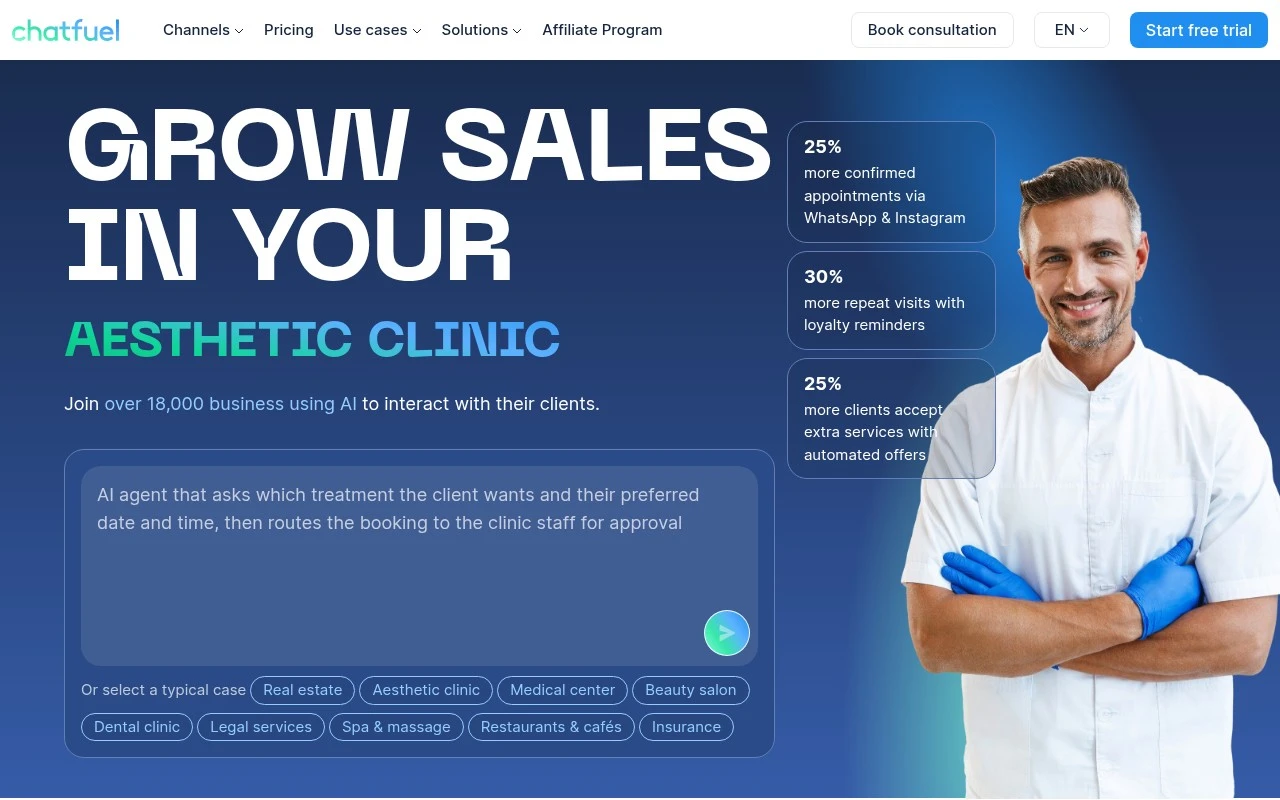
Chatfuel is an AI agent platform for social-media-based sales, marketing automation, and customer operations across Instagram, WhatsApp, Facebook, and TikTok. Chatfuel is built for businesses that receive customer intent through messages, comments, ads, and social conversations, and need those interactions handled faster than a human team can manage manually. For brands that live in direct messages, the platform turns social inboxes into operational channels. It can answer incoming questions, qualify interest, guide people toward a purchase or booking, and keep conversations moving without forcing every customer into a separate support portal or website form. At its center is the idea that conversational automation should support revenue as well as service. The tool is not positioned only as a basic chatbot deployment product, because it also helps teams manage clients, coordinate bookings, respond to ad-driven enquiries, and improve the way social conversations are structured. Lead capture is one of the main roles Chatfuel plays for growing businesses. Instead of letting comments, story replies, or paid social responses disappear in a crowded inbox, it can collect details, identify intent, and route people into the next step of a sales or service journey. Customer support automation is another core use case, especially for teams that repeatedly answer the same questions about availability, delivery, services, products, or policies. The platform helps reduce response delays while keeping the conversation inside the channels customers already use, which matters for mobile-first audiences and social commerce workflows. Booking-heavy businesses can use it to move from conversation to appointment more smoothly. A customer asking about a service can be guided through availability, requirements, and next steps, while the business keeps a clearer record of who the client is and what they need. Ad-driven conversations are a major part of the product story. When people respond to campaigns on Instagram, Facebook, WhatsApp, or TikTok, Chatfuel can help continue the interaction after the first click or message, making paid traffic more conversational and easier to convert. Beyond automation, the platform also leans into guidance and strategic recommendations. That makes it useful for teams that do not only want to build a flow, but also want help understanding how to improve engagement, handle objections, follow up with prospects, and design more effective customer journeys. The overall character of Chatfuel is practical and commerce-focused. Chatfuel is best at turning social messaging into a structured system for proactive customer engagement, lead capture, customer support automation, and sales follow-up, while still fitting the informal way customers communicate on social platforms.

Use cases

Best for

Chatbot Deployment

Deploy Chatfuel AI agents to answer Instagram, WhatsApp, Facebook, and TikTok messages with automated conversation flows.

Marketing Automation

Automate ad driven conversations by routing replies from Instagram and Facebook ads into predefined message sequences and follow ups.

Lead Capture

Capture leads by collecting contact details and booking requests in chat, then saving them to your client list for follow up.

ANALYSIS

Strengths & limitations

Strengths
  • Strong fit for businesses that sell through Instagram, WhatsApp, Facebook, and TikTok because it centralizes AI replies across high-volume social messaging channels.
  • Useful for service businesses with bookings because it can qualify leads, manage appointments, send reminders, and reduce no-shows.
  • Helpful for teams running social ads because it supports ad-related conversations and business-performance recommendations that connect inbound engagement to sales operations.

Limitations
  • Less suitable for companies whose customer operations happen mainly in email, phone, or web ticketing because its strengths are tied to social messaging channels.
  • The paid pricing model makes it a poorer fit for very small or experimental projects that need a free, lightweight automation option.
  • Requires setup around brand voice, lead rules, booking logic, and social account connections, so teams should expect ongoing configuration and monitoring rather than a plug-and-forget chatbot.

Evaluation

FYAI score breakdown

Our structured evaluation across five key criteria

8.1 / 10

Overall score

Based on 45 reviews

  • Ease of use8.8 / 10
  • Features7.8 / 10
  • Pricing8.4 / 10
  • Integrations7.8 / 10
  • Support7.3 / 10

What users say

Findings from public reviews, documentation and community sources.

  • Ease of use

    G2 summarizes that users "consistently praise the ease of use and intuitive design" and that Chatfuel is accessible "without coding experience."

  • Features

    Chatfuel's website describes social-commerce conversational automation across Instagram, WhatsApp, Facebook and TikTok. Chatfuel's website lists DMs/comments/story replies, AI sales/marketing/booking/strategy agents, shared inbox and flow builder among its features.

  • Pricing

    Chatfuel's pricing page lists a free Chatfuel Light plan and states "No credit card required." Chatfuel's pricing page lists AI PRO at "$49 USD per month" with annual billing "-29%" and notes usage limits and custom help for higher usage.

  • Integrations

    Chatfuel's integrations help page lists "Hubspot," "Zendesk," "Salesforce," "Kommo," and "Facebook Conversions API." Chatfuel product materials also surface API/Zapier-style connectivity.

  • Support

    A Reddit r/Chatbots workplace user describes raising a Messenger handoff issue and notes Chatfuel responded with "Their reply was..." G2 product-review ratings are positive but not strongly support-specific.

Who is this for?

Best for social-commerce teams managing conversations on Instagram, WhatsApp, Facebook and TikTok. Chatfuel supports DMs/comments/story replies and AI sales/marketing/booking/strategy agents. Less suited to teams that need a broad enterprise conversational-AI suite, because Chatfuel's listed capabilities center on social messaging automation rather than broad enterprise conversational-AI coverage.

PRODUCT PREVIEW

Feature highlights

AI DM Agent

Instantly answers Instagram, WhatsApp, Facebook, and TikTok messages.

Booking & Lead Capture

Qualifies leads, collects details, and helps schedule appointments.

Ad-to-DM Conversion

Handles ad-driven chats and guides prospects to purchase or booking.

COMPARE

Discover curated alternatives worth comparing

Compare similar AI tools based on features, pricing and use cases

8.1/ 10FYAI score

Helply

Customer Support BotsKnowledge Base Bots
Answers tickets, drafts replies, flags gaps and churn risks
Best for:
Customer support teams
Pricing
Freemium

8.7/ 10Based on 7,757 reviews

Zoho Desk

Customer Support BotsKnowledge Base Bots
Handles routine tickets, flags issues, and drafts replies
Best for:
Customer support teams
Pricing
Freemium

7.8/ 10Based on 31,824 reviews

Zoho

Customer Support Bots
Runs business apps for sales, finance, HR, and support teams
Best for:
Operations teams
Pricing
Freemium

Chatfuel

Turn more chats into customers with automated Messenger conversations. See why teams choose chatfuel to respond faster, qualify leads, and stay available 24/7.

FAQ

Frequently asked
questions

Everything you need to know about this AI tool,
its features, pricing, use cases, and limitations.

Who is Chatfuel best suited for?
Chatfuel is best suited for businesses that sell, book appointments, or manage customer conversations through social messaging channels. It fits teams handling many Instagram, WhatsApp, Facebook, or TikTok interactions, especially when they need automated replies, lead qualification, booking links, reminders, and follow-up workflows without manually answering every message.
How much does Chatfuel cost, and is there a free plan?
Chatfuel is a paid platform, so buyers should expect pricing and usage limits to depend on the plan they choose. When evaluating cost, check how pricing applies to message volume, social channels, automation features, team access, and WhatsApp-related usage, since those factors can affect the total cost of ownership.
How does Chatfuel compare with other chatbot and marketing automation tools?
Chatfuel is more focused on social messaging automation than a general chatbot, help desk, or broad marketing automation platform. It is a strong fit for social selling workflows, ad conversations, lead capture, and booking follow-ups. Other tools may be better if your main channels are email, phone, web chat, or in-app support.
How quickly can a team set up Chatfuel?
The main trade-off is that Chatfuel is strongest when social messaging is central to sales or operations. Teams should validate how much customization, analytics depth, integration coverage, and human oversight they need before committing. It may be less relevant for businesses whose customer communication happens mostly outside social messaging channels.
What should buyers check about Chatfuel privacy and compliance?
Buyers should review Chatfuel’s current data processing terms, privacy documentation, channel permissions, and retention controls before using it for customer conversations. Chatfuel states that it is an Official Meta Partner and WhatsApp Business Solution Provider, but regulated teams should still confirm compliance needs such as access controls, consent handling, and audit requirements.