Chatbot
Curated ToolThis tool is part of our curated AI directory. We only include tools that meet our standards for relevance, usability and real-world value.

Chatbot

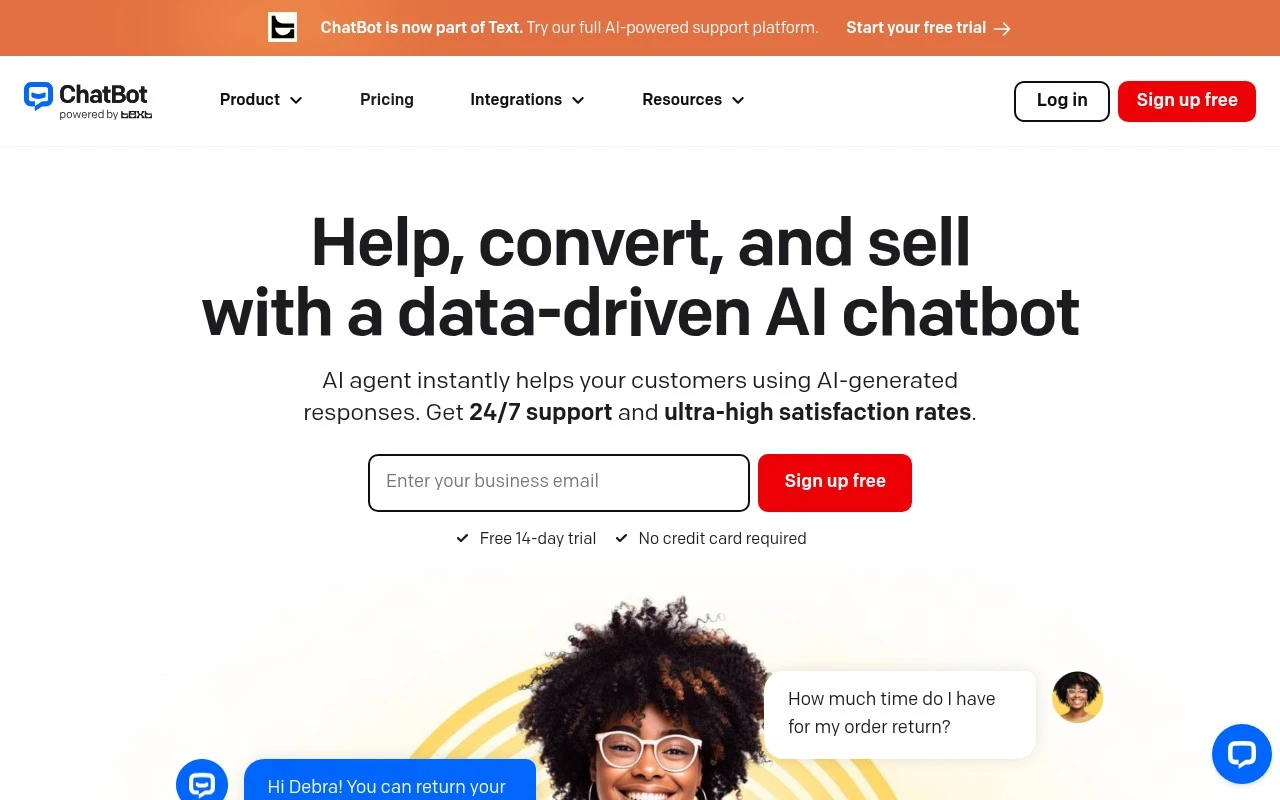
Chatbot is a no-code platform for building and deploying customer service chatbots on websites and messaging channels. It provides visual conversation flows, integrations, and handoff to human agents.
Customer Support BotsChatbots

Chatbot

FYAI Score

7.9 / 10

Based on 804 reviews

Pricing:

Freemium

Best for:

Support and ecommerce teams automating customer chats

Score Breakdown

  • Ease of use8.4 / 10
  • Features7.4 / 10
  • Pricing7.6 / 10
  • Integrations7.4 / 10
  • Support8.5 / 10

PRODUCT PREVIEW

What this AI tool does

Chatbot
Chatbot is an AI chatbot platform for businesses that want to automate customer service and sales conversations using an agent trained on their own content. Chatbot is designed for support, ecommerce, SaaS, and service teams that need fast answers for customers while keeping human agents focused on conversations that require judgment, empathy, or negotiation. For customer-facing teams, the platform acts like a first line of response across common questions, product discovery, order-related queries, policy explanations, and routine troubleshooting. It can use website pages, help center articles, product documentation, catalogs, and company policies as its knowledge base, so the answers are shaped by the business rather than by generic model behavior. Training begins with the material a company already maintains. Instead of forcing teams to script every possible exchange, it lets them connect sources of truth and turn that information into a conversational assistant. This makes Chatbot especially useful for customer support automation, where accuracy, consistency, and speed matter more than novelty. Sales and commerce use cases are a natural extension of that support role. The assistant can guide visitors toward relevant items, answer pre-purchase questions, and provide product recommendations based on the information available in a catalog or product database. For online stores and product-led businesses, this helps turn passive browsing into a guided conversation without requiring a salesperson to be present for every interaction. Human handoff is part of the core story rather than an afterthought. Chatbot is best at handling repeatable, information-driven conversations and identifying when a customer needs a person. When a request is complex, sensitive, high-value, or outside the agent’s confidence, the platform can route the conversation to the right team so automation supports the service workflow instead of replacing it blindly. Implementation is positioned for business users as much as technical teams. A company can prepare a chatbot deployment by defining the knowledge sources, expected behavior, escalation paths, and channels where the agent should appear. The no-code or low-code nature of this kind of platform makes it practical for support managers, ecommerce operators, and operations teams to improve coverage without building a custom AI system from scratch. The platform’s value is strongest where businesses receive many variations of the same questions. Shipping policies, return rules, feature explanations, setup guidance, compatibility details, and account questions can all consume agent time even when the answer is already documented. By turning that documentation into a conversational layer, it reduces repetitive workload while giving customers a faster route to the information they need. For growing teams, Chatbot provides a structured way to add AI to customer communication without losing control of the brand experience. The tool is not simply a pop-up widget that replies to messages, it is a trained service and sales assistant that reflects a company’s own content, workflows, and escalation rules. Its character is practical and operational, focused on making support and sales conversations more efficient while preserving the option for human help when it matters.

Use cases

Best for

Customer Support Automation

Chatbot answers routine customer questions by training on your help center, policies, and docs, and escalates complex chats to agents.

Product Recommendations

It recommends products in chat by using your catalog and product documentation to match user questions with relevant items.

Chatbot Deployment

You deploy the chatbot on your website by embedding it as a chat widget and connecting it to your knowledge sources for responses.

ANALYSIS

Strengths & limitations

Strengths
  • Best suited to support and ecommerce teams with existing website, help center, product, and policy content because the AI agent can learn from those sources and answer common customer questions consistently.
  • Useful for sales-assisted shopping because it can recommend products and guide routine buying questions before routing complex or high-value chats to humans.
  • Practical for teams serving customers across web and messaging channels because one chatbot can handle repetitive conversations and escalation instead of relying only on live agents.

Limitations
  • Less suitable for teams without well-structured and regularly maintained content because the bot’s usefulness depends on accurate website, catalog, help center, and policy material.
  • Less suitable for organizations that need deep bespoke process automation because its core fit is customer conversations, product guidance, routine chat handling, and human handoff.
  • The freemium model can constrain growing teams because higher conversation volume, broader deployment, or advanced automation needs are likely to require a paid plan.

Evaluation

FYAI score breakdown

Our structured evaluation across five key criteria

7.9 / 10

Overall score

Based on 804 reviews

  • Ease of use8.4 / 10
  • Features7.4 / 10
  • Pricing7.6 / 10
  • Integrations7.4 / 10
  • Support8.5 / 10

What users say

Findings from public reviews, documentation and community sources.

  • Ease of use

    ChatBot's website emphasizes fast no-code setup with “Train it on your website. Deploy it in minutes,” plus a “Free 14-day trial” and “No credit card required.” ChatBot's website includes customer quotes describing the product as “much easier to use than I expected” and saying “the onboarding process was easy.”

  • Features

    ChatBot's website describes AI Agents that answer questions, recommend products, close sales, and learn from a “website, help center, and product docs.” ChatBot's website also lists support handover to humans, proactive sales offers, workflow automation, and inbox/ticketing.

  • Pricing

    ChatBot's pricing page lists Essential at “$19 per user / mo” yearly and Growth at “$79 per user / mo,” with monthly prices of $25 and $99 and a custom Enterprise tier. ChatBot's pricing page lists usage limits including Essential with “10 AI resolutions” per month and Growth with “200 AI resolutions.”

  • Integrations

    ChatBot's pricing page states that one AI can support customers across “website, Messenger, SMS, and more.” ChatBot's pricing page includes “10,000 API calls” on Essential, “20,000 API calls” on Growth, and “Selling through Shopify.”

  • Support

    ChatBot's pricing page says Enterprise includes “Support from Product Expert,” “Personalized onboarding,” “Product training for your team,” “Direct engineering support,” and “SLAs.” ChatBot's website includes customer quotes saying “the chat support is brilliant” and “the team at chatbot resolves everything.”

Who is this for?

Best for customer support or sales teams that want a no-code chatbot trained on existing content, ChatBot's website says “Train it on your website. Deploy it in minutes.” Best for teams that need human fallback and sales actions, because ChatBot's website lists support handover to humans, proactive sales offers, workflow automation, and inbox/ticketing. Less suited to teams expecting many included AI resolutions on standard plans, ChatBot's pricing page lists Essential with “10 AI resolutions” per month and Growth with “200 AI resolutions.”

PRODUCT PREVIEW

Feature highlights

Train on your content

Learn from your site, docs, FAQs, catalog, and policies.

AI chat automation

Answer FAQs, recommend products, and handle routine requests 24/7.

Human handoff

Route complex or high-value chats to your team with context.

COMPARE

Discover curated alternatives worth comparing

Compare similar AI tools based on features, pricing and use cases

8.1/ 10FYAI score

Helply

Customer Support BotsKnowledge Base Bots
Answers tickets, drafts replies, flags gaps and churn risks
Best for:
Customer support teams
Pricing
Freemium

8.7/ 10Based on 7,757 reviews

Zoho Desk

Customer Support BotsKnowledge Base Bots
Handles routine tickets, flags issues, and drafts replies
Best for:
Customer support teams
Pricing
Freemium

7.8/ 10Based on 31,824 reviews

Zoho

Customer Support Bots
Runs business apps for sales, finance, HR, and support teams
Best for:
Operations teams
Pricing
Freemium

Chatbot

Turn more visitors into buyers with faster answers and smoother shopping journeys. Start using chatbot today to boost conversions and customer satisfaction.

FAQ

Frequently asked
questions

Everything you need to know about this AI tool,
its features, pricing, use cases, and limitations.

Who is Chatbot best suited for?
Chatbot is best suited for customer support, ecommerce, sales, and digital teams that want to automate repetitive customer conversations. It is a good fit for answering common questions, guiding shoppers, recommending products, showing offers, and handing chats to human agents across websites and messaging channels.
Does Chatbot have a free plan or only paid plans?
Chatbot follows a freemium pricing model and offers a free trial, but buyers should check chatbot.com for current plan details. Teams should compare limits around conversation volume, channels, training sources, integrations, and handoff needs before deciding whether a free or paid option is sufficient.
How does Chatbot compare with other AI chatbot tools?
Chatbot is most relevant when the priority is customer support automation and ecommerce sales assistance rather than a general-purpose internal chatbot. Compared with similar tools, buyers should evaluate knowledge-source training, website and messaging deployment, product recommendation features, agent handoff, pricing, and fit with existing support workflows.
How much setup work does Chatbot usually require?
Chatbot’s main trade-off is that answer quality depends heavily on the completeness and accuracy of the business knowledge used to train it. It is also positioned mainly for customer support and ecommerce conversations, so teams looking for broad internal workflow automation should assess whether its focus matches their requirements.
What should teams check about data privacy and compliance before using Chatbot?
Teams should review Chatbot’s current data handling, privacy, security, and compliance terms before connecting customer conversations or business knowledge sources. Important checks include where conversation data is stored, how training content is used, access controls, retention options, and whether the setup meets industry or regional compliance requirements.