Chatbase
Curated ToolThis tool is part of our curated AI directory. We only include tools that meet our standards for relevance, usability and real-world value.

Chatbase

Chatbase is a platform for building AI chatbots trained on your website, documents, and other data sources. It lets teams embed chatbots on their sites to answer visitor questions, qualify leads, and hand off conversations when needed.
Customer Support BotsAgent Builders

FYAI Score

7.9 / 10

Based on 73 reviews

Pricing:

Freemium

Best for:

Support teams scaling customer conversations with AI agents

Score Breakdown

  • Ease of use7.8 / 10
  • Features8.1 / 10
  • Pricing7.6 / 10
  • Integrations8.8 / 10
  • Support7.3 / 10

PRODUCT PREVIEW

What this AI tool does

Chatbase
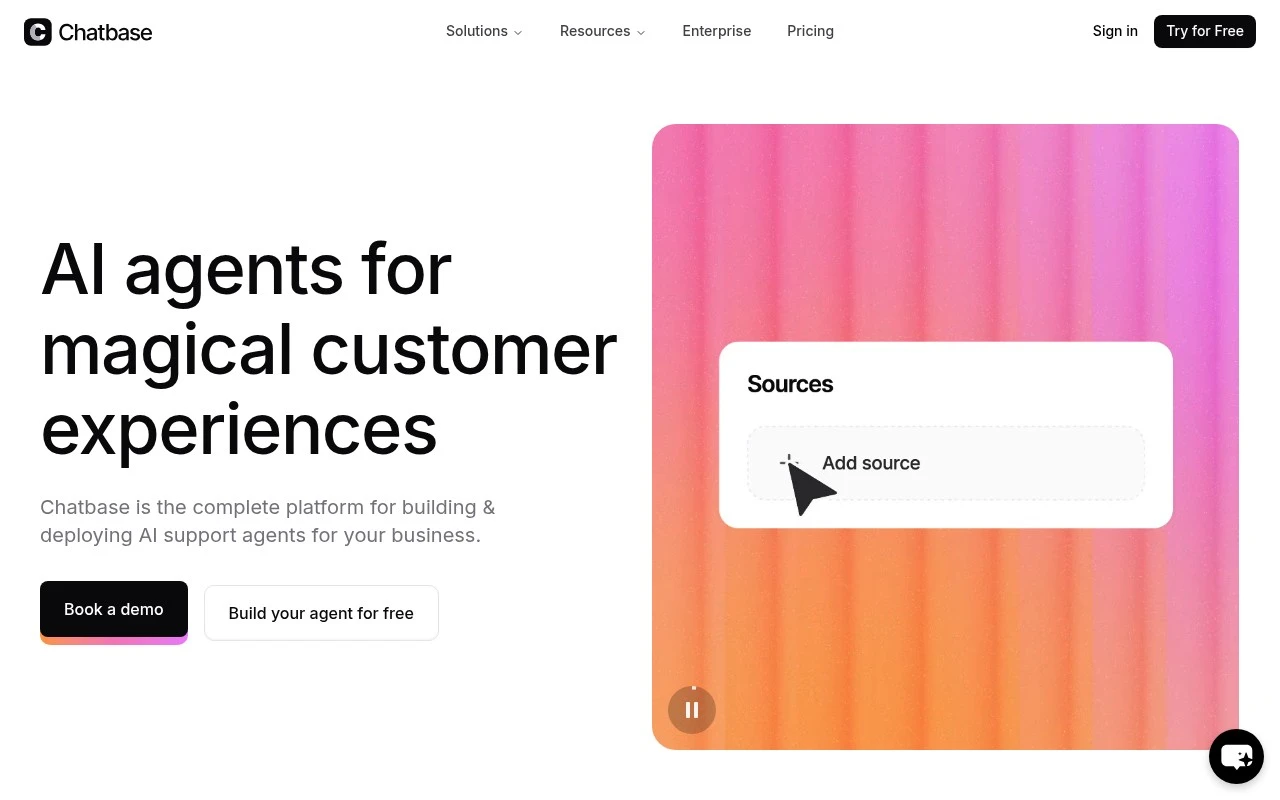
Chatbase is an AI customer service platform for companies that want to build support agents capable of answering questions, taking action across business systems, and handing off complex conversations to human teams. Chatbase is designed for customer support automation at scale, especially for businesses that need consistent, data-grounded responses across high volumes of customer interactions. At its core, the platform turns company knowledge into an operational support agent. Teams can train an agent on help center articles, documentation, websites, files, and other business content so it can perform knowledge base search and produce answers that reflect the organisation’s actual policies, products, and workflows. The emphasis is not just on generating fluent replies, but on making those replies useful, controlled, and connected to the business context. For support leaders, Chatbase addresses the gap between a basic website chatbot and a more complete AI service layer. It can be deployed across customer-facing channels, including web chat and other messaging environments, so customers can get help where they already are. This makes chatbot deployment part of a broader support strategy rather than a standalone widget on a single page. Agent building is a central part of the product story. Instead of requiring teams to code every conversation path manually, the platform gives businesses a structured way to define what the agent knows, what it can do, when it should ask clarifying questions, and when it should escalate. That makes it relevant for startups that want to reduce repetitive tickets, as well as larger organisations that need more control over service quality, permissions, and compliance. Connected workflows are what move the tool beyond simple question answering. An AI support agent can be linked to business systems, allowing it to retrieve information, trigger processes, or guide users through common tasks. In practice, this can mean helping with account questions, product guidance, order-related requests, troubleshooting, onboarding, or internal support scenarios, while preserving the option for a human agent to step in when judgement or exception handling is required. Control and reliability are important themes in Chatbase. The platform includes guardrails, analytics, and performance monitoring so teams can see what customers are asking, where the agent succeeds, and where content or workflows need improvement. These feedback loops help support teams treat the AI agent as a managed service channel rather than a one-time automation project. Multilingual support also broadens the platform’s role for companies serving international audiences. A business can use the same underlying knowledge and support logic to respond to customers in different languages, reducing the operational burden of staffing every language and region equally. For global teams, that can make AI assistance a practical layer between self-service content and live support. Security and enterprise controls shape how Chatbase is positioned for more serious business use. Companies adopting AI in customer service often need permission management, data handling safeguards, integration controls, and predictable escalation paths. By combining these controls with omnichannel support, analytics, and workflow automation, Chatbase presents itself as a platform for building AI agents that participate in real customer operations, not merely a chatbot builder for answering FAQs.

Use cases

Best for

Customer Support Automation

Chatbase automates customer support by answering chats, triggering workflows via integrations, and escalating to human agents when needed.

Agent Building

Build and deploy AI support agents by training them on your business data, setting guardrails, and connecting them to internal systems.

Knowledge Base Search

Use a Chatbase agent to search your docs and knowledge base and return cited answers inside chat across supported channels.

ANALYSIS

Strengths & limitations

Strengths
  • Strong fit for teams aiming to reduce repetitive tickets because agents can be trained on business data and connected systems to answer support questions at scale.
  • Good for support operations that need more than FAQ responses because agents can retrieve information, perform predefined actions, and automate common workflows.
  • Practical for growing support teams because it combines omnichannel deployment, multilingual support, analytics, guardrails, and human escalation in one platform.

Limitations
  • Less suitable for teams that only need a simple website FAQ widget because connecting business systems, workflows, and guardrails adds setup and maintenance overhead.
  • Less suitable for organisations with fragmented or outdated support data because the agent depends on accurate knowledge sources and connected systems to give useful answers.
  • The freemium model is less predictable for high-volume support teams because meaningful usage and scaling needs can push teams toward paid plans.

Evaluation

FYAI score breakdown

Our structured evaluation across five key criteria

7.9 / 10

Overall score

Based on 73 reviews

  • Ease of use7.8 / 10
  • Features8.1 / 10
  • Pricing7.6 / 10
  • Integrations8.8 / 10
  • Support7.3 / 10

What users say

Findings from public reviews, documentation and community sources.

  • Ease of use

    G2 user-facing review evidence describes Chatbase's interface as “very clean and user-friendly,” making it “easy to understand and perform tasks quickly.” G2 lists 19 reviews for Chatbase.

  • Features

    Chatbase presents itself on its website as a “complete platform for building AI customer support agents,” with training on business data, workflow actions, smart escalation, and multilingual support in “80+ languages.” Chatbase also references analytics, guardrails, voice/omnichannel capabilities, and white-labeling on its website.

  • Pricing

    The Chatbase pricing page lists Free with 50 message credits/month, Hobby at $32/month for 500 credits, Standard at $120/month for 4,000 credits, and Pro at $400/month for 15,000 credits. The Chatbase pricing page lists add-ons including $40 per 1,000 extra message credits.

  • Integrations

    The Chatbase pricing page lists “Integrations & API,” including API access plus Stripe, Zendesk, Salesforce, Intercom, HubSpot, Zapier, Twilio, Shopify, Slack, WhatsApp, Messenger, Instagram, Calendly, and WordPress.

  • Support

    The Chatbase pricing page says Enterprise includes “Priority support,” a “Success manager (CSM),” and “SLAs.” The Chatbase pricing page also includes an FAQ section for common billing and usage questions.

Who is this for?

Best for teams building AI customer support agents. Chatbase supports training on business data, workflow actions, smart escalation, and multilingual support in “80+ languages.” It is also a fit for teams that need broad connectivity because the Chatbase pricing page lists API access plus integrations such as Zendesk, Salesforce, Intercom, HubSpot, Zapier, Slack, WhatsApp, and WordPress. Less suited to teams with high message volume on lower plans. Free includes 50 message credits/month, Hobby includes 500 credits, and extra message credits are listed at $40 per 1,000.

PRODUCT PREVIEW

Feature highlights

Train on your data

Ground answers in your docs, FAQs, and knowledge base for accuracy.

Workflows & actions

Automate support tasks and connect to business systems to get work done.

Analytics & guardrails

Track performance and control responses with safety and policy rules.

COMPARE

Discover curated alternatives worth comparing

Compare similar AI tools based on features, pricing and use cases

8.1/ 10FYAI score

Helply

Customer Support BotsKnowledge Base Bots
Answers tickets, drafts replies, flags gaps and churn risks
Best for:
Customer support teams
Pricing
Freemium

8.7/ 10Based on 7,757 reviews

Zoho Desk

Customer Support BotsKnowledge Base Bots
Handles routine tickets, flags issues, and drafts replies
Best for:
Customer support teams
Pricing
Freemium

7.8/ 10Based on 31,824 reviews

Zoho

Customer Support Bots
Runs business apps for sales, finance, HR, and support teams
Best for:
Operations teams
Pricing
Freemium

Chatbase

Turn your support content into instant answers. Start with chatbase today and resolve more customer questions automatically, with a better experience for every user.

FAQ

Frequently asked
questions

Everything you need to know about this AI tool,
its features, pricing, use cases, and limitations.

Who is Chatbase best suited for?
Chatbase is best suited for businesses and support teams that want to automate customer support with AI agents. It is a strong fit for teams handling repeated customer questions, website chat, WhatsApp, Slack, or email support, especially when the agent needs to use company data and escalate unresolved issues to humans.
Does Chatbase have a free plan, and what should I check before upgrading?
Chatbase uses a freemium pricing model, so teams can typically start with a free option and upgrade for broader usage or advanced needs. Before choosing a paid plan, check current limits for conversations, agents, channels, integrations, API access, white-labeling, analytics, and any team or enterprise features on chatbase.co.
How does Chatbase compare with other customer support chatbot tools?
Chatbase is positioned more as an AI customer support agent platform than a generic chatbot builder. Compared with similar tools, its fit depends on whether you need support automation, connected business data, workflow actions, omnichannel deployment, analytics, guardrails, and human escalation rather than only simple FAQ responses or lead capture.
How much setup work does Chatbase usually require?
Chatbase’s main trade-off is that performance depends heavily on the quality of the connected knowledge sources, business data, configured actions, and escalation logic. Teams with complex support processes should validate accuracy, edge-case handling, permissions, analytics, and human handoff behavior before relying on it for high-volume or sensitive customer interactions.
What should buyers consider about Chatbase privacy and compliance?
Buyers should review how Chatbase handles customer conversations, connected data sources, integrations, access controls, retention, and audit requirements before deployment. Teams in regulated industries should confirm current security practices, compliance certifications, data processing terms, and whether sensitive data can be limited, masked, or routed according to internal policies.