Curated ToolThis tool is part of our curated AI directory. We only include tools that meet our standards for relevance, usability and real-world value.

Zed

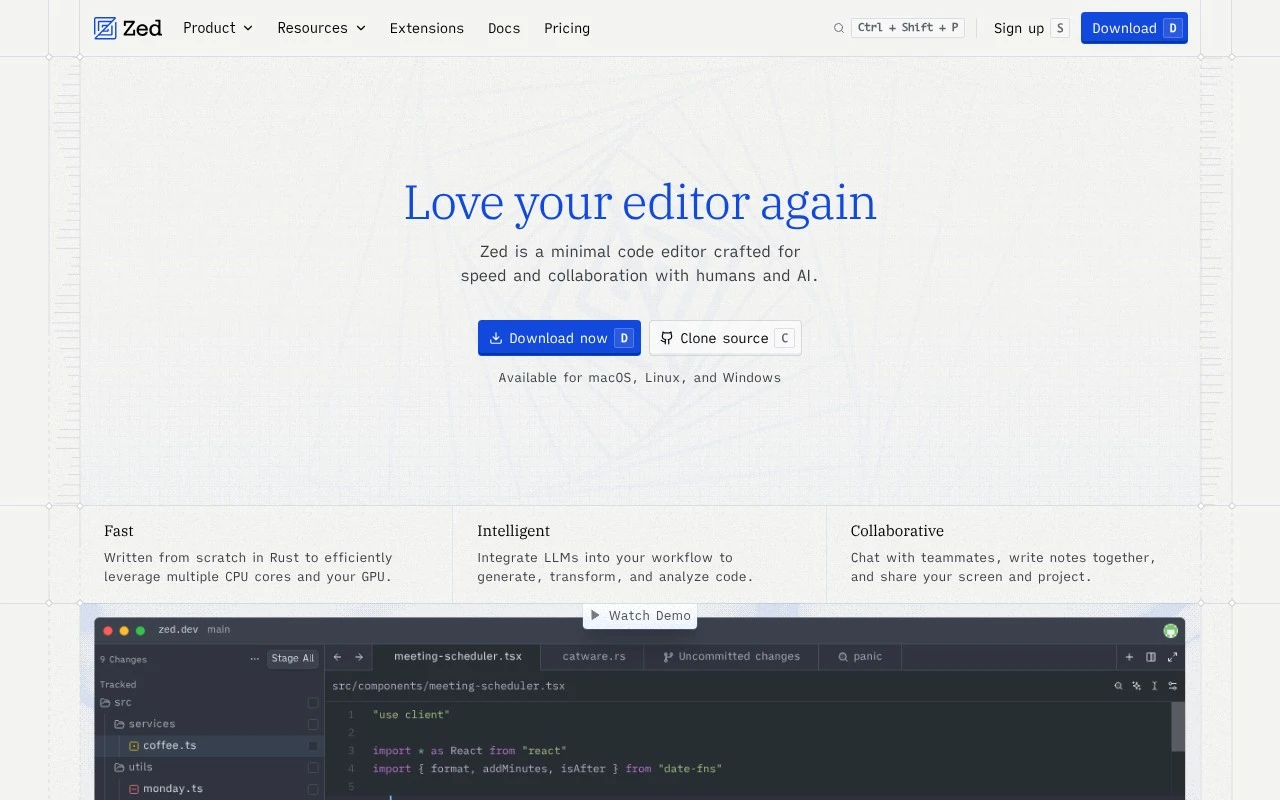
Zed is a high-performance code editor for building software, with language server support, Git integration, integrated terminal workflows, and real-time collaboration features. It also includes AI-assisted coding capabilities within the editor.
Code Generation & CompletionDebugging

FYAI Score

8.0 / 10

Based on 44 reviews

Pricing:

Freemium

Best for:

Developers who want a fast, minimal editor with modern collaboration

Score Breakdown

  • Ease of use8.5 / 10
  • Features7.1 / 10
  • Pricing9.1 / 10
  • Integrations7.5 / 10
  • Support7.6 / 10

PRODUCT PREVIEW

What this AI tool does

Zed is a native code editor from the creators of Atom and Tree-sitter, built for developers who want a fast, minimal workspace that can also support collaboration and AI-assisted programming. Written in Rust and designed around GPU acceleration and multicore performance, Zed positions itself as a modern editor for people who spend much of their day reading, editing, navigating, and shaping code. Performance is central to the product’s identity. Instead of feeling like a web app wrapped as a desktop tool, the editor is designed to respond quickly to typing, search, file navigation, and large project movement. That makes it especially relevant for engineers who value low latency, clean interface design, and an editing environment that stays out of the way. For professional software teams, Zed is a code editor for collaborative development, not just individual file editing. Its real-time collaboration model lets teammates share a workspace, follow each other through code, and work together without switching constantly between an editor, a screen share, and a chat tool. The result is closer to pair programming inside the editor than a traditional solo coding setup with external communication layered on top. AI-agent workflows are another major part of the story. The tool can help developers generate code, explain unfamiliar sections, assist with code refactoring, debug code, and support tasks such as test generation when integrated into a broader development workflow. Rather than treating AI as a separate chatbot beside the editor, Zed is built around the idea that agents should be able to understand and operate within the codebase the developer is already working in. A minimal interface gives the platform a different feel from heavier integrated development environments. It is aimed at developers who want strong editing performance, language-aware navigation, and modern assistance without a cluttered workspace. Zed is best at combining the responsiveness of a native editor with team collaboration and AI-native coding support in one focused environment. Cross-platform availability also broadens its role. With support for macOS, Linux, and Windows, it can fit into varied engineering teams rather than being tied to one operating system. Developers who know the lineage of Atom and Tree-sitter will also recognise the emphasis on editor craft, syntax intelligence, and extensibility, but the product is clearly positioned as a newer generation of code editor shaped by speed, real-time teamwork, and agentic development.

Use cases

Best for

Code Refactoring

Use Zed to refactor code with AI agent edits and Tree-sitter syntax awareness for safe, project-wide changes.

Generate Code

Generate code by prompting Zed’s AI agent to insert functions, tests, or boilerplate directly into the active buffer.

Debug Code

Debug code by navigating symbols and references with Tree-sitter parsing and collaborating in real time to inspect fixes.

ANALYSIS

Strengths & limitations

Strengths
  • Best suited to developers who prioritize low-latency editing because its native Rust design, GPU acceleration, and multicore support are built around performance.
  • Strong fit for teams that pair program or review code together because real-time collaboration is built into the editor workflow.
  • Useful for AI-assisted development because agents can inspect the codebase, edit files, navigate code, and run tools without leaving the editor.

Limitations
  • Less suitable for teams that want a full IDE experience because Zed is positioned as a minimal code editor rather than a broad, language-specific development suite.
  • Less suitable for browser-based development environments because Zed is a native desktop editor that must be installed on macOS, Linux, or Windows.
  • Teams with strict controls on AI-assisted coding need governance around code access and tool execution because Zed’s agent workflows operate directly inside the developer’s workspace.

Evaluation

FYAI score breakdown

Our structured evaluation across five key criteria

8.0 / 10

Overall score

Based on 44 reviews

  • Ease of use8.5 / 10
  • Features7.1 / 10
  • Pricing9.1 / 10
  • Integrations7.5 / 10
  • Support7.6 / 10

What users say

Findings from public reviews, documentation and community sources.

  • Ease of use

    A Reddit user said they used Zed because they “liked the speed” and because Zed felt less intrusive around AI. Product Hunt reviewers describe Zed as “fast, lightweight” and “simpler and less bloated than VS Code.”

  • Features

    Zed’s own page positions Zed as a “high-performance, multiplayer code editor” with speed, collaboration, and agentic AI. A Reddit post says “Zed is lacking many features.”

  • Pricing

    Zed’s pricing page lists Personal as “$0 forever,” Pro as “$10 per month” with “$5 of tokens included,” and Business as “$30 per seat, per month.” Zed’s pricing page includes a free editor, a bring-your-own-key option, and hosted AI usage-based billing beyond included credits.

  • Integrations

    Zed’s extensions page says users can “Choose from the hundreds of community-created extensions.”

  • Support

    Zed’s pricing FAQ directs users to “LLM providers docs” for setup and lists [email protected] for larger-team discussions.

Who is this for?

Best for developers who want a fast, lightweight code editor with collaboration and AI, Zed’s own page calls Zed a “high-performance, multiplayer code editor,” and Product Hunt reviewers describe Zed as “fast, lightweight.” Less suited to users who need a mature, feature-complete coding editor, a Reddit post says “Zed is lacking many features,” which can mean missing workflows for teams depending on established editor capabilities.

PRODUCT PREVIEW

Feature highlights

Blazing performance

Native Rust editor with GPU + multicore for smooth, fast editing.

Live collaboration

Work together in real time with shared editing and navigation.

AI agent workflows

Use AI to edit, refactor, and move through code with less friction.

COMPARE

Discover curated alternatives worth comparing

Compare similar AI tools based on features, pricing and use cases

8.3/ 10Based on 68 reviews

Gemini Code Assist

Code Generation & CompletionTesting & Refactoring
Completes code, edits codebases, and answers dev questions
Best for:
Software developers
Pricing
Freemium

9.1/ 10Based on 46 reviews

GitHub Copilot

Code Generation & CompletionTesting & Refactoring
Suggests code, reviews changes, and automates repo tasks
Best for:
Software developers
Pricing
Freemium

8.9/ 10Based on 6 reviews

Cline

Code Generation & CompletionDebugging
Inspects code, edits files, runs commands, automates CI
Best for:
Software developers
Pricing
Free

Write and ship code faster with Zed. Join teams using a lightning-fast editor built for modern workflows and start building with less friction today.

FAQ

Frequently asked
questions

Everything you need to know about this AI tool,
its features, pricing, use cases, and limitations.

Who is Zed best suited for?
Zed is best suited for software developers and engineering teams that want a fast native code editor with collaboration and AI-assisted coding workflows. It fits teams that spend most of their time writing, navigating, reviewing, and editing code locally, while also wanting shared projects, chat, screen sharing, and AI agents inside the editor.
Is Zed free, or does it require a paid plan?
Zed uses a freemium pricing model, so teams can expect some functionality to be available for free with paid options for additional capabilities. Buyers should review the current pricing details on zed.dev, especially if they need collaboration features, AI-agent usage, or team-level controls at scale.
How does Zed compare with other code editors?
Zed mainly competes with other developer code editors by focusing on speed, local desktop performance, collaboration, and AI-agent workflows in one environment. The best choice depends on whether a team values a minimal, high-performance editor more than a heavier IDE experience with extensive built-in enterprise tooling.
How quickly can a team get started with Zed?
Zed’s main trade-off is that it is a desktop code editor focused on speed and a minimal development experience, not a fully browser-based IDE. Teams should verify whether it supports their required language workflows, refactoring habits, debugging setup, test generation process, extensions, and any heavier IDE features they depend on.
What should teams check about Zed’s privacy and compliance?
Teams evaluating Zed should review how its collaboration and AI-agent features handle code, prompts, project data, and tool execution. Buyers working with sensitive repositories should confirm current privacy terms, data retention practices, model configuration options, access controls, and compliance documentation directly with Zed before rolling it out broadly.