Curated ToolThis tool is part of our curated AI directory. We only include tools that meet our standards for relevance, usability and real-world value.

Warp

Terminal app for running AI coding agents with team controls

AI Coding Agents
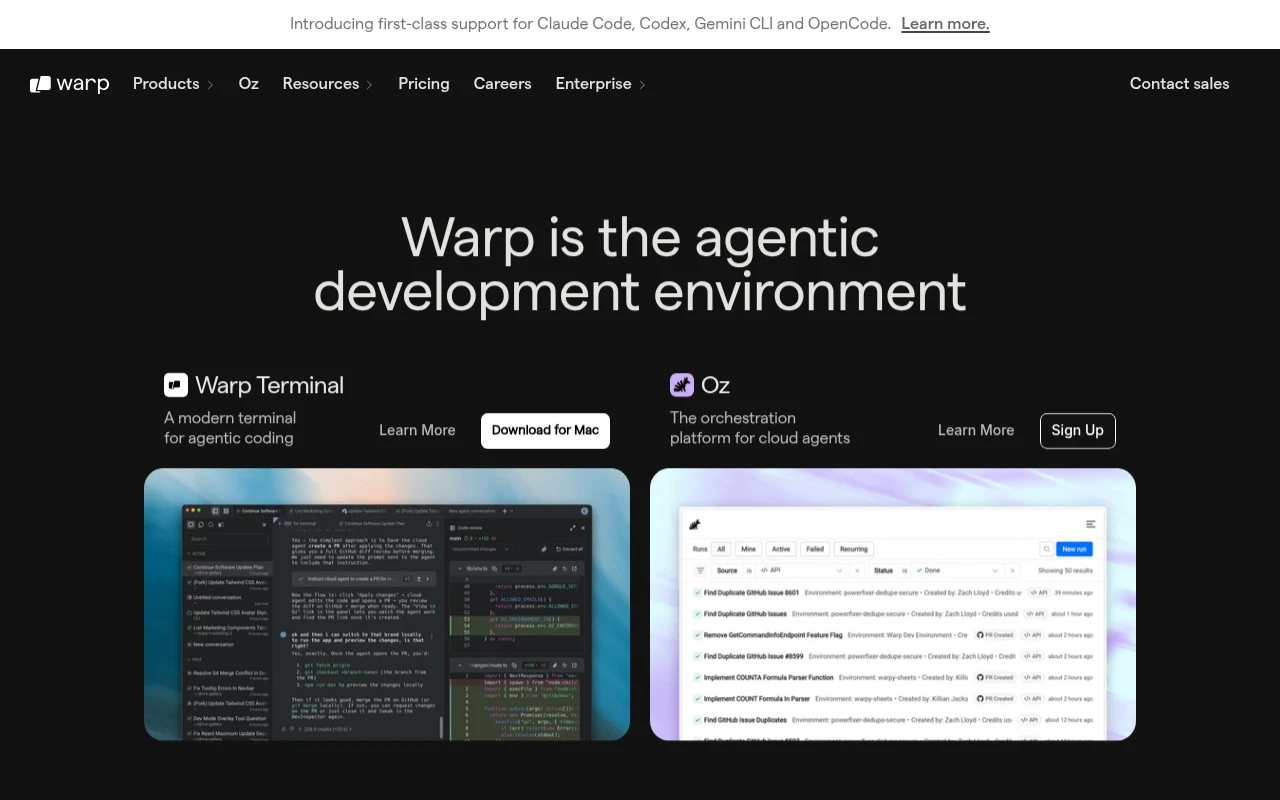
Warp is a modern AI terminal and open agentic development environment for software development. It is built around using coding agents from the terminal, including Warp Agent and third-party agents such as Claude Code, Codex, and Gemini CLI. The product also includes Oz, a cloud agent platform for launching agents from the terminal, SDK, or CLI, and enterprise controls for scaling agent usage across teams.

FYAI Score

8.7 / 10

Based on 76 reviews

Pricing:

Freemium

Best for:

Developers who want agent-assisted coding from the terminal

Score Breakdown

  • Ease of use8.3 / 10
  • Features9.0 / 10
  • Pricing8.9 / 10
  • Integrations8.3 / 10
  • Support8.8 / 10

PRODUCT PREVIEW

What this AI tool does

Warp is an AI-assisted terminal designed to help developers work more efficiently from the command line. It combines a modern terminal interface with built-in assistance that can help you understand commands, draft shell snippets, and reduce the time spent looking up syntax or pasting from documentation. In day-to-day use, it can support common workflows like navigating projects, running builds, managing Git tasks, and troubleshooting errors by providing contextual suggestions and explanations. This makes it useful for both experienced engineers who want faster iteration and newer users who are still learning how to use the terminal. Because it operates within the terminal environment, it fits naturally into existing development setups without requiring a separate chat window for every question. As with any AI tool, it’s best used as a helper for drafting and guidance, with final commands reviewed before running them—especially in production or on sensitive systems.

Use cases

Best for

Terminal Agent Control

Warp runs AI coding agents from your terminal and lets you start, stop, and monitor their tasks during development.

Local to Cloud Runs

Use Oz to move the same agent workflow between your local machine and cloud execution without changing your terminal flow.

Agent Usage Governance

Warp provides team controls for agent permissions, credit caps, and usage visibility across users and projects.

ANALYSIS

Strengths & limitations

Strengths
  • Designed specifically for terminal-based coding workflows with AI agents rather than as a general chatbot interface.
  • Supports multiple agents and models, including third-party coding agents and Warp’s own agent harness.
  • Offers both local and cloud-oriented agent workflows, with team governance features for enterprise use.
Limitations
  • Primarily relevant to developers and engineering teams; it is not a general-purpose AI productivity tool.
  • Some described capabilities, such as Oz and enterprise governance, are platform-level features that may be more complex than needed for individual terminal users.
  • The provided site text does not fully detail pricing, setup requirements, or limits for each agent and cloud workflow.

Evaluation

FYAI score breakdown

Our structured evaluation across five key criteria

8.7 / 10

Overall score

Based on 76 reviews

  • Ease of use8.3 / 10
  • Features9.0 / 10
  • Pricing8.9 / 10
  • Integrations8.3 / 10
  • Support8.8 / 10

What users say

Findings from public reviews, documentation and community sources.

  • Ease of use

    In a Reddit r/commandline discussion, users describe Warp as fast and comfortable for terminal workflows, with one saying “built-in ssh, serial and shell detection are great” and another saying Warp feels “just so much faster.”

  • Features

    Warp’s docs position Warp as an “Agentic Development Environment” combining a “modern, high-performance terminal” with local and cloud agents, Terminal and Agent modes, and a code editor with LSP support.

  • Pricing

    Warp’s pricing page lists five tiers from Free at “$0/month” to Enterprise. Warp’s pricing page says Build starts at “$20/month” monthly or “$18/month” annually with “1,500 credits per month.”

  • Integrations

    Warp’s docs list third-party CLI agents “Claude Code, Codex, and OpenCode.” Warp’s docs list cloud-agent triggers from “Slack, Linear, GitHub, or custom webhooks.”

  • Support

    Warp’s pricing page links users to documentation and lists “Private email support” on Build. Warp’s pricing page says Enterprise includes “White-glove onboarding,” an “implementation engineer,” a “Dedicated account manager,” and “a shared Slack channel.”

Who is this for?

Best for developers who want an AI-oriented terminal workflow, Warp’s docs describe an “Agentic Development Environment” with a “modern, high-performance terminal,” local and cloud agents, and Terminal and Agent modes. Best for teams that trigger coding work from developer tools, Warp’s docs list cloud-agent triggers from “Slack, Linear, GitHub, or custom webhooks.” Less suited to users who want flat, unlimited AI usage, Warp’s pricing page says Build includes “1,500 credits per month,” so usage is tied to credits rather than a simple unlimited allowance.

PRODUCT PREVIEW

Feature highlights

Agentic terminal

Run coding agents to plan, edit, and execute tasks from your CLI.

Cloud agents with Oz

Launch and manage cloud agents via terminal, SDK, or CLI.

Enterprise controls

Scale agent usage with governance, policies, and team management.

COMPARE

Discover curated alternatives worth comparing

Compare similar AI tools based on features, pricing and use cases

8.3/ 10Based on 68 reviews

Gemini Code Assist

Code Generation & CompletionTesting & Refactoring
AI coding assistant for code completion, edits, and explanations
Best for:
Software developers
Pricing
Freemium

9.1/ 10Based on 46 reviews

GitHub Copilot

Code Generation & CompletionTesting & Refactoring
AI coding assistant for code suggestions, chat, and reviews
Best for:
Software developers
Pricing
Freemium

8.9/ 10Based on 6 reviews

Cline

Code Generation & CompletionDebugging
Agentic coding runtime that edits files and runs commands
Best for:
Software developers
Pricing
Free

Move faster in the terminal with AI that helps you build, debug, and ship. See why developers choose Warp to stay in flow and get more done every day.

FAQ

Frequently asked
questions

Everything you need to know about this AI tool,
its features, pricing, use cases, and limitations.

What types of development work is Warp a good fit for?
Warp fits best if your workflow already lives in the terminal and you want AI help with coding tasks like editing files, generating patches, running commands, and automating repetitive dev steps. It’s a strong option for individual developers or teams who want multiple agents/models available in one place. If you mainly want a chat-first assistant or non-technical automation, other tools may feel more natural.
What’s free in Warp, and what typically requires a paid plan?
Warp is free to download and use as a terminal, but advanced AI agent features and team controls may be gated by plan or usage limits. The site emphasizes sales contact for business/enterprise needs, which usually implies paid tiers for governance, visibility, and permissioning. If pricing transparency is important for your comparison, you’ll likely need to confirm plan boundaries directly with Warp.
How does Warp compare to GitHub Copilot, Cursor, or Claude/ChatGPT for coding?
Warp is terminal-centered, so it’s closer to an AI-augmented command-line workflow than an IDE-first tool like Cursor or Copilot inside VS Code. Compared with general chat tools (Claude/ChatGPT), Warp is more action-oriented around running commands and applying changes in a dev environment. If you want deep IDE refactors and inline code completion, an IDE-native option may be a better primary tool.
How quickly can I get Warp running, and what onboarding effort should I expect?
Warp is optimized for developers who prefer terminal-driven work; if your team is IDE-centric, adoption may be uneven. Some of the more advanced capabilities (multi-agent orchestration, enterprise governance) can introduce operational overhead. Also, if you need clear, self-serve pricing and strict plan limits up front, Warp may require more diligence to evaluate.
What should I check about data handling, privacy, and compliance before using Warp?
Confirm what data is sent to external model providers when agents run (prompts, code snippets, command output) and whether you can restrict or disable that per workspace. For teams, verify available controls like permissions, audit/usage visibility, and whether data can be kept local versus processed in the cloud. If you have compliance requirements, review Warp’s published security documentation and clarify retention and logging behavior before rollout.