Curated ToolThis tool is part of our curated AI directory. We only include tools that meet our standards for relevance, usability and real-world value.

Sweep AI

Sweep AI is an AI coding assistant that reads GitHub issues, plans code changes, and opens pull requests with generated implementations. It helps teams generate code for bug fixes, refactors, and small feature requests directly within their existing GitHub workflow.
Code Generation & Completion

FYAI Score

8.1 / 10

Based on 38 reviews

Pricing:

Freemium

Best for:

JetBrains developers who want AI help with real project context

Score Breakdown

  • Ease of use9.1 / 10
  • Features7.6 / 10
  • Pricing8.3 / 10
  • Integrations7.4 / 10
  • Support7.6 / 10

PRODUCT PREVIEW

What this AI tool does

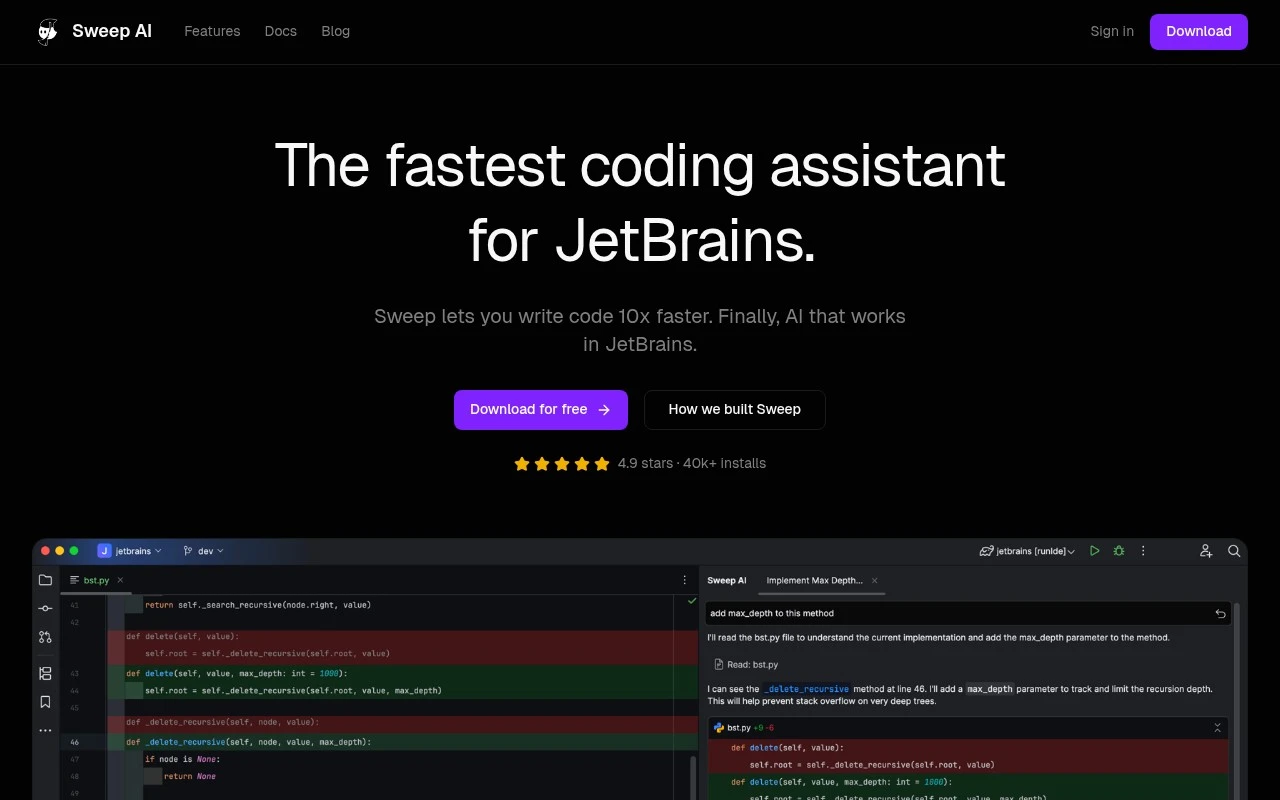
Sweep AI is a JetBrains-focused AI coding assistant for developers who want modern, context-aware AI help without leaving IntelliJ IDEA, PyCharm, WebStorm, or other JetBrains IDEs. Sweep AI is built for teams and individual engineers who like the JetBrains workflow but want Cursor-like autocomplete, code edits, and agentic project assistance inside their existing development environment. For developers already committed to JetBrains tools, the appeal is continuity. Instead of moving a project into a separate AI-first editor, it brings AI coding support into the place where many engineers already manage navigation, refactoring, debugging, and version control. That positioning makes the tool especially relevant for professional codebases where switching editors is inconvenient or disruptive. At its core, the plugin combines custom autocomplete with next-edit predictions. The experience is not only about asking an assistant to generate code from a prompt, but about receiving inline help as the developer moves through a file, updates logic, or follows an obvious next step. This makes it feel closer to an active coding companion than a detached chat window. Project context is a major part of the story. The AI agent can use indexed repository knowledge, which means it is designed to reason over the codebase rather than respond only to the currently open file. In practical terms, that can help when making edits that depend on existing patterns, internal APIs, naming conventions, or related files spread across a project. Sweep AI is best at bringing AI-assisted coding, next-edit prediction, and repository-aware agent support to JetBrains users who want speed without abandoning their preferred IDE. Its strongest use case is not replacing a developer’s judgement, but reducing the friction around repetitive implementation work, code navigation, small refactors, and context gathering. The tool is aimed at making everyday development feel more responsive and less interrupted. Compared with general AI chatbots, the product is more tightly connected to the coding environment. A standalone chat assistant can explain concepts or draft snippets, but a JetBrains plugin can participate where the work is happening. That distinction matters for developers who want suggestions that are grounded in their project rather than generic examples. The broader category is AI pair programming, but the JetBrains emphasis gives the tool a clear identity. Many AI coding assistants have grown around VS Code or browser-based workflows, while Sweep AI focuses on developers who prefer the structure, inspections, and mature language support of JetBrains IDEs. This makes it a natural option for engineers evaluating an AI coding assistant specifically for IntelliJ-based workflows. A balanced Sweep AI review should look at how well its predictions match a real project, how useful the indexed context is in large repositories, and whether the agent improves day-to-day coding enough to justify adoption. Sweep AI pricing is also likely to matter for teams, since the value depends on how often developers use autocomplete, code generation, and agentic edits in regular work. For the right JetBrains-heavy team, the platform is less about novelty and more about fitting AI assistance into an established professional workflow.

Use cases

Best for

IDE Code Autocomplete

Generates context-aware autocomplete and next-edit suggestions inline in JetBrains IDEs as you type.

In-Ide AI Agent

Uses Sweep AI as an in-IDE agent in JetBrains to propose and apply code changes using your project context.

Project Codebase Indexing

Indexes your project so suggestions can reference definitions, files, and services from the codebase context.

ANALYSIS

Strengths & limitations

Strengths
  • Best suited to JetBrains-first developers because it brings AI coding assistance into their existing IDE workflow without requiring an editor switch.
  • Useful for larger codebases because its agent can use indexed project context to make suggestions that are more relevant to the current repository.
  • Helpful for fast iteration because custom autocomplete and next-edit predictions support both line-level coding and follow-up edits inside the editor.

Limitations
  • Less suitable for teams standardized on non-JetBrains editors because its core experience is centered on JetBrains IDE plugins.
  • Less suitable for organizations with strict code privacy or compliance review requirements because codebase-aware AI assistance depends on project indexing and model-driven workflows.
  • The freemium model can create adoption friction for growing teams because broader or heavier usage may require managing paid access and usage limits.

Evaluation

FYAI score breakdown

Our structured evaluation across five key criteria

8.1 / 10

Overall score

Based on 38 reviews

  • Ease of use9.1 / 10
  • Features7.6 / 10
  • Pricing8.3 / 10
  • Integrations7.4 / 10
  • Support7.6 / 10

What users say

Findings from public reviews, documentation and community sources.

  • Ease of use

    Sweep's homepage says users can “Download for free,” “Install and start coding faster in minutes,” and use autocomplete by “Just hit tab.” Sweep's homepage cites “4.9 stars” and “40k+ installs.”

  • Features

    Sweep's features page lists an “AI Agent,” custom “Tab” autocomplete, whole-project indexing that “indexes your entire project,” and AI code review. Sweep's features page also references privacy mode, SOC 2 compliance, and zero data retention.

  • Pricing

    Sweep's pricing page lists a Free Trial with “1,000 Autocompletes” and “$5 API credits,” plus Basic at “$10/mo,” Pro at “$20/mo,” and Ultra at “$60/mo.” Sweep's pricing page says paid plans offer unlimited autocomplete, while API credits and top-ups apply to AI features like chat, code generation, and advanced completions.

  • Integrations

    Sweep's integrations page says Sweep “works with all JetBrains IDEs,” including IntelliJ IDEA, PyCharm, Android Studio, WebStorm, PhpStorm, Rider, and more. Sweep's integrations page also mentions “Remote MCP Servers - Full OAuth 2.0/2.1 support.”

  • Support

    Sweep's pricing page presents support through documentation links, “Contact Sales,” a team email for student/open-source discounts, and “priority support” on the Pro plan. Sweep's pricing page ties “priority support” to the Pro plan.

Who is this for?

Best for developers who work in JetBrains IDEs, Sweep's integrations page says Sweep “works with all JetBrains IDEs,” including IntelliJ IDEA, PyCharm, Android Studio, WebStorm, PhpStorm, Rider, and more. Less suited to teams that need broad coding-environment coverage, Sweep's stated integration coverage is centered on JetBrains, so non-JetBrains workflows have less cited coverage.

PRODUCT PREVIEW

Feature highlights

JetBrains Autocomplete

Custom code completions tuned for your IDE and coding patterns.

Next-Edit Predict

Predicts your next change and applies multi-line edits in place.

Indexed Repo Context

Agent uses indexed project context to make safer, relevant changes.

COMPARE

Discover curated alternatives worth comparing

Compare similar AI tools based on features, pricing and use cases

8.3/ 10Based on 68 reviews

Gemini Code Assist

Code Generation & CompletionTesting & Refactoring
Completes code, edits codebases, and answers dev questions
Best for:
Software developers
Pricing
Freemium

9.1/ 10Based on 46 reviews

GitHub Copilot

Code Generation & CompletionTesting & Refactoring
Suggests code, reviews changes, and automates repo tasks
Best for:
Software developers
Pricing
Freemium

8.9/ 10Based on 6 reviews

Cline

Code Generation & CompletionDebugging
Inspects code, edits files, runs commands, automates CI
Best for:
Software developers
Pricing
Free

Ship cleaner code faster in JetBrains with an AI copilot that feels instant and stays in your flow. See why teams choose Sweep AI for everyday coding.

FAQ

Frequently asked
questions

Everything you need to know about this AI tool,
its features, pricing, use cases, and limitations.

Who is Sweep AI best suited for?
Sweep AI is best suited for professional developers and engineering teams that primarily work in JetBrains IDEs. It focuses on helping users write, edit, and navigate code inside tools such as IntelliJ IDEA, PyCharm, GoLand, WebStorm, Rider, and Android Studio, with autocomplete, next-edit suggestions, and an in-editor coding agent.
Is Sweep AI free, and what do paid plans add?
Sweep AI uses a freemium pricing model, so users can expect a free entry point with paid options for expanded use. Exact limits, plan names, and enterprise terms should be checked on sweep.dev, especially for teams evaluating usage volume, codebase indexing needs, compliance requirements, or centralized administration.
How does Sweep AI compare with other AI coding assistants?
Sweep AI stands out mainly by focusing on JetBrains IDE workflows rather than positioning itself as a broad extension for every editor. It combines fast autocomplete, next-edit suggestions, codebase-aware context, and an in-IDE agent. The right choice depends on your preferred IDE, team size, budget, and required deployment controls.
How much setup does Sweep AI require?
Sweep AI’s main trade-off is its focus on JetBrains IDE users, which may make it less suitable for teams standardized on other editors. Buyers should also validate pricing details, plan limits, and real-world performance in their own codebase, since speed and productivity claims can vary by project, language, and workflow.
How does Sweep AI handle privacy and compliance?
Sweep AI emphasizes privacy and enterprise readiness, including SOC 2 compliance and zero data retention claims. Teams handling sensitive code should still review its current security documentation, data processing terms, retention settings, and deployment options to confirm alignment with internal policies, regulatory requirements, and customer commitments.