Curated ToolThis tool is part of our curated AI directory. We only include tools that meet our standards for relevance, usability and real-world value.

Refact AI

Repository-aware coding assistant for generation, review, and debuggin

Code Generation & CompletionDebugging
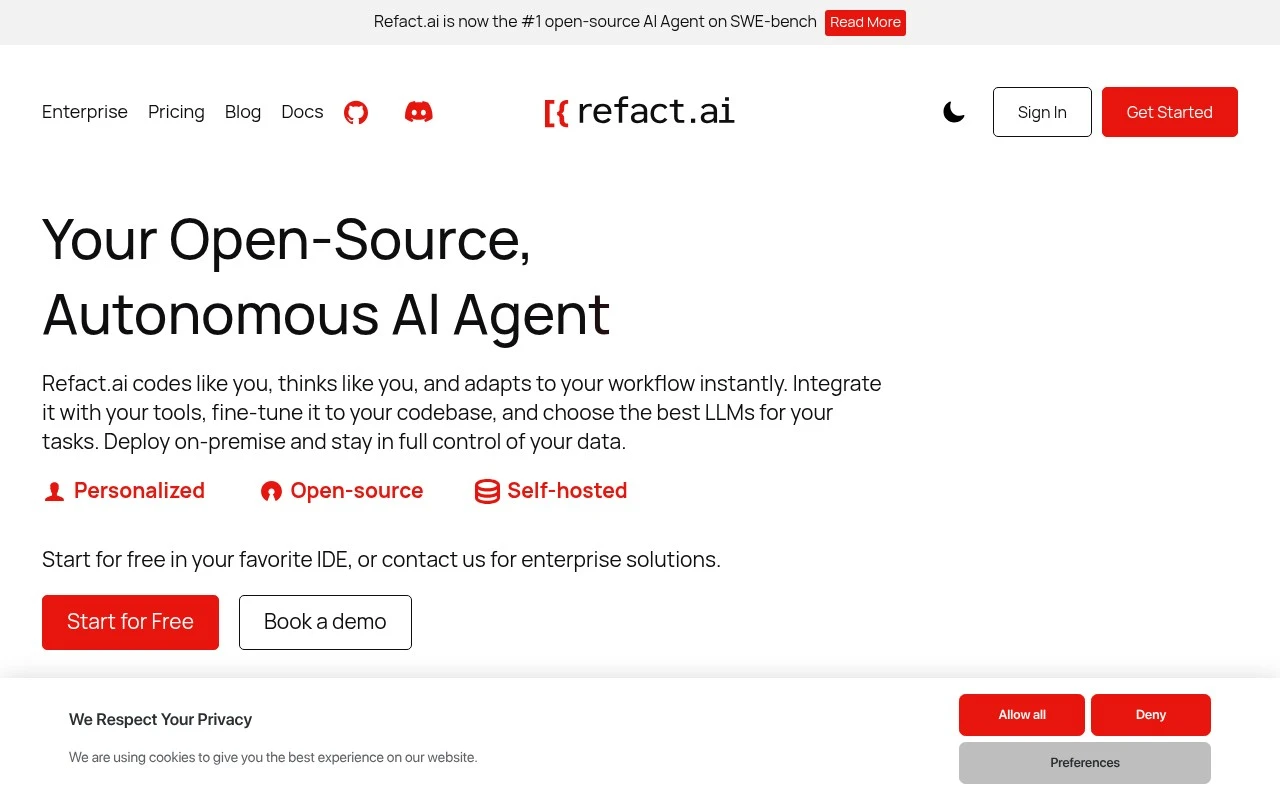
Refact AI AI is an open-source AI coding agent positioned as an alternative to tools such as Cursor and GitHub Copilot. It combines autonomous task execution, in-IDE chat, and code completion, with emphasis on full codebase context, workflow personalization, choice of LLMs, and on-premise deployment for teams that need control over their source code and data.

FYAI Score

7.6 / 10

Based on 1 reviews + FYAI product analysis

Pricing:

Freemium

Best for:

Engineering teams needing on-prem AI coding with full repo context

Score Breakdown

  • Ease of use7.2 / 10
  • Features7.8 / 10
  • Pricing8.1 / 10
  • Integrations7.6 / 10
  • Support7.3 / 10

PRODUCT PREVIEW

What this AI tool does

Refact AI is an AI-assisted coding tool designed to help developers work more efficiently inside their development workflow. It focuses on understanding the context of your code and providing suggestions that can reduce repetitive typing and speed up common editing tasks. In practice, it can be used while writing new code, modifying existing modules, or navigating unfamiliar parts of a codebase. The tool aims to support day-to-day programming by offering context-aware completions and refactoring help, while leaving final decisions and code quality checks to the developer. This page provides an informational overview of what refact is intended for and the kinds of development scenarios where it may be useful, so you can decide whether it fits your team’s workflow and coding standards.

Use cases

Best for

Generate Code

Generate code in your IDE using full-repo context, chat prompts, and inline completions to implement functions and files.

Code Review

Use Refact AI to review pull requests by scanning diffs and related files, then flagging issues and suggesting fixes in chat.

Code Refactoring

Refactor code by asking the agent to apply repo-wide changes, update call sites, and adjust tests across the codebase.

ANALYSIS

Strengths & limitations

Strengths
  • Supports multiple AI coding modes: autonomous agent workflows, IDE chat, code generation, debugging, review, and real-time autocompletion.
  • Designed to use broad development context, including the workspace, repository, files, documentation, databases, web resources, and connected tools.
  • Offers open-source and self-hosted/on-premise positioning, which is useful for teams with privacy, security, or data ownership requirements.
Limitations
  • Autonomous code changes still require developer review and validation before relying on them in production.
  • The official page gives limited detail on exact IDE support, enterprise setup requirements, and pricing tiers.
  • Advanced benefits such as fine-tuning, tool integrations, and on-premise deployment may require additional configuration or team infrastructure.

Evaluation

FYAI score breakdown

Our structured evaluation across five key criteria

7.6 / 10

Overall score

Based on 1 reviews + FYAI product analysis

  • Ease of use7.2 / 10
  • Features7.8 / 10
  • Pricing8.1 / 10
  • Integrations7.6 / 10
  • Support7.3 / 10

What users say

Findings from public reviews, documentation and community sources.

  • Ease of use

    Reddit feedback says setup for the self-hosted server was "easy enough" and the IDE integration was "disappointing," indicating usable setup with possible editor-workflow friction.

  • Features

    Refact.ai lists an autonomous coding agent that can "plan, execute, and deploy," repository search/analysis, in-IDE chat, and support for "25+ programming languages." Refact.ai also lists real-time autocomplete, AI code review, image-to-code, and self-hosting.

  • Pricing

    Refact.ai shows a "Free" plan for personal/hobby projects and "Pro From $10/month" with "40 requests/day to Autonomous AI Agent." Request and credit consumption affect how much value users get from the paid plan.

  • Integrations

    Refact.ai says users can start in a favorite IDE and "connects with GitHub, databases, CI/CD pipelines, and more." Refact.ai also supports on-premise deployment.

  • Support

    Refact.ai links "Docs" and "Blog" resources, offers enterprise demo/contact paths, and includes testimonials attributed to its Discord Community.

Who is this for?

Best for developers or teams that want coding help across a repository and deployment workflow, Refact.ai lists an autonomous coding agent that can "plan, execute, and deploy," plus repository search/analysis and support for "25+ programming languages." Less suited to users who need a frictionless IDE experience, Reddit feedback called the IDE integration "disappointing," which means the editor workflow may not feel seamless.

PRODUCT PREVIEW

Feature highlights

Autonomous coding agent

Plans and executes multi-step tasks across your codebase.

Full-repo context

Chat and completions grounded in your entire project structure.

On-prem deployment

Keep source code and data in-house with team-controlled setup.

COMPARE

Discover curated alternatives worth comparing

Compare similar AI tools based on features, pricing and use cases

8.3/ 10Based on 68 reviews

Gemini Code Assist

Code Generation & CompletionTesting & Refactoring
AI coding assistant for code completion, edits, and explanations
Best for:
Software developers
Pricing
Freemium

9.1/ 10Based on 46 reviews

GitHub Copilot

Code Generation & CompletionTesting & Refactoring
AI coding assistant for code suggestions, chat, and reviews
Best for:
Software developers
Pricing
Freemium

8.9/ 10Based on 6 reviews

Cline

Code Generation & CompletionDebugging
Agentic coding runtime that edits files and runs commands
Best for:
Software developers
Pricing
Free

Ship cleaner, safer code faster with automated refactoring. See why teams choose Refact AI to reduce tech debt and keep codebases maintainable.

FAQ

Frequently asked
questions

Everything you need to know about this AI tool,
its features, pricing, use cases, and limitations.

What types of teams and codebases is Refact AI a good fit for?
Refact AI tends to fit teams that want to reduce technical debt through consistent, repeatable refactoring across active repositories. It’s most useful when you have established coding standards and CI practices so changes can be reviewed and tested quickly. If your work is mostly greenfield or you rarely refactor, you may get less value than from a general code assistant.
Does Refact AI have a free plan, and what are the typical limitations compared to paid tiers?
Refact AI may offer a free option or trial, but free access commonly comes with caps on usage, fewer advanced refactoring features, or limited team/admin controls. Paid tiers are usually where you’ll see collaboration features, policy controls, and higher throughput for larger repos. Before choosing, confirm whether the plan supports your languages, IDEs, and any on-prem or private deployment needs.
How does Refact AI compare to GitHub Copilot or JetBrains AI for refactoring-focused workflows?
Copilot and JetBrains AI are often used for code generation and inline assistance, while Refact AI is typically evaluated more on structured refactoring and code quality improvements across a codebase. If you need broad autocomplete and chat features, a general assistant may cover more day-to-day tasks. If your priority is systematic refactoring and reducing code smells with reviewable changes, Refact AI may align better.
How quickly can a team get Refact AI running, and what onboarding effort should we expect?
Automated refactoring still requires human review, especially when changes affect architecture, performance, or domain-specific patterns. Legacy or highly customized codebases may see lower-quality suggestions or limited applicability. You should also plan for occasional mismatches with project style guides, which can add manual cleanup.
What should we check about data handling, privacy, and compliance when evaluating Refact AI?
Verify what code and metadata Refact AI sends off-machine, whether prompts or snippets are stored, and how long logs are retained. If you have strict requirements, confirm options for private deployment, access controls, and auditability, plus whether it supports your compliance needs (e.g., SOC 2/ISO expectations). It’s also worth checking how the tool handles secrets detection and whether it can be restricted from indexing sensitive repositories.