Curated ToolThis tool is part of our curated AI directory. We only include tools that meet our standards for relevance, usability and real-world value.

Qodo

Qodo is an AI coding platform that helps developers generate tests, review code, and improve code quality inside IDEs and Git workflows. It focuses on code integrity by analyzing context and suggesting changes for more reliable software.
Code Review & Quality

FYAI Score

8.2 / 10

Based on 64 reviews

Pricing:

Freemium

Best for:

Engineering teams needing consistent PR quality and code governance

Score Breakdown

  • Ease of use8.5 / 10
  • Features8.4 / 10
  • Pricing8.1 / 10
  • Integrations7.7 / 10
  • Support8.2 / 10

PRODUCT PREVIEW

What this AI tool does

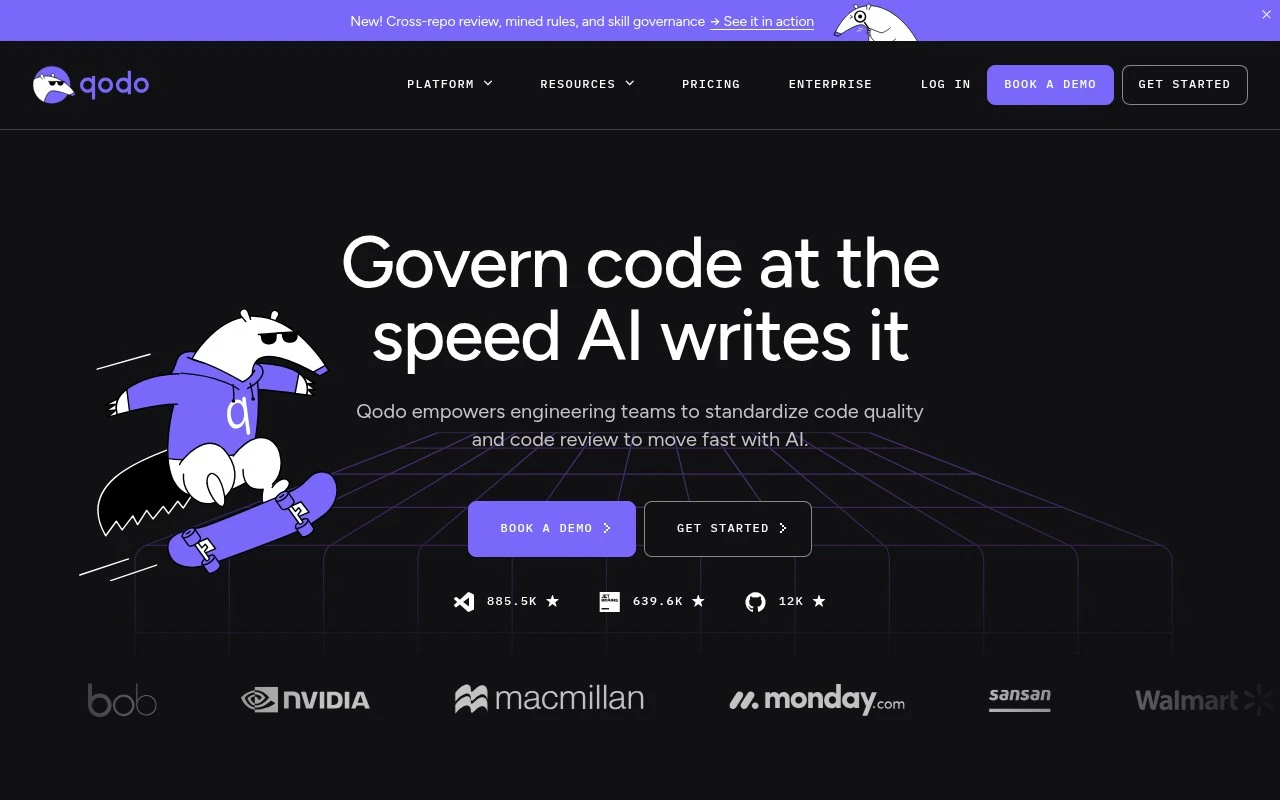
Qodo is an AI code review and governance platform for engineering teams that want an independent quality layer across pull requests, local code, repository standards, and delivery processes. It is built less as a code generator and more as a reviewer that understands the surrounding engineering context before deciding whether code is safe, maintainable, and aligned with team expectations. Instead of looking at a diff in isolation, the platform is designed to reason over the broader codebase, repository history, previous pull requests, custom rules, and business requirements. That context is central to its value, because the goal is not simply to comment more often, but to catch issues that matter in the way a human reviewer would understand them. For engineering leaders, Qodo is a way to add consistency to code review without replacing developer judgment. It can help teams enforce architecture patterns, security expectations, testing standards, naming conventions, and other local practices that are easy to document but hard to apply evenly across every review. Code review is where the tool’s positioning is clearest. It sits in the path between writing code and shipping code, reviewing pull requests and local changes so problems can be found before they reach production. This makes it especially relevant for teams adopting AI coding assistants, where more code can be produced faster but still needs careful validation. Context-aware review also changes the character of its feedback. Rather than giving generic lint-style advice, it can connect a proposed change to existing patterns, prior decisions, and stated requirements. That makes the platform useful for identifying regressions, missing tests, risky assumptions, inconsistent implementations, and changes that may violate team-specific rules. In day-to-day workflows, Qodo is meant to fit into the review process developers already use. Teams can apply it around pull requests, use it before code is submitted, and treat its output as another layer of review alongside automated tests, static analysis, and human approval. The practical benefit is earlier feedback, fewer avoidable review cycles, and a more reliable path from implementation to merge. Team-specific governance is a major part of the story. The platform gives organizations a way to encode expectations about how software should be built, not only whether it compiles. This is particularly important for larger teams, regulated environments, and organizations where engineering standards need to remain consistent across services, repositories, and contributors. Qodo is best at serving engineering teams that need AI-assisted code review, code quality enforcement, and development governance grounded in their own codebase and rules. Its role is not to make every engineering decision automatically, but to surface risk, enforce standards, and give reviewers better information at the moment decisions are made. The broader significance is that Qodo treats AI in software development as a quality and accountability problem, not only a productivity problem. As teams generate and change code faster, the need for independent review becomes more important. The platform addresses that gap by combining code understanding, repository awareness, and policy enforcement into a review layer built for modern software teams.

Use cases

Best for

Pull Request AI Reviews

Qodo analyzes pull requests with codebase context to flag logic gaps, critical issues, standards violations, and requirement mismatches.

In-Ide Code Review

Qodo runs local IDE review workflows that analyze your current changes with repository context and suggest fixes inside the editor.

Coding Standards Governance

Define and enforce coding standards across repositories by applying policy checks to PRs and monitoring compliance for auditability.

ANALYSIS

Strengths & limitations

Strengths
  • Best suited to engineering teams that need context-aware review because it uses repository, pull request, history, rules, and requirement context to flag issues before production.
  • Strong fit for teams standardizing code quality because it can enforce team-specific engineering rules consistently across pull requests and local code.
  • Useful for engineering managers and platform teams because it provides a governance layer across repositories and teams rather than only assisting individual developers.

Limitations
  • Less suitable for solo developers or very small teams that mainly want code generation because its main value comes from review governance and team-wide standards.
  • Requires meaningful setup and maintenance of repository access, rules, and workflow integration, so teams without established review processes may face extra adoption overhead.
  • The freemium model can limit fit for growing teams because broader governance, scale, or advanced controls are typically tied to paid usage.

Evaluation

FYAI score breakdown

Our structured evaluation across five key criteria

8.2 / 10

Overall score

Based on 64 reviews

  • Ease of use8.5 / 10
  • Features8.4 / 10
  • Pricing8.1 / 10
  • Integrations7.7 / 10
  • Support8.2 / 10

What users say

Findings from public reviews, documentation and community sources.

  • Ease of use

    G2 shows Qodo at "4.7/5" across "64 reviews," and users praise context-aware suggestions that "seamlessly" boost productivity during coding tasks. Qodo's pricing FAQ says the trial path requires "No" credit card: sign in with GitHub/Google/email, install on repos, and reviews start running.

  • Features

    Qodo's website positions Qodo as an "AI Code Review and Governance Platform" with "15+ agentic workflows for IDEs, PRs and security." Qodo's website lists context-aware PR review, local IDE review, cross-repo context, and rules enforcement.

  • Pricing

    Qodo's pricing page lists Pro Team at "$30," credits at "$.012/credit," and a "Free 14 Day Trial" with "no credit card." Qodo's pricing page says overage uses the same per-credit rate with a customer-set cap, Enterprise is custom, and there is not a permanent free tier after trial.

  • Integrations

    Qodo's website describes automated review across "your IDE, pull requests, CLI, and Git workflows." Qodo's website also references workflow integrations such as Linear for checking PRs against business requirements.

  • Support

    Qodo's pricing page says Pro Team includes "Standard support." Qodo's pricing page says Enterprise adds "Priority support / SLA" and a "Dedicated CSM."

Who is this for?

Best for engineering teams that want AI review inside existing development workflows, Qodo's website describes automated review across "your IDE, pull requests, CLI, and Git workflows." Less suited to teams that need a permanent free plan, Qodo's pricing page says there is not a permanent free tier after the "Free 14 Day Trial," so continued use requires moving beyond the trial.

PRODUCT PREVIEW

Feature highlights

Contextual PR Review

Reviews PRs using repo history, codebase context, and past decisions.

Policy & Standards

Enforces team rules and business requirements before code hits prod.

Local Code Checks

Find issues in local changes early, before opening a pull request.

COMPARE

Discover curated alternatives worth comparing

Compare similar AI tools based on features, pricing and use cases

8.3/ 10Based on 68 reviews

Gemini Code Assist

Code Generation & CompletionTesting & Refactoring
Completes code, edits codebases, and answers dev questions
Best for:
Software developers
Pricing
Freemium

9.1/ 10Based on 46 reviews

GitHub Copilot

Code Generation & CompletionTesting & Refactoring
Suggests code, reviews changes, and automates repo tasks
Best for:
Software developers
Pricing
Freemium

8.9/ 10Based on 6 reviews

Cline

Code Generation & CompletionDebugging
Inspects code, edits files, runs commands, automates CI
Best for:
Software developers
Pricing
Free

Turn messy marketing data into clear insights in minutes. Start using Qodo to make faster decisions and improve campaign ROI with confidence.

FAQ

Frequently asked
questions

Everything you need to know about this AI tool,
its features, pricing, use cases, and limitations.

Who is Qodo best suited for?
Qodo is best suited for software engineering teams that need consistent AI-assisted code review and governance across repositories. It fits code reviewers, engineering managers, platform teams, and enterprise organizations that want to detect defects, enforce evolving engineering standards, and review AI- or human-written code before merge.
Does Qodo have a free plan, and when would a team need to pay?
Qodo uses a freemium pricing model, so teams can typically start with free access and move to paid options when they need broader usage or advanced capabilities. Buyers should check qodo.ai for current plan limits, since practical constraints often relate to users, repositories, governance features, and enterprise controls.
How does Qodo compare with other AI code review tools?
Qodo is more focused on context-aware code review and governance than on generic code suggestions alone. It emphasizes repository context, pull request history, engineering rules, requirements, audit trails, and cross-team visibility, so it is most relevant when review consistency and standards enforcement matter as much as individual developer productivity.
How much setup does Qodo usually require?
Qodo is not a general-purpose AI assistant or primarily a code generation tool. Its value is strongest for engineering organizations that can maintain repository context, rules, and review workflows. Very small teams looking for simple, low-configuration feedback may find a governance-oriented platform heavier than they need.
What should teams consider about security and compliance before using Qodo?
Teams should evaluate how Qodo handles source code, repository access, audit trails, deployment options, and compliance requirements before adoption. Enterprise buyers should confirm current security controls, data retention practices, access permissions, and certification status directly with Qodo, especially when reviewing sensitive codebases or regulated development environments.