Curated ToolThis tool is part of our curated AI directory. We only include tools that meet our standards for relevance, usability and real-world value.

Qoder

AI agents for repo understanding, code editing, and workflows

Code Generation & CompletionCodebase Chat

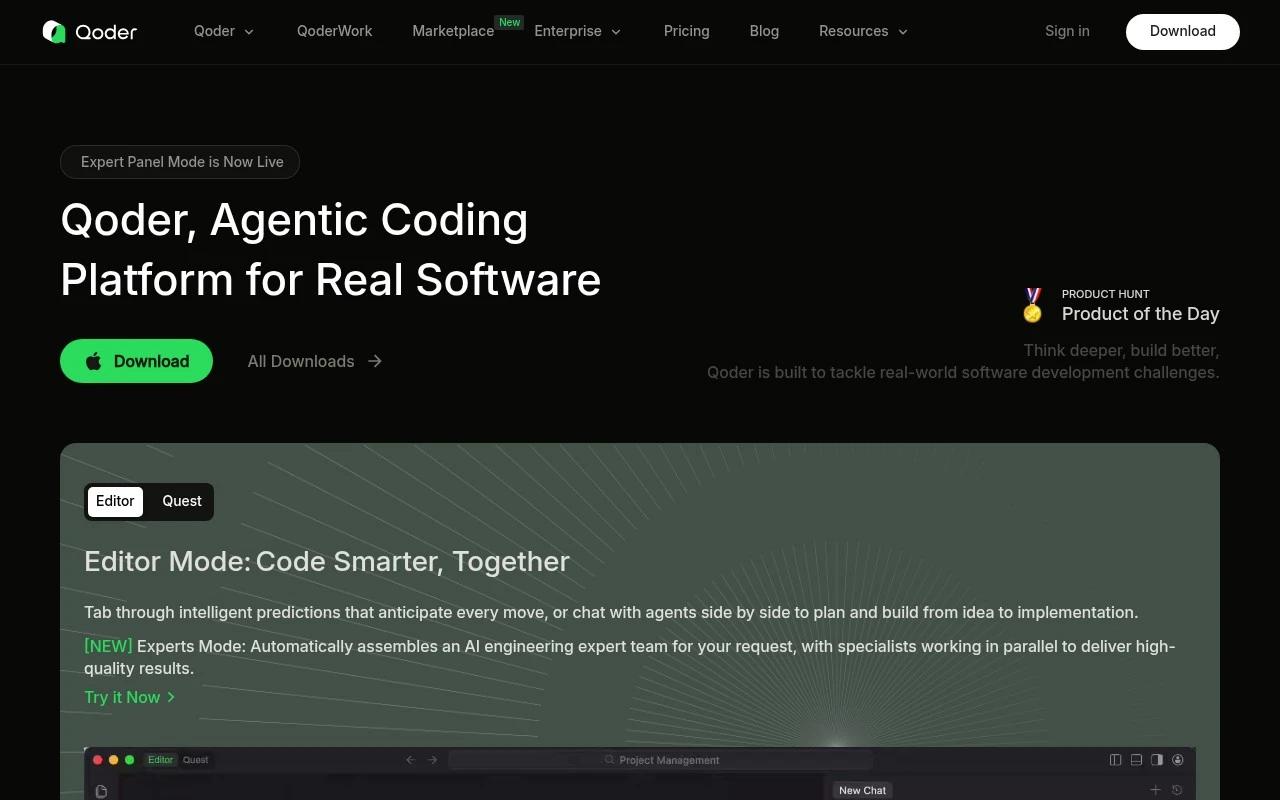
Qoder is an AI coding and agent platform whose main product is an autonomous development desktop for real-world software development. The official site describes support for VS Code-style workflows, JetBrains IDEs, a terminal-native CLI, codebase analysis, multi-agent collaboration, memory and rules, skills and plugins, and long-running agent execution. It also markets adjacent products for general office work and always-on AI employees, but the clearest established function is AI-assisted software development and codebase-aware agent execution.

FYAI Score

7.9 / 10

Based on 6 reviews + FYAI product analysis

Pricing:

Freemium

Best for:

Software engineers building and maintaining real-world codebases

Score Breakdown

  • Ease of use8.2 / 10
  • Features7.8 / 10
  • Pricing7.3 / 10
  • Integrations7.7 / 10
  • Support8.5 / 10

PRODUCT PREVIEW

What this AI tool does

Qoder is an AI tool designed to help people work with code more efficiently by turning natural-language prompts into useful programming output. It can be used during development to draft snippets, explain what existing code is doing, or suggest changes when you describe the behavior you want. In practice, it fits into common workflows like prototyping, refactoring, and learning unfamiliar codebases. You can provide a short description of a task or paste in a section of code and ask for clarification or improvements, then review and adapt the result to match your project’s requirements. Because outputs may vary depending on context, it works best when you share relevant details such as the language, framework, and constraints, and when you validate the suggestions with tests or code review. This makes it a practical option for informational use cases where you want quick guidance or a starting point rather than a final, authoritative answer.

Use cases

Best for

Codebase Chat

Chat with your repository as Qoder indexes files and answers questions with code references and suggested edits.

Code Refactoring

Refactor modules by having the agent apply structured changes across files, update imports, and run terminal commands to verify.

Generate Code

Generate new functions, tests, or scripts from a prompt using codebase context and IDE integration for insertion and review.

ANALYSIS

Strengths & limitations

Strengths
  • Offers multiple developer entry points, including desktop, JetBrains plugin, and CLI.
  • Emphasizes codebase-wide context, including support for large repositories and generated codebase wikis.
  • Includes agent-oriented features such as planning, execution, verification loops, memory, rules, skills, and plugins.
Limitations
  • The site does not name the specific AI models used, only saying users are served by advanced models.
  • Pricing is credit-based and requires checking the pricing page for exact limits and costs.
  • Non-coding products such as QoderWork, QoderWake, and Cloud Agents are described broadly, with limited concrete workflow or integration detail in the provided page text.

Evaluation

FYAI score breakdown

Our structured evaluation across five key criteria

7.9 / 10

Overall score

Based on 6 reviews + FYAI product analysis

  • Ease of use8.2 / 10
  • Features7.8 / 10
  • Pricing7.3 / 10
  • Integrations7.7 / 10
  • Support8.5 / 10

What users say

Findings from public reviews, documentation and community sources.

  • Ease of use

    The Qoder site says users can “Sign up with email, Google, or GitHub” and “Download, install and start coding smarter in seconds - no setup, no friction.” Product Hunt users describe Qoder as having “smooth UX.”

  • Features

    The Qoder site lists “intelligent code completion, AI conversational programming, and automatic code generation.” The Qoder site also describes “Multi-Agent Expert Collaboration,” “Memory and Rules,” “Skills and Plugins,” and up to “100k Files” for codebase analysis.

  • Pricing

    The Qoder pricing snippet lists “$0” and “3,000 Credits per seat-month,” and the Qoder site says new users get a “free 2-week Pro Trial.” Reddit feedback says, “The $30 plan lasted me two days.”

  • Integrations

    The Qoder site says it “supports mainstream IDEs like VS Code and JetBrains,” includes “Qoder CLI,” and has a JetBrains plugin. Qoder docs describe an Agent SDK for TypeScript that can read/write files, search code, and execute commands.

  • Support

    Qoder lists support through a FAQ, “community forum,” and email at “[email protected].” Reddit user sentiment says, “The documentation is excellent too.”

Who is this for?

Best for developers who want an AI coding assistant inside existing coding workflows. Qoder supports mainstream IDEs like VS Code and JetBrains and includes “Qoder CLI.” Less suited to users who do not want to manage credit consumption, the pricing snippet lists “3,000 Credits per seat-month,” and Reddit feedback says, “The $30 plan lasted me two days.”

PRODUCT PREVIEW

Feature highlights

Codebase-aware agent

Analyzes your repo to plan, change code, and stay consistent.

IDE + CLI workflows

Work in desktop IDEs or terminal with a VS Code-style flow.

Multi-agent teamwork

Coordinate agents with shared memory, rules, skills, and plugins.

COMPARE

Discover curated alternatives worth comparing

Compare similar AI tools based on features, pricing and use cases

8.3/ 10Based on 68 reviews

Gemini Code Assist

Code Generation & CompletionTesting & Refactoring
AI coding assistant for code completion, edits, and explanations
Best for:
Software developers
Pricing
Freemium

9.1/ 10Based on 46 reviews

GitHub Copilot

Code Generation & CompletionTesting & Refactoring
AI coding assistant for code suggestions, chat, and reviews
Best for:
Software developers
Pricing
Freemium

8.9/ 10Based on 6 reviews

Cline

Code Generation & CompletionDebugging
Agentic coding runtime that edits files and runs commands
Best for:
Software developers
Pricing
Free

Ship cleaner, safer code with less review overhead. See why teams choose Qoder to speed up pull requests and keep quality high.

FAQ

Frequently asked
questions

Everything you need to know about this AI tool,
its features, pricing, use cases, and limitations.

What teams and workflows is Qoder a good fit for?
Qoder fits software teams that do frequent pull requests and want more consistent, automated code review coverage. It’s most useful when you already have defined coding standards and want faster feedback on bugs, security issues, and style. If your reviews are highly architectural or domain-specific, you may still rely heavily on senior engineers for final judgment.
Does Qoder have a free plan, and what are the typical limitations compared to paid tiers?
Qoder’s availability and scope of a free tier can vary, so it’s worth confirming current plan details on qoder.com. In tools like Qoder, free plans commonly cap usage (repos, PRs, or seats) and may limit advanced policy controls or security-focused checks. Paid tiers usually add team management, deeper integrations, and more configurable rules.
How does Qoder compare with other automated code review tools?
Compared with traditional linters and static analysis tools, Qoder can provide more contextual, PR-style feedback but may be less deterministic than rule-based checks. Versus AI coding assistants that focus on generating code, Qoder is more review-centric and aimed at catching issues before merge. If you need strict compliance gates, pairing Qoder with established SAST/linters may still be necessary.
How quickly can a team get Qoder running, and what onboarding work is involved?
Qoder’s suggestions can miss context-specific intent, so it shouldn’t replace human review for design decisions or nuanced business logic. Automated comments can also create noise if not configured carefully, which may slow reviews instead of speeding them up. Cost can be a factor for smaller teams, especially if pricing scales by seats or repositories.
What should I evaluate about Qoder’s data handling, privacy, and compliance before adopting it?
Check what code and metadata Qoder processes (full repo vs. diffs), where it’s stored, and whether it’s retained for model improvement. Confirm access controls, encryption, and whether it supports requirements like SOC 2, ISO 27001, or GDPR if those matter to your org. If you handle sensitive code, ask about on-prem/VPC options, data residency, and the ability to disable training on your data.