Curated ToolThis tool is part of our curated AI directory. We only include tools that meet our standards for relevance, usability and real-world value.

Devin AI

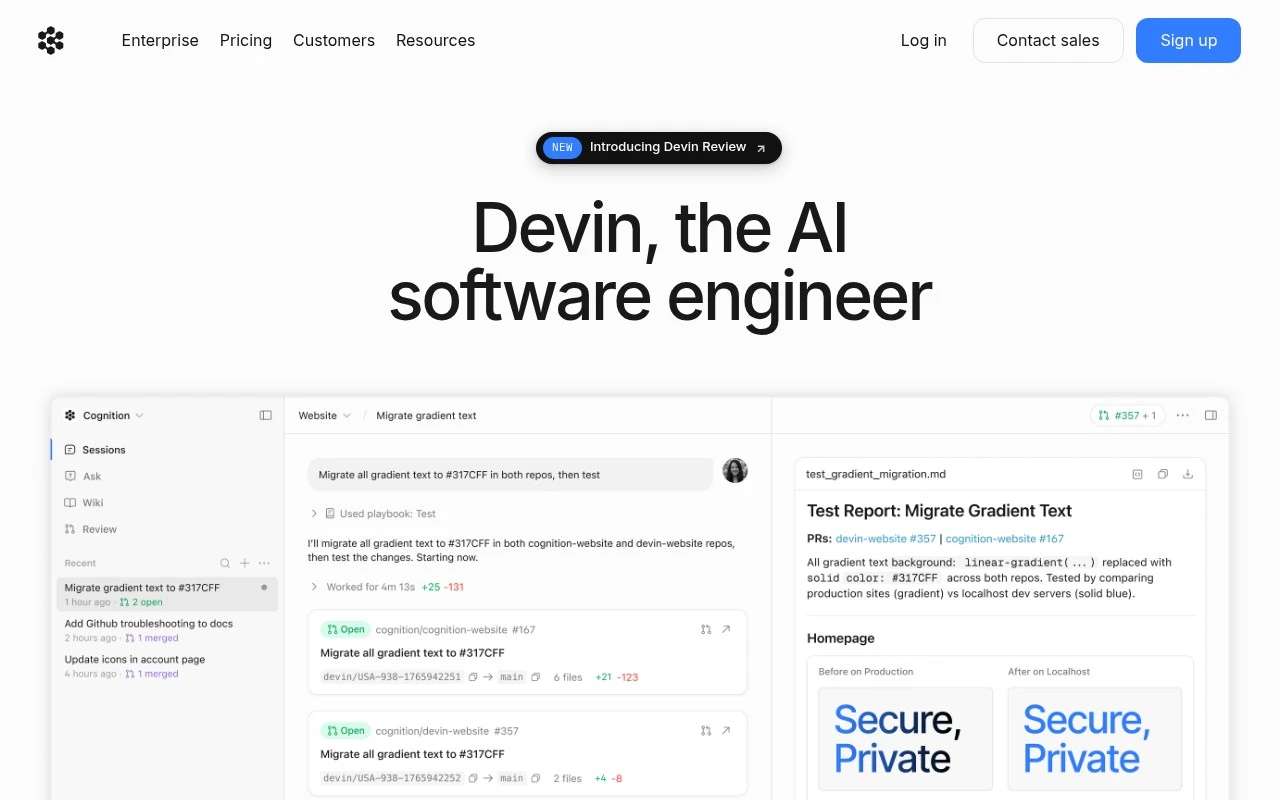
Devin AI is an autonomous AI software engineer from Cognition that can plan and carry out coding tasks, edit code, run tests, use developer tools, and submit pull requests. It is designed to handle software development workflows from issue intake through implementation.
Code Generation & CompletionDebugging

FYAI Score

8.0 / 10

Based on 1 reviews

Pricing:

Paid

Best for:

Engineering teams delegating real coding work with review control

Score Breakdown

  • Ease of use7.4 / 10
  • Features8.2 / 10
  • Pricing7.9 / 10
  • Integrations8.3 / 10
  • Support8.5 / 10

PRODUCT PREVIEW

What this AI tool does

Devin AI is a cloud-based AI software engineering agent for teams that want to delegate real development tasks, not just receive autocomplete suggestions. Built by Cognition and presented through devin.ai, it is designed to work inside a software workflow, understand a repository, make changes, run checks, and hand results back to developers for review. Devin AI is for engineering teams that need practical help with coding work such as migrations, refactors, pull request support, visual QA, and incident response. Instead of acting like a chat window that only explains code, the platform behaves more like an autonomous teammate with access to the tools needed to complete a task. It can investigate an issue, plan an approach, edit files, generate code, debug code, run tests, and prepare a pull request. The point is not to remove engineers from the process, but to move more of the execution burden onto an agent while humans keep control over approval and merge decisions. Engineering teams use the tool most naturally when work is clear enough to delegate but time-consuming enough to slow people down. Code refactoring, dependency updates, test generation, and repetitive implementation tasks are good examples because they often require context, care, and verification rather than pure creativity. Devin AI is best at bounded, repository-aware engineering work where progress can be inspected through commits, logs, test results, and reviewable code changes. For legacy systems and larger codebases, the appeal is application modernization without turning every cleanup effort into a major project. The agent can help trace how old components behave, adjust code across multiple files, and support migrations that would otherwise consume many engineering hours. In this role, it is less a novelty coding assistant and more an operational layer for reducing backlog, maintaining quality, and keeping systems moving. Human oversight remains central to how the product is positioned. Developers stay in the loop to review its reasoning, inspect diffs, request changes, and decide what is safe to merge. That makes Devin AI a fit for teams that want AI-assisted delivery but still care about code ownership, review standards, security, and production responsibility. Code review is another part of the story because the platform is meant to participate in the software development lifecycle rather than sit outside it. It can examine proposed changes, identify issues, suggest improvements, and help validate that an implementation behaves as expected. Visual QA and incident resolution extend the same idea into quality and operations, where the agent can investigate failures, reproduce problems, and propose fixes. The larger story of Devin AI is the shift from AI as a code suggestion engine to AI as a software engineering agent. It represents a more ambitious category of developer tooling, one where teams assign outcomes and receive completed, reviewable work rather than isolated snippets. For organizations with mature engineering processes, its value is strongest when it is treated as a delegated execution partner: useful for accelerating routine and complex tasks, but still governed by the judgment of experienced developers.

Use cases

Best for

Generate Code

Devin AI implements assigned tickets by writing code, running tests, and opening a pull request for review and merge.

Code Review

It reviews pull requests by checking diffs, running checks, and leaving inline comments or suggested changes for developers.

Code Refactoring

It refactors code by applying structured changes across files, updating tests, and submitting the refactor as a pull request.

ANALYSIS

Strengths & limitations

Strengths
  • Best suited to engineering teams with maintained codebases because it can take on larger implementation tasks such as migrations, refactors, QA, and incident-related changes rather than only suggesting snippets.
  • Keeps developers in the loop because work is reviewed and merged through normal engineering oversight instead of being treated as fully unmanaged automation.
  • Useful for teams with recurring code maintenance work because cloud-based agents can run delegated tasks in parallel with human developers.

Limitations
  • Less suitable for individuals or small teams that only need lightweight autocomplete or chat-based coding help because Devin is built around delegating substantial engineering tasks.
  • Requires repository and workflow access for cloud agents, so teams with strict security, compliance, or change-control requirements need extra review before adoption.
  • Paid-only positioning makes it a poorer fit for casual experimentation or very low-volume coding use because costs need to be justified against real engineering throughput.

Evaluation

FYAI score breakdown

Our structured evaluation across five key criteria

8.0 / 10

Overall score

Based on 1 reviews

  • Ease of use7.4 / 10
  • Features8.2 / 10
  • Pricing7.9 / 10
  • Integrations8.3 / 10
  • Support8.5 / 10

What users say

Findings from public reviews, documentation and community sources.

  • Ease of use

    Devin’s customer case frames the workflow as delegation plus review, saying engineers could “just review Devin’s changes, make minor adjustments, then merge their PR,” and that Devin “provided an easy way” to reduce engineering hours. Devin’s website also describes a small upfront teaching/fine-tuning step and a human-in-the-loop approval flow.

  • Features

    Devin’s website positions Devin as an “AI coding agent and software engineer” with “parallel cloud agents.” Devin’s website lists use cases including code migrations, PR review, visual QA, and incident-resolution-style workflows, and the Nubank case describes large-scale refactoring across millions of lines of code.

  • Pricing

    The Devin pricing page lists 5 tiers, from Free to Enterprise as “Let’s talk.” The Devin pricing page says usage allowances are described as “light,” “increased,” or “significantly higher,” with extra usage consumed at API pricing.

  • Integrations

    The Devin pricing page lists “Slack and Teams,” “Linear and Jira,” “GitHub, GitLab, and Bitbucket,” and “Devin API.” The Devin pricing page says Enterprise connectivity includes “SAML/OIDC SSO” and centralized admin controls.

  • Support

    The Devin pricing page says Teams includes “Priority support.” The Devin pricing page says Enterprise adds “Highest priority support,” “Dedicated account management,” “Dedicated Slack Connect channel for support,” an “Optional onboarding call,” and “Dedicated account and engineering support.”

Who is this for?

Best for engineering teams that want to delegate coding work and review the output, Devin’s customer case says engineers could “just review Devin’s changes, make minor adjustments, then merge their PR.” Less suited to users who need near-zero setup, Devin’s website describes a small upfront teaching/fine-tuning step and a human-in-the-loop approval flow.

PRODUCT PREVIEW

Feature highlights

Autonomous coding

Takes on migrations, refactors, and fixes end-to-end in the cloud.

PR-ready output

Opens PRs and iterates from feedback so you can review and merge.

QA & incident help

Supports visual QA, PR review, and incident resolution workflows.

COMPARE

Discover curated alternatives worth comparing

Compare similar AI tools based on features, pricing and use cases

8.3/ 10Based on 68 reviews

Gemini Code Assist

Code Generation & CompletionTesting & Refactoring
Completes code, edits codebases, and answers dev questions
Best for:
Software developers
Pricing
Freemium

9.1/ 10Based on 46 reviews

GitHub Copilot

Code Generation & CompletionTesting & Refactoring
Suggests code, reviews changes, and automates repo tasks
Best for:
Software developers
Pricing
Freemium

8.9/ 10Based on 6 reviews

Cline

Code Generation & CompletionDebugging
Inspects code, edits files, runs commands, automates CI
Best for:
Software developers
Pricing
Free

See why teams choose Devin AI to resolve more customer requests faster. Start delivering consistent, timely support today while reducing workload and costs.

FAQ

Frequently asked
questions

Everything you need to know about this AI tool,
its features, pricing, use cases, and limitations.

Who is Devin AI best suited for?
Devin AI is best suited for software teams that need to delegate real engineering work, especially refactors, migrations, PR review, QA, and incident-related development tasks. It is aimed at developers, engineering managers, and teams maintaining production codebases where AI-generated changes still go through human review.
Is Devin AI free or paid?
Devin AI is a paid coding agent rather than a casual free coding assistant. Teams evaluating it should expect a commercial adoption process and should check devin.ai for current pricing, access options, and usage terms, especially if they plan to run multiple cloud agents in parallel.
How does Devin AI compare with other AI coding tools?
Devin AI is positioned more as an autonomous AI software engineer than a simple code completion or chat-based coding assistant. Its fit is strongest when a team wants agents to plan and execute multi-step engineering tasks, while other tools may be better for lightweight code suggestions, debugging help, or individual developer productivity.
How much setup does Devin AI usually require?
The main trade-off with Devin AI is that human engineering oversight remains essential. It can generate and execute code changes, but teams still need developers to review pull requests, validate behavior, manage risk, and own production outcomes. It is better viewed as delegated engineering capacity than a replacement for engineering judgment.
What should teams check about Devin AI privacy and compliance?
Teams should evaluate Devin AI’s data handling, repository access controls, retention practices, deployment model, and compliance posture before connecting sensitive codebases. Buyers in regulated environments should confirm current security documentation directly with Devin AI and align its use with internal policies for source code, credentials, logs, and customer data.