Curated ToolThis tool is part of our curated AI directory. We only include tools that meet our standards for relevance, usability and real-world value.

Aider

Terminal AI coding assistant that edits files and commits changes

Code Generation & CompletionTesting & Refactoring

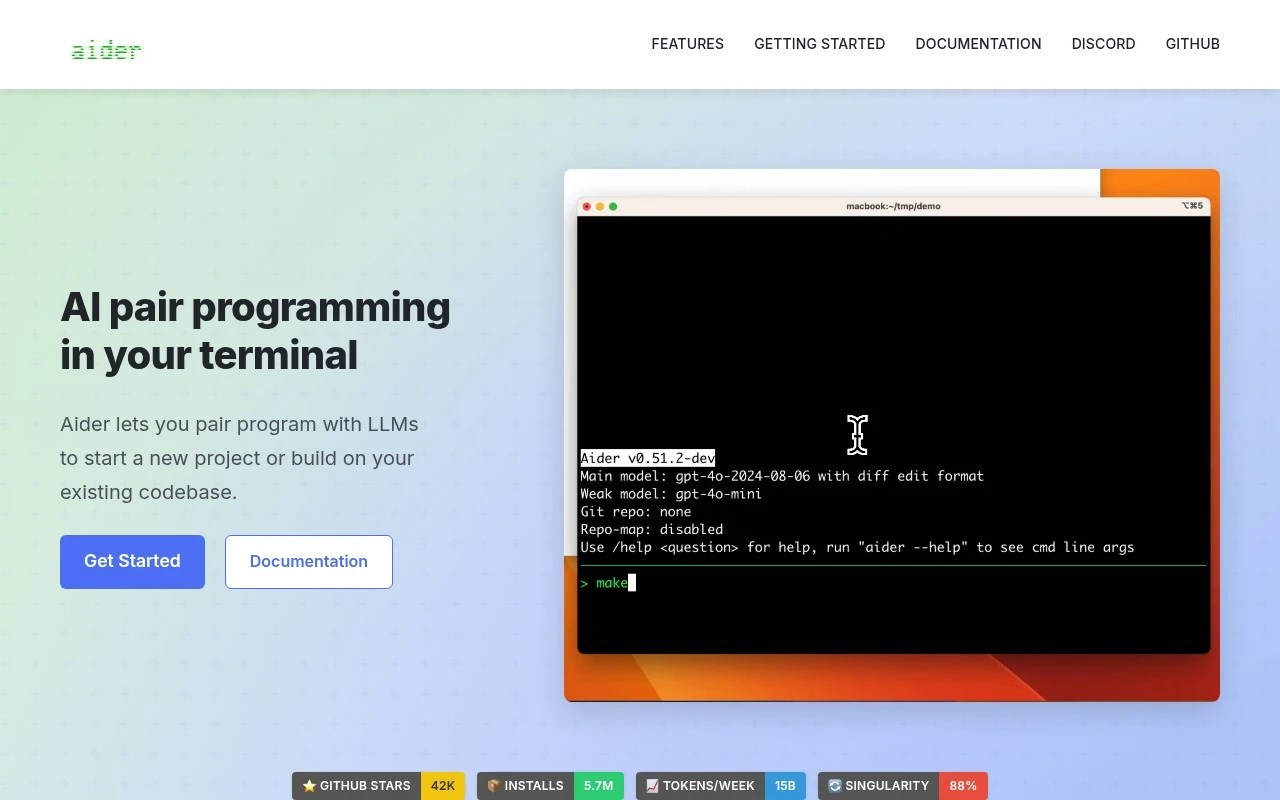
Aider is an AI pair programming tool for developers that runs from the terminal and connects to cloud or local LLMs. It can work on new projects or existing repositories, map the codebase for larger projects, edit code across many programming languages, run linting and tests, and automatically commit changes with git messages. It is distinct from many chat-only coding assistants because it is designed to operate directly inside a local codebase with git-aware change management.

FYAI Score

8.3 / 10

Industry standard in Coding

Pricing:

Freemium

Best for:

Developers who want AI help that edits real code with git-aware changes

Score Breakdown

  • Ease of use7.2 / 10
  • Features8.4 / 10
  • Pricing8.1 / 10
  • Integrations9.2 / 10
  • Support9.1 / 10

PRODUCT PREVIEW

What this AI tool does

Aider is an AI-assisted coding tool designed to help developers make changes to a codebase through a conversational workflow. Instead of switching between a chat window and an editor, you describe what you want to change and the tool applies edits directly to your project files, keeping the work grounded in the actual repository. It’s typically used for tasks like implementing small features, refactoring existing code, fixing bugs, and updating tests or documentation while staying consistent with the surrounding code. Because it operates on real files and can incorporate project context, it can be useful when you want quick iterations without losing track of what changed. In practice, you run it alongside your normal development setup and review the resulting diffs the same way you would with any other change. This makes it easier to keep control over code quality and version history while still benefiting from AI assistance.

Use cases

Best for

Generate Code

Use Aider in your terminal to generate new functions and files directly in your git repo using a local or cloud LLM.

Code Refactoring

Refactor existing modules by having Aider map the codebase, apply multi-file edits, and commit the changes with git messages.

Debug Code

Debug failing code by asking Aider to run tests or linting, inspect errors, and patch the relevant files in the repository.

ANALYSIS

Strengths & limitations

Strengths
  • Works directly in the terminal with existing codebases and git workflows.
  • Supports many LLMs, including Claude, DeepSeek, OpenAI models, and local models.
  • Includes developer-focused context and safety features such as codebase mapping, lint/test loops, diffs, and automatic commits.
Limitations
  • Best suited to developers who are comfortable with terminal-based workflows.
  • Requires configuring an LLM connection, such as API keys or a local model setup, for the main workflow.
  • AI code quality still depends on the chosen model, project context, and the user reviewing tests and diffs.

Evaluation

FYAI score breakdown

Our structured evaluation across five key criteria

8.3 / 10

Overall score

Industry standard in Coding

  • Ease of use7.2 / 10
  • Features8.4 / 10
  • Pricing8.1 / 10
  • Integrations9.2 / 10
  • Support9.1 / 10

What users say

Findings from public reviews, documentation and community sources.

  • Ease of use

    A Reddit discussion in r/ChatGPTCoding says users praise Aider productivity while noting the tradeoff that "you have to [be] more hands on with Aider." Aider’s terminal/API-key workflow is usable for developers but less near-zero-friction than IDE-first tools.

  • Features

    The Aider product page lists "Cloud and local LLMs," a codebase map, "100+ code languages," and git auto-commits. The Aider product page also lists IDE use, images/web pages, voice-to-code, and automatic linting/testing.

  • Pricing

    The Aider product page’s getting-started examples require provider API keys such as "deepseek=<key>," "anthropic=<key>," and "openai=<key>." Aider’s total cost depends on model/API usage rather than a simple fixed product tier.

  • Integrations

    The Aider docs list model/provider connections including OpenAI, Anthropic, Gemini, and Amazon Bedrock. The Aider docs also reference git/IDE/browser workflows.

  • Support

    The Aider docs include installation, usage, troubleshooting, and FAQ materials. The Aider docs also link to tutorial videos, examples, release history, GitHub, and Discord community resources.

Who is this for?

Best for developers who are comfortable with a terminal/API-key workflow, Aider’s getting-started examples use provider API keys such as "deepseek=<key>," "anthropic=<key>," and "openai=<key>." Best for codebases where git workflows matter, because the Aider product page lists git auto-commits and the docs reference git/IDE/browser workflows. Less suited to users who want near-zero-friction IDE-first setup, Reddit users note that "you have to [be] more hands on with Aider."

PRODUCT PREVIEW

Feature highlights

Terminal pair coding

Chat and apply edits directly in your local codebase from the CLI.

Repo-wide refactors

Maps large projects and updates multiple files across languages.

Tests + git commits

Run lint/tests and auto-commit changes with clear git messages.

COMPARE

Discover curated alternatives worth comparing

Compare similar AI tools based on features, pricing and use cases

8.3/ 10Based on 68 reviews

Gemini Code Assist

Code Generation & CompletionTesting & Refactoring
AI coding assistant for code completion, edits, and explanations
Best for:
Software developers
Pricing
Freemium

9.1/ 10Based on 46 reviews

GitHub Copilot

Code Generation & CompletionTesting & Refactoring
AI coding assistant for code suggestions, chat, and reviews
Best for:
Software developers
Pricing
Freemium

8.9/ 10Based on 6 reviews

Cline

Code Generation & CompletionDebugging
Agentic coding runtime that edits files and runs commands
Best for:
Software developers
Pricing
Free

Ship cleaner code faster without leaving your terminal. Start pairing with Aider today and turn ideas into working commits with less context switching.

FAQ

Frequently asked
questions

Everything you need to know about this AI tool,
its features, pricing, use cases, and limitations.

When is Aider a good fit compared to other AI coding tools?
Aider fits best if you want an AI pair programmer that can edit multiple files in a real repo and keep changes tied to a Git workflow. It’s especially useful for adding features, refactors, tests, and bug fixes where repository context matters. If you mainly want inline autocomplete or quick one-off snippets, a lighter editor plugin may be a better match.
Is Aider free, and what costs should I expect?
Aider itself is typically free to use as a CLI tool, but you usually pay for the LLM you connect it to (API usage for hosted models). If you run a local model, your cost shifts to hardware and setup time rather than per-token fees. Some workflows also rely on a web-chat copy/paste approach, which can be “free” but less automated.
How does Aider compare with GitHub Copilot, Cursor, or ChatGPT for coding?
Aider is more focused on repo-aware, multi-file edits and Git-integrated change management from the terminal, rather than primarily autocomplete. Tools like Copilot or Cursor tend to feel smoother inside an IDE for continuous suggestions, while ChatGPT-style tools are often less connected to your actual working tree. If you want a command-line-first workflow with explicit diffs and commits, Aider is often the closer fit.
How fast can I get Aider working, and what setup is involved?
Aider works best for users comfortable with command-line tools and Git, so it can feel heavy if you prefer a purely GUI/IDE experience. Code changes still require careful review, running tests, and sometimes iterative prompting to get the exact design you want. Model quality and cost vary depending on which LLM you connect.
What should I consider about data privacy and compliance when using Aider?
Aider sends prompts and relevant code context to whichever LLM backend you configure, so data handling depends largely on that provider or your local model setup. For sensitive repos, consider running a local model or using an enterprise LLM offering with clear retention and access controls. You should also review what files you share in prompts and align usage with your organization’s policies.