Curated ToolThis tool is part of our curated AI directory. We only include tools that meet our standards for relevance, usability and real-world value.

Describely

Describely is an AI product content platform for ecommerce teams that creates and optimizes product titles, descriptions, bullet points, and SEO metadata in bulk. It can generate meta description copy for product pages while keeping content aligned with catalog data and brand guidelines.
Copy OptimizationProduct Descriptions

FYAI Score

8.2 / 10

Based on 8 reviews + FYAI product analysis

Pricing:

Paid only

Best for:

eCommerce catalog teams scaling product listing content

Score Breakdown

  • Ease of use8.6 / 10
  • Features7.7 / 10
  • Pricing8.5 / 10
  • Integrations8.2 / 10
  • Support7.9 / 10

PRODUCT PREVIEW

What this AI tool does

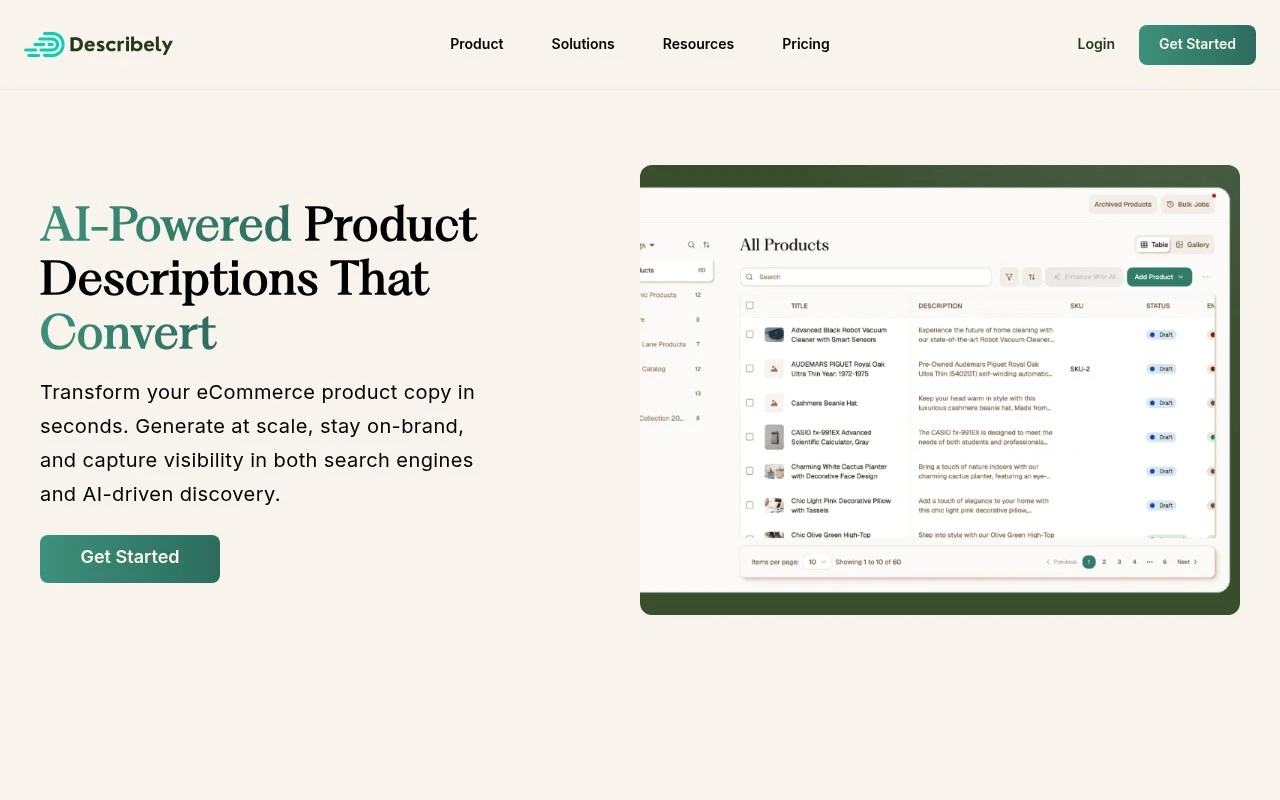
Describely is an AI product content platform for eCommerce teams that need to create, optimize, and maintain product catalog copy at scale. It is built for retailers, brands, agencies, and marketplace operators that manage large numbers of SKUs and need consistent product descriptions, metadata, and SEO-focused listing content without treating every item as a one-off writing task. For catalog-heavy retailers, the core problem is rarely a blank page. It is the ongoing work of turning incomplete product data, supplier feeds, spreadsheets, and legacy descriptions into accurate, searchable, on-brand content. Describely is best at turning messy product catalog inputs into structured product copy that supports search visibility, AI discovery, and conversion. At the center of the platform is bulk product content generation. Teams can generate product description drafts, product titles, bullet points, meta titles, and metadata across many items at once, then refine outputs with rules that reflect the brand, category, channel, and audience. This makes it more specific than a general writing assistant, because the workflow starts with catalog management rather than open-ended copywriting. Brand governance is a major part of its value. The platform helps teams apply tone of voice, formatting standards, prohibited claims, keyword guidance, and other content rules consistently across a catalog. That matters when product content is created by several people, across multiple suppliers, or for stores that need copy to feel unified even when the underlying data comes from different sources. Missing or thin product data is another important use case. Instead of only rewriting existing text, the tool can help enrich listings by identifying gaps and generating more complete content from available attributes. For merchants with thousands of products, that can mean fewer weak pages, fewer duplicate descriptions, and better foundations for ecommerce seo. Workflow fit is a key part of the product story. Describely connects to common commerce and catalog environments such as Shopify, WooCommerce, Wix, Squarespace, Akeneo, Google Sheets, and Excel CSV workflows, so teams can move content between the platform and the systems where product data already lives. This makes it useful for both direct store operators and teams that manage catalogs through spreadsheets, PIM-related processes, or multi-channel content operations. Search optimization is handled as part of the listing workflow rather than as a separate afterthought. Teams can generate meta description copy, SEO titles, and keyword-aware product content while still keeping the output grounded in product facts and brand standards. The positioning is not simply to produce more words, but to improve how product pages are found, understood, and acted on by shoppers and search systems. Compared with broad AI writing tools, the platform is narrower and more operational. It is designed around SKU-level content, repeatable catalog updates, bulk editing, and synchronization, which are the practical concerns of eCommerce content teams. That focus makes it especially relevant for businesses where product copy is tied directly to merchandising, organic search, paid traffic quality, and conversion rate. For teams evaluating Describely pricing, the main consideration is usually the scale and complexity of the catalog content operation. A small store may value faster listing creation, while a larger retailer or agency may value governance, bulk workflows, and integration with existing catalog systems. In either case, Describely is positioned as a dedicated product content platform for improving eCommerce catalog quality, not as a generic AI text generator.

Use cases

Best for

Generate Product Description

Describely generates on brand product descriptions in bulk from your catalog data and exports them to Shopify, CSV, or Sheets.

Ecommerce SEO

It creates SEO focused titles, attributes, and listing copy across your catalog using content rules and product data enrichment.

Generate Meta Description

Use Describely to generate meta descriptions at scale from product attributes and sync them back via CSV, Sheets, or PIM workflows.

ANALYSIS

Strengths & limitations

Strengths
  • Strong fit for eCommerce teams with large catalogs because it can generate product descriptions, metadata, and listing copy in bulk.
  • Useful for teams standardizing catalog content because brand voice, SEO guidance, and content rules can be applied across many product pages.
  • Practical for catalog operations because it supports store, spreadsheet, CSV, and PIM-related workflows including Shopify, WooCommerce, Wix, Akeneo, Google Sheets, and Excel CSV.

Limitations
  • Less suitable for teams that need a general-purpose writing assistant because its scope is focused on eCommerce product catalog content.
  • Less suitable for very small catalogs because the paid-only model and bulk workflow orientation can be more platform than a small shop needs.
  • Teams with complex approval, compliance, or highly technical product data requirements should plan for human review because AI-generated catalog copy still needs validation before publishing.

Evaluation

FYAI score breakdown

Our structured evaluation across five key criteria

8.2 / 10

Overall score

Based on 8 reviews + FYAI product analysis

  • Ease of use8.6 / 10
  • Features7.7 / 10
  • Pricing8.5 / 10
  • Integrations8.2 / 10
  • Support7.9 / 10

What users say

Findings from public reviews, documentation and community sources.

  • Ease of use

    Describely cites user feedback saying the “UI is minimal and streamlined, and the process is quick.” G2’s snippet says Describely’s “interface is simple and clean and easy to navigate.”

  • Features

    Describely’s site lists ecommerce-specific product descriptions, SEO/GEO metadata, catalog scoring for ChatGPT/Google/Gemini visibility, and bulk generation. Describely’s site also lists brand/content rules and catalog-scale workflows for product-content copy.

  • Pricing

    Describely’s pricing page publishes pay-as-you-go pricing of “$0.75 per product for up to 500 products,” with the first 5 products free. Describely’s pricing page states “no subscription and no long-term commitment” and lists enrichment and image-processing credit costs, while higher-volume catalogs move to custom pricing for 500+ SKUs.

  • Integrations

    Describely’s site lists ecommerce and catalog connectors including Shopify, WooCommerce, Wix, Akeneo PIM, Google Sheets CSV, and Microsoft Excel CSV. Describely’s site also states “Unlimited Store Connectors.”

  • Support

    Describely’s pricing page includes a customer testimonial that calls out “exceptional customer service.” Describely’s supplied support evidence centers on customer satisfaction rather than detailed documentation, support channels, or response-time commitments.

Who is this for?

Best for ecommerce teams managing product catalogs. Describely supports bulk generation, product descriptions, SEO/GEO metadata, and catalog scoring for ChatGPT/Google/Gemini visibility. Best for teams that want usage-based buying, the pricing page says “$0.75 per product for up to 500 products,” the first 5 products free, and “no subscription and no long-term commitment.” Less suited to teams needing a broad writing-app ecosystem, the listed integrations center on ecommerce, PIM, Google Sheets CSV, and Microsoft Excel CSV connectivity.

PRODUCT PREVIEW

Feature highlights

Bulk listing copy

Generate descriptions, titles, and bullets for thousands of SKUs at once.

Brand voice rules

Apply tone, formatting, and compliance rules across every product page.

Catalog data sync

Export and sync via Shopify, PIMs, Sheets, and CSV workflows.

COMPARE

Discover curated alternatives worth comparing

Compare similar AI tools based on features, pricing and use cases

7.4/ 10Based on 5 reviews

Chapterly

Copy OptimizationBlog & Article Writing
Refines narrative, characters, and settings for authors
Best for:
Content creators
Pricing
Freemium

7.5/ 10Based on 12,890 reviews

Zoominfo

Lead GenerationCRM & Segmentation
Finds prospects, enriches accounts, and flags buyer signals
Best for:
Sales teams
Pricing
Paid only

8.6/ 10Based on 6,982 reviews

Zoho CRM

Sales & OutreachAnalytics & Reporting
Rewrites emails, detects anomalies, and builds CRM modules
Best for:
Sales teams
Pricing
Freemium

See why teams choose Describely to ship persuasive marketing copy faster. Turn briefs into conversion-ready messaging in minutes and keep campaigns moving.

FAQ

Frequently asked
questions

Everything you need to know about this AI tool,
its features, pricing, use cases, and limitations.

Can Describely generate product descriptions and meta descriptions for a large ecommerce catalog?
Describely is built for creating and improving product descriptions, SEO metadata, and enriched catalog content at scale. It is most relevant for eCommerce teams, retailers, catalog managers, agencies, and web production teams that need consistent copy across dozens, hundreds, or thousands of SKUs.
Is Describely free or paid?
Describely is a paid tool for eCommerce product content workflows. Teams evaluating it should review current plan details, usage limits, catalog size allowances, integrations, and any trial or demo options directly on describely.ai, especially if they need bulk generation or publishing across a large product catalog.
How does Describely compare with general AI writing tools?
Describely is more specialized than general AI writing tools because it focuses on eCommerce product content, catalog enrichment, SEO metadata, and bulk product workflows. A general writing tool may suit blogs or broad marketing copy better, while Describely is a closer fit for structured product-page production.
How much setup work does Describely usually require?
Describely is primarily positioned for eCommerce catalog content, so it may not be the best fit for general blogging, creative writing, or broad campaign copy. Output quality also depends on the product data, source materials, brand rules, and human review process used before publishing.
What should teams check about data privacy and compliance before using Describely?
Teams should review Describely’s data handling, access controls, retention practices, integrations, and compliance documentation before uploading product catalogs or proprietary merchandising data. Buyers in regulated industries should also confirm contractual terms, security reviews, and approval workflows match their internal privacy and governance requirements.