Curated ToolThis tool is part of our curated AI directory. We only include tools that meet our standards for relevance, usability and real-world value.

Copy AI

Copy AI is an AI writing and go-to-market platform that helps teams create marketing copy, sales emails, blog content, social posts, and related business content from prompts and workflows.
Blog & Article WritingAd & Sales Copy

FYAI Score

7.9 / 10

Based on 7,574 reviews

Pricing:

Freemium

Best for:

Sales and marketing teams scaling GTM workflows

Score Breakdown

  • Ease of use7.4 / 10
  • Features8.6 / 10
  • Pricing7.5 / 10
  • Integrations9.2 / 10
  • Support7.1 / 10

PRODUCT PREVIEW

What this AI tool does

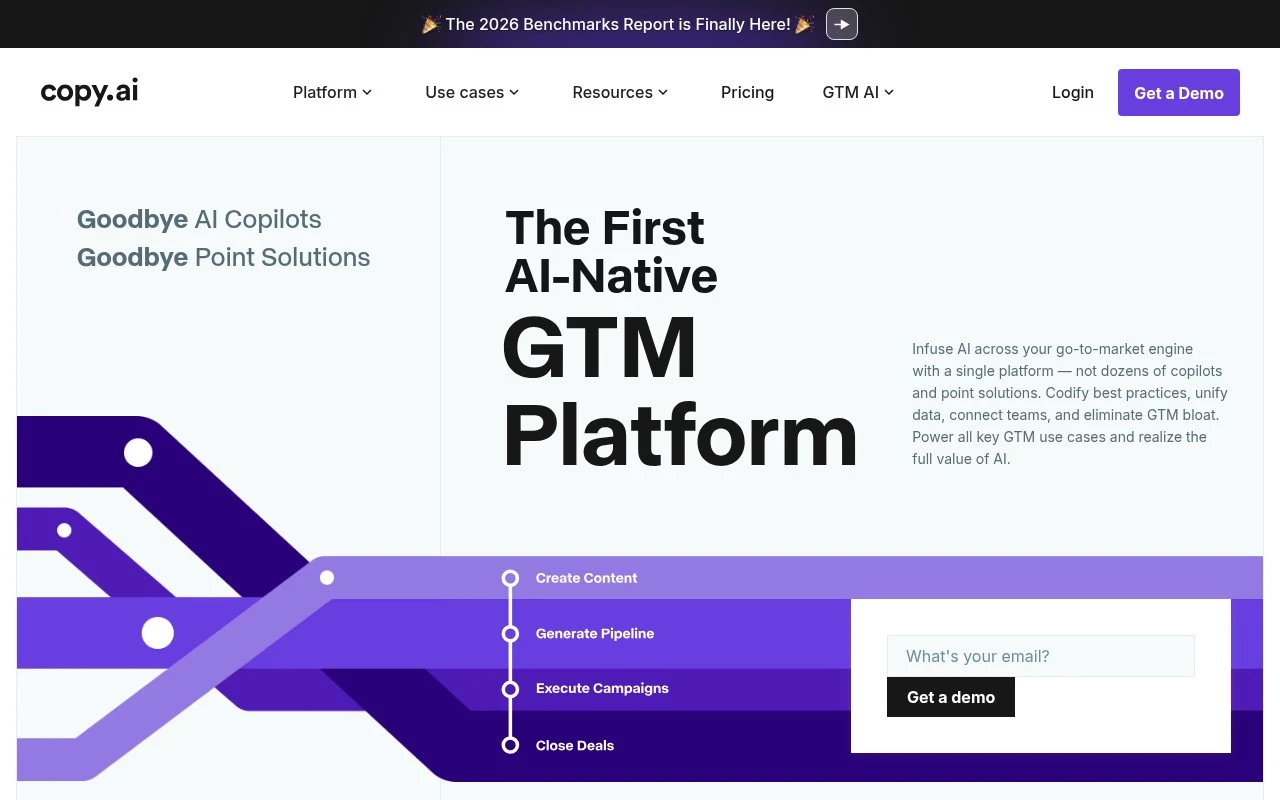
Copy AI is a GTM AI platform for sales and marketing teams that want to apply artificial intelligence across their revenue engine, not just generate isolated pieces of copy. It is designed for businesses that need repeatable workflows, connected data, brand consistency, and AI-assisted execution across prospecting, content, inbound lead handling, account-based marketing, and deal support. At its core, the platform shifts AI from a single chat box into a structured operating layer for go-to-market work. Teams can build workflows made from actions, agents, tables, integrations, chat, an infobase, and brand voice controls, allowing AI to follow defined processes rather than depend on one-off prompts. Copy AI is best at turning repeatable sales and marketing processes into AI-powered workflow automation that teams can standardise, monitor, and improve over time. Instead of asking each user to invent their own prompt, the platform helps organisations codify best practices into reusable systems for tasks such as creating sales copy, qualifying leads, preparing account research, or drafting campaign assets. For marketing teams, the product story goes well beyond basic content generation. It can support long form content creation, short form content creation, social media content creation, content repurposing, translation, and campaign drafting while keeping outputs aligned with brand voice and stored knowledge. A marketer might use it to write blog post drafts from internal context, turn a webinar into multiple content formats, or create email campaign variants for different audience segments. Sales teams use the platform as a sales enablement layer that can reduce manual research and improve consistency across outreach. It can help with prospecting workflows, account summaries, personalised messaging, inbound lead follow-up, and deal analysis. The emphasis is not simply on producing more text, but on helping revenue teams move faster with better context and fewer disconnected tools. A key part of the platform’s character is its model-agnostic AI infrastructure. Copy AI is built to work across different AI models and providers, which gives businesses more flexibility than a tool tied to one model family. This matters for teams that care about reliability, cost control, data flow, and the ability to adapt as AI models improve. The infobase and brand voice features help make the system more useful inside real organisations. Rather than relying only on public model knowledge, teams can ground outputs in product information, positioning, customer insights, company language, and internal documentation. That makes the platform better suited to business workflows where accuracy, tone, and context matter. Integrations are central to how the tool fits into a revenue stack. By connecting with systems that already hold customer, campaign, or sales data, the platform can support marketing automation and sales processes without forcing teams to constantly copy information between applications. The broader goal is to make AI part of the workflow itself, rather than a separate destination users visit after the real work has already happened. Compared with simple AI writing assistants, the platform is positioned as a more operational system for GTM teams. It still helps users draft copy, brainstorm messaging, and produce content, but its larger purpose is to coordinate actions, automate repeatable work, and give teams a common AI workspace. This makes it especially relevant for organisations that have outgrown ad hoc prompting and need more governance around how AI is used. Copy AI is a strong fit for businesses that want AI to support revenue execution across marketing, sales, and operations in a structured way. Its value lies in combining content generation, workflow design, data connection, and agentic automation into one platform, so teams can move from scattered AI experiments to more consistent go-to-market systems.

Use cases

Best for

Create Sales Copy

Copy AI generates emails, LinkedIn messages, and call scripts from a product brief, persona, and brand voice.

Marketing Automation

It runs workflow automations that route inbound leads, enrich records via integrations, and trigger follow up content.

Sales Enablement

It provides deal coaching by summarizing calls and surfacing next steps, objections, and tailored follow ups for reps.

ANALYSIS

Strengths & limitations

Strengths
  • Best suited to GTM teams because it combines writing, workflows, agents, data tables, brand voice, and knowledge management in one platform for revenue processes.
  • Useful for sales and marketing operations because it can codify repeatable tasks such as prospect research, outreach generation, lead handling, translation, and deal coaching.
  • Helpful for teams standardising AI adoption because its model-agnostic infrastructure and integrations reduce reliance on disconnected point tools.

Limitations
  • Less suitable for individuals who only need occasional copywriting because the broader GTM workflow platform can be heavier than a simple writing assistant.
  • Requires process design and connected data to get the most value, so teams without clear GTM workflows or RevOps ownership may face a setup burden.
  • Freemium access is useful for trialling the platform, but teams that need higher-volume automation, collaboration, and advanced workflow capabilities should expect to move to a paid plan.

Evaluation

FYAI score breakdown

Our structured evaluation across five key criteria

7.9 / 10

Overall score

Based on 7,574 reviews

  • Ease of use7.4 / 10
  • Features8.6 / 10
  • Pricing7.5 / 10
  • Integrations9.2 / 10
  • Support7.1 / 10

What users say

Findings from public reviews, documentation and community sources.

  • Ease of use

    Copy.ai's features page describes “Actions” that let users harness AI “without being AI experts” and a “Chat” interface for rapid one-off tasks. Copy.ai's features page also positions the product around workflows, agents, tables, and implementation.

  • Features

    Copy.ai's features page lists “Content Creation” for SEO, thought leadership, use cases and social, along with workflows, agents, tables, and Brand Voice.

  • Pricing

    Copy.ai's pricing page lists Chat at $29/mo monthly or $24/mo annually. Copy.ai's pricing page lists Growth, Expansion, and Scale at $1,000–$3,000/mo annually with workflow-credit limits.

  • Integrations

    Copy.ai's platform page states “2,000+ Integrations,” Zapier lists Copy.ai as connecting with “9000 other apps,” and Copy.ai's pricing page includes “API Access & Bulk Workflow Runs” for Enterprise.

  • Support

    Copy.ai's pricing page describes “Guided Jumpstart Implementation,” “Guided onboarding with AI experts,” and a “Designated Account & Support Team.” Trustpilot shows 1.8/5 across 196 reviews for Copy.ai and includes a complaint about reaching support by email and website form with “No response for months.”

Who is this for?

Best for GTM teams that want copy generation tied to operational workflows, Copy.ai's features page lists “Content Creation” alongside workflows, agents, tables, and Brand Voice. Less suited to users who mainly need low-cost one-off copy tasks with advanced workflow capacity, because Copy.ai's pricing page lists Chat at $29/mo monthly or $24/mo annually while Growth, Expansion, and Scale are $1,000–$3,000/mo annually with workflow-credit limits. Less suited to buyers who rely on public support reputation signals, since Trustpilot shows 1.8/5 across 196 reviews and includes a complaint about reaching support by email and website form with “No response for months.”

PRODUCT PREVIEW

Feature highlights

GTM AI Workflows

Automate prospecting, inbound, ABM, and content with repeatable flows.

Agents & Actions

Deploy AI agents to execute tasks across tools and hand off to humans.

Infobase & Tables

Ground outputs in your data, brand voice, and shared GTM knowledge.

COMPARE

Discover curated alternatives worth comparing

Compare similar AI tools based on features, pricing and use cases

7.4/ 10Based on 5 reviews

Chapterly

Copy OptimizationBlog & Article Writing
Refines narrative, characters, and settings for authors
Best for:
Content creators
Pricing
Freemium

7.5/ 10Based on 12,890 reviews

Zoominfo

Lead GenerationCRM & Segmentation
Finds prospects, enriches accounts, and flags buyer signals
Best for:
Sales teams
Pricing
Paid only

8.6/ 10Based on 6,982 reviews

Zoho CRM

Sales & OutreachAnalytics & Reporting
Rewrites emails, detects anomalies, and builds CRM modules
Best for:
Sales teams
Pricing
Freemium

Write high-converting copy in minutes, not hours. See why teams choose Copy AI to launch campaigns faster and keep messaging consistent across every channel.

FAQ

Frequently asked
questions

Everything you need to know about this AI tool,
its features, pricing, use cases, and limitations.

Who is Copy AI best for?
Copy AI is best suited for go-to-market teams that want to automate repeatable sales and marketing workflows. It is a fit for marketing, sales, revenue operations, demand generation, ABM, content, and sales leadership teams working on prospect research, outreach, lead processing, content creation, localization, and deal insights.
Is Copy AI free, and when would a team need a paid plan?
Copy AI uses a freemium pricing model, so teams can start with a free option before considering paid access. A paid plan is more relevant when multiple users need shared workflows, higher usage, integrations, company knowledge, brand voice controls, or automation across sales and marketing processes. Check copy.ai for current plan limits.
How does Copy AI compare with other AI writing and marketing automation tools?
Copy AI is broader than a standalone AI writing tool because it focuses on go-to-market workflow automation across sales and marketing. Similar tools may be stronger for narrow needs such as long-form writing, social content, or email copy, while Copy AI is better aligned with teams that need shared workflows, connected data, and repeatable GTM processes.
How much setup effort does Copy AI require?
Copy AI’s main trade-off is that it is designed around go-to-market workflows rather than general productivity or simple copywriting alone. Teams may need operational work upfront to codify processes and connect data. Buyers should also evaluate how workflow configuration, governance, quality review, and measurement will work for their specific use cases.
What should teams check before using Copy AI with customer or sales data?
Teams using Copy AI with customer, prospect, or revenue data should review its current privacy, security, and compliance documentation before deployment. Key checks include data retention, access controls, integration permissions, auditability, data processing terms, model training policies, and whether internal rules allow sensitive sales or customer information in AI-assisted workflows.