Curated ToolThis tool is part of our curated AI directory. We only include tools that meet our standards for relevance, usability and real-world value.

BuzzSumo

Generates content ideas and PR briefs from research data

Content & On-pageKeyword & Research
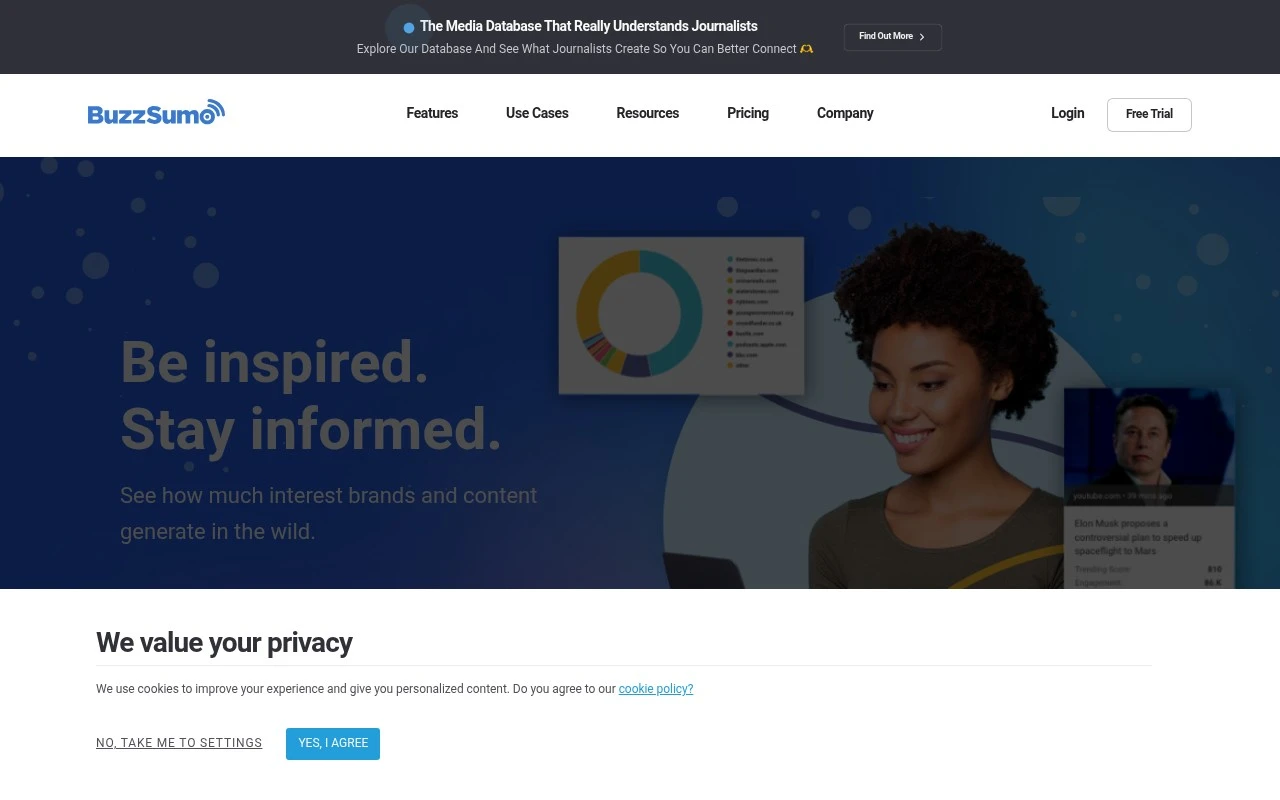
BuzzSumo helps marketing and PR teams understand what content, topics, brands, and publications are getting attention online. It combines content discovery, trend research, media monitoring, journalist outreach, influencer research, alerts, reporting, a Chrome extension, and API access. Its distinct strength is the combination of a large article archive, social engagement analysis, real-time trend monitoring, and a media database focused on active journalists.

FYAI Score

8.6 / 10

Based on 146 reviews

Pricing:

Paid

Best for:

Marketing and PR teams tracking content performance and media coverage

Score Breakdown

  • Ease of use9.0 / 10
  • Features9.1 / 10
  • Pricing7.4 / 10
  • Integrations8.6 / 10
  • Support8.5 / 10

PRODUCT PREVIEW

What this AI tool does

BuzzSumo is a research tool used to understand what content is performing well across the web and social platforms. It helps you see which topics and formats are getting attention, so you can make more informed decisions about what to publish or promote. In practice, it’s often used by content marketers, SEO teams, and PR professionals to explore trending themes, compare engagement across similar pieces, and identify potential influencers or publishers in a niche. This can support content planning, competitive research, and campaign ideation by grounding ideas in observable performance data. Because the focus is on discovery and analysis rather than content creation, buzzsumo fits best when you need context before writing, pitching, or updating a strategy. It can be useful for both quick checks on what’s resonating right now and deeper research into longer-term patterns.

Use cases

Best for

Competitor Analysis

Compare competitors by tracking their top content and social engagement in BuzzSumo, plus mentions and backlinks via alerts.

Keyword Research

Use BuzzSumo to research keywords by filtering trending topics and high engagement articles, then exporting related questions and headlines.

Content Gap Analysis

Identify content gaps by comparing which topics and formats drive engagement for competitors but have little coverage from your brand.

ANALYSIS

Strengths & limitations

Strengths
  • Combines content ideation, competitive research, monitoring, outreach, and reporting in one platform.
  • Uses a large archive of articles and social engagement data to show what content performs well by topic, URL, domain, or niche.
  • Includes PR-specific capabilities such as a journalist database, coverage reports, alerts, Slack integration, and outreach support.
Limitations
  • Pricing is oriented toward professional marketing and PR teams, with the listed annual plans starting at a relatively high monthly cost.
  • Its value depends on the availability and accuracy of indexed web, media, and social engagement data, so it may not capture every mention or private-channel interaction.
  • It supports content research and pitching, but it is not primarily a publishing, CMS, or full campaign execution platform.

Evaluation

FYAI score breakdown

Our structured evaluation across five key criteria

8.6 / 10

Overall score

Based on 146 reviews

  • Ease of use9.0 / 10
  • Features9.1 / 10
  • Pricing7.4 / 10
  • Integrations8.6 / 10
  • Support8.5 / 10

What users say

Findings from public reviews, documentation and community sources.

  • Ease of use

    G2 reports 4.5/5 from 107 reviews and says users “consistently praise BuzzSumo for its ease of use” and content analysis workflows.

  • Features

    BuzzSumo’s site lists content analysis, trending feeds, journalist/media database, and an “archive of 8bn articles worldwide.”

  • Pricing

    BuzzSumo’s pricing page lists public annual plans starting at “$199/mo” for Content Creation, then $299/mo, $499/mo, and $999/mo, with unlimited searches but plan-limited users and alerts.

  • Integrations

    BuzzSumo’s pricing page lists “Slack Integration,” RSS feed sync with apps “such as Zapier or IFTTT,” and a “BuzzSumo API”; BuzzSumo also has a Chrome extension.

  • Support

    A Reddit user evaluating BuzzSumo’s price says “their support is fantastic” after speaking with the team.

Who is this for?

Best for PR and content teams that need research plus outreach workflows, BuzzSumo’s site lists content analysis, monitoring alerts, journalist/media database, outreach, and influencer discovery. Less suited to lighter SEO/content-idea use cases, BuzzSumo’s pricing page lists public annual plans starting at “$199/mo” for Content Creation, so occasional users still need to budget for that entry plan.

PRODUCT PREVIEW

Feature highlights

Content Discovery

Find top-performing articles by topic, domain, and format fast.

Trend Monitoring

Spot rising topics in real time to plan timely, relevant content.

Journalist Database

Identify active journalists and pitch the right contacts with context.

COMPARE

Discover curated alternatives worth comparing

Compare similar AI tools based on features, pricing and use cases

7.5/ 10Based on 12.890 reviews

Zoominfo

Lead GenerationCRM & Segmentation
Find and enrich B2B leads with firmographic and contact data
Best for:
Sales teams
Pricing
Paid only

8.6/ 10Based on 6.982 reviews

Zoho CRM

Sales & OutreachAnalytics & Reporting
AI assists CRM tasks: rewrite emails, detect anomalies, predict
Best for:
Sales teams
Pricing
Freemium

8.0/ 10Based on 1.041 reviews

Zoho Campaigns

Lead GenerationCRM & Segmentation
Create, automate, and analyze email and SMS marketing campaigns
Best for:
Marketing teams
Pricing
Freemium

Join thousands of marketers using BuzzSumo to spot what’s trending and create content that earns attention, links, and shares. Start making smarter content decisions today.

FAQ

Frequently asked
questions

Everything you need to know about this AI tool,
its features, pricing, use cases, and limitations.

When is BuzzSumo the best fit compared to other SEO & GEO tools?
BuzzSumo is a strong choice if your priority is content ideation, validating topics with engagement data, and finding authors or influencers to amplify distribution. It’s especially useful for editorial planning, PR outreach, and competitive content research. If your main need is technical SEO audits or rank tracking, you’ll likely want a dedicated SEO suite alongside it.
Does BuzzSumo have a free plan, and what do you miss without paid access?
BuzzSumo typically offers limited free access (often as a trial or restricted searches), while most ongoing features require a paid subscription. Paid plans unlock deeper historical data, more searches/exports, alerts, and broader influencer and content discovery capabilities. If you need regular reporting or team workflows, free access usually won’t be sufficient.
How does BuzzSumo compare with Ahrefs, Semrush, or Similarweb for content research?
BuzzSumo is more focused on content performance signals (shares, backlinks to specific content, and trending topics) and influencer discovery than on full SEO workflows. Ahrefs and Semrush generally go deeper on keyword research, site audits, and rank tracking, while Similarweb is stronger for traffic and audience estimates. Many teams pair BuzzSumo with an SEO platform rather than using it as a replacement.
How quickly can a team get value from BuzzSumo, and what setup is required?
BuzzSumo can be expensive for small teams if you need higher usage limits, multiple users, or extensive exports. The interface and data volume can feel heavy if you only need a narrow set of metrics. It also won’t replace technical SEO tooling, so budget for additional software if you need audits, rank tracking, or deeper on-page optimization features.
What should I consider about data handling, privacy, and compliance when using BuzzSumo?
BuzzSumo primarily analyzes publicly available web and social content, but you should still review its data sources and terms to ensure they align with your organization’s compliance requirements. If you’re exporting reports or storing influencer/contact details, treat those files as personal data and apply your internal retention and access controls. For regulated environments, confirm vendor policies on data processing, storage location, and security documentation before rolling it out.