Curated ToolThis tool is part of our curated AI directory. We only include tools that meet our standards for relevance, usability and real-world value.

Tidio

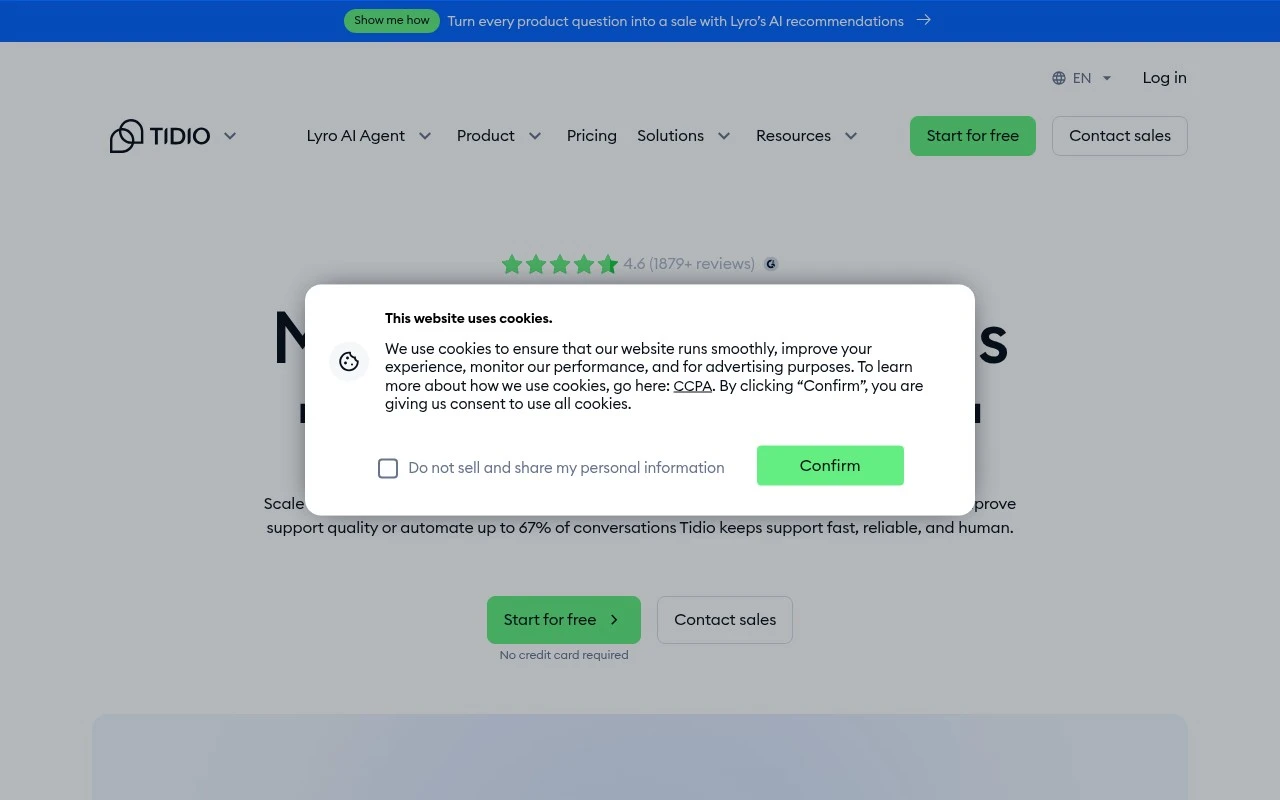
Tidio is a customer service platform that provides live chat, AI chatbots, and a shared inbox for managing website visitor and customer conversations. It helps businesses answer common questions, route messages, and support customers across channels such as website chat, email, and social messaging.
Sales & OutreachLead Generation

FYAI Score

8.9 / 10

Based on 1,907 reviews

Pricing:

Freemium

Best for:

Ecommerce and SMB support teams scaling customer service

Score Breakdown

  • Ease of use9.3 / 10
  • Features8.6 / 10
  • Pricing8.6 / 10
  • Integrations9.0 / 10
  • Support9.0 / 10

PRODUCT PREVIEW

What this AI tool does

Tidio is an AI customer service and support platform for businesses that want to answer customers faster, automate repetitive conversations, and keep human agents involved when judgement is needed. Tidio is built around Lyro AI Agent, live chat, help desk tools, and automation flows, making it especially useful for teams that need customer support automation without turning support into a fully hands-off experience. At the center of the platform is Lyro, an AI agent designed to resolve common customer questions using information a business has approved. Instead of relying on open-ended guesses, the AI is trained on verified sources such as help center content, website data, and business-specific knowledge. That positioning matters for support teams because the goal is not simply to generate answers, but to provide consistent, grounded responses that customers can trust. For growing ecommerce brands, SaaS companies, and service businesses, the platform brings several support channels into one operating space. Live chat gives visitors a direct path to a real person, while the help desk helps teams manage conversations, assign ownership, and continue discussions beyond the first message. This makes Tidio practical for companies that want AI speed at the front line, but still need team visibility and accountability behind the scenes. Automation in the platform is shaped around common customer journeys rather than isolated chatbot messages. Businesses can create flows for lead capture, order questions, product recommendations, qualification, FAQs, and handoffs to agents. This supports proactive customer engagement, where a visitor can be guided at the right moment instead of waiting until they decide to ask for help. Trustworthy AI is a major part of the product’s story. The platform is intended to reduce the burden of repetitive tickets while preserving escalation paths for cases that need human review, policy interpretation, or emotional sensitivity. In practice, this means chatbot deployment can begin with predictable use cases and expand as the company becomes more confident in the knowledge base, workflows, and customer experience. Integrations help Tidio fit into existing business systems rather than operate as a separate support island. Native connections with ecommerce, CRM, email, and support tools allow conversations to draw on customer context and send information back to the systems teams already use. For more technical teams, APIs, webhooks, JavaScript actions, and MCP support deeper customization, including tailored workflows and more advanced agent behavior. Beyond the AI agent, the broader value is operational. Managers can use the platform to reduce response times, create clearer routing, and give agents more time for complex or high-value interactions. Agents benefit when repetitive questions are handled automatically, while customers benefit from immediate answers and a smoother path to human help when needed. Tidio is best suited for businesses that want an AI-first support layer with live human backup, especially when customer conversations directly affect sales, retention, or service quality. It is not just a website widget or a simple rule-based chatbot, but a customer communication platform that combines AI resolution, live chat, help desk structure, and workflow automation. Its character is pragmatic, focused on scaling support capacity while keeping the business in control of the customer experience.

Use cases

Best for

Customer Support Automation

Tidio uses Lyro AI Agent, automation flows, and help desk routing to resolve repetitive tickets and escalate complex cases to agents.

Lead Capture

It captures leads by running website live chat that asks qualifying questions and saves visitor contact details to the inbox or CRM integrations.

Proactive Customer Engagement

It proactively engages visitors by triggering chat messages based on pages, time on site, or events, then hands off to live agents when needed.

ANALYSIS

Strengths & limitations

Strengths
  • Strong fit for SMB and ecommerce support teams because Lyro can answer repetitive questions from verified knowledge sources while escalating complex conversations to humans.
  • Useful for teams that want one support workspace because it combines an AI agent, live chat, help desk tools, automation flows, and lead capture.
  • Adaptable for growing teams because native integrations plus APIs, webhooks, JavaScript actions, and MCP allow more customized support workflows.

Limitations
  • Less suitable for teams that want to replace human support entirely because Tidio is designed to automate repetitive conversations while keeping agents involved for complex or high-priority cases.
  • Less suitable for support teams centered on phone-first or complex contact center operations because its core strengths are chat-based AI, live chat, help desk workflows, and automations.
  • The freemium model can become a constraint for higher-volume teams because broader AI usage, automation capacity, or advanced support workflows may require paid upgrades.

Evaluation

FYAI score breakdown

Our structured evaluation across five key criteria

8.9 / 10

Overall score

Based on 1,907 reviews

  • Ease of use9.3 / 10
  • Features8.6 / 10
  • Pricing8.6 / 10
  • Integrations9.0 / 10
  • Support9.0 / 10

What users say

Findings from public reviews, documentation and community sources.

  • Ease of use

    Capterra lists 590 reviews for Tidio, and one user said Tidio was “incredibly easy to set up and customise” with live chat running “without needing any technical help.” Tidio’s own page says “Add Lyro without technical knowledge.”

  • Features

    Tidio’s features page lists “Lyro AI Agent,” “Live Chat,” “Ticketing,” and “Flows” as part of its conversational-support suite.

  • Pricing

    Tidio’s pricing page lists Free at “$0/mo,” Starter at “$24.17/mo,” Growth starting at “$49.17/mo,” and Lyro AI Agent starting at “$32.50/mo,” with usage-based conversation and visitor limits shown. Tidio’s pricing page also lists higher tiers at “Starts at $749/mo” or “Contact for pricing.”

  • Integrations

    Tidio states it supports “120+ tools to integrate” and connectivity through “REST APIs, webhooks, JS actions, or Model Context Protocol (MCP).” Tidio’s pricing page references adding Lyro AI Agent to “Zendesk, Salesforce, or any other help desk software.”

  • Support

    Tidio’s pricing page says Plus includes “Live chat support” and a “Dedicated Success Manager,” while Premium adds “Slack support” and managed-service elements. A Trustpilot reviewer said setup hiccups were resolved “after a few messages with their support crew.”

Who is this for?

Best for teams that want live chat and AI support without technical setup, Capterra cites a user saying Tidio was “incredibly easy to set up and customise” and ran “without needing any technical help,” and Tidio says “Add Lyro without technical knowledge.” Less suited to teams that need a published price for every tier, Tidio’s higher tiers move to “Starts at $749/mo” or “Contact for pricing,” so budgeting those plans requires contacting Tidio.

PRODUCT PREVIEW

Feature highlights

Lyro AI Agent

Resolves repetitive chats with answers grounded in your verified content.

Live Chat + Help Desk

Handle conversations and tickets in one place with smooth agent handoff.

APIs & Webhooks

Customize flows with JS actions, integrations, and MCP-ready automation.

COMPARE

Discover curated alternatives worth comparing

Compare similar AI tools based on features, pricing and use cases

8.1/ 10FYAI score

Helply

Customer Support BotsKnowledge Base Bots
Answers tickets, drafts replies, flags gaps and churn risks
Best for:
Customer support teams
Pricing
Freemium

8.7/ 10Based on 7,757 reviews

Zoho Desk

Customer Support BotsKnowledge Base Bots
Handles routine tickets, flags issues, and drafts replies
Best for:
Customer support teams
Pricing
Freemium

7.8/ 10Based on 31,824 reviews

Zoho

Customer Support Bots
Runs business apps for sales, finance, HR, and support teams
Best for:
Operations teams
Pricing
Freemium

Turn more visitors into buyers with faster, friendlier support. Start using Tidio today to respond instantly, reduce tickets, and keep customers coming back.

FAQ

Frequently asked
questions

Everything you need to know about this AI tool,
its features, pricing, use cases, and limitations.

Who is Tidio best suited for?
Tidio is best suited for small and midsize businesses, ecommerce teams, and support teams that want to automate common customer conversations while keeping live agents available. It fits teams handling support questions, lead capture, proactive chat, help desk workflows, and routine service tasks from one platform.
Does Tidio have a free plan, and when would I need a paid plan?
Tidio uses a freemium pricing model, so teams can start with a free option and move to paid access as their needs grow. Paid plans are typically relevant when a team needs more automation capacity, AI usage, support workflow features, integrations, or higher conversation volume. Check tidio.com for current plan limits.
How does Tidio compare with other customer support automation tools?
Tidio stands out by combining an AI support agent, live chat, help desk tools, and automation flows in one customer service platform. Compared with more specialized tools, it may be easier for smaller teams to manage, but the best choice depends on support volume, integration needs, budget, and workflow complexity.
How much work does it take to set up Tidio?
Tidio’s main trade-off is that it is focused on customer support and service automation rather than being a general-purpose AI assistant. Teams with highly specialized processes may need extra configuration or technical setup, and buyers should confirm current plan limits, AI usage rules, and feature availability before committing.
What should I check about Tidio’s data handling and compliance?
Teams using Tidio for customer conversations should review how it handles support data, knowledge sources, integrations, user permissions, retention, and compliance requirements. This is especially important for businesses processing sensitive customer information. Buyers should verify current privacy, security, and compliance documentation directly on tidio.com before deployment.