Curated ToolThis tool is part of our curated AI directory. We only include tools that meet our standards for relevance, usability and real-world value.

OpusClip

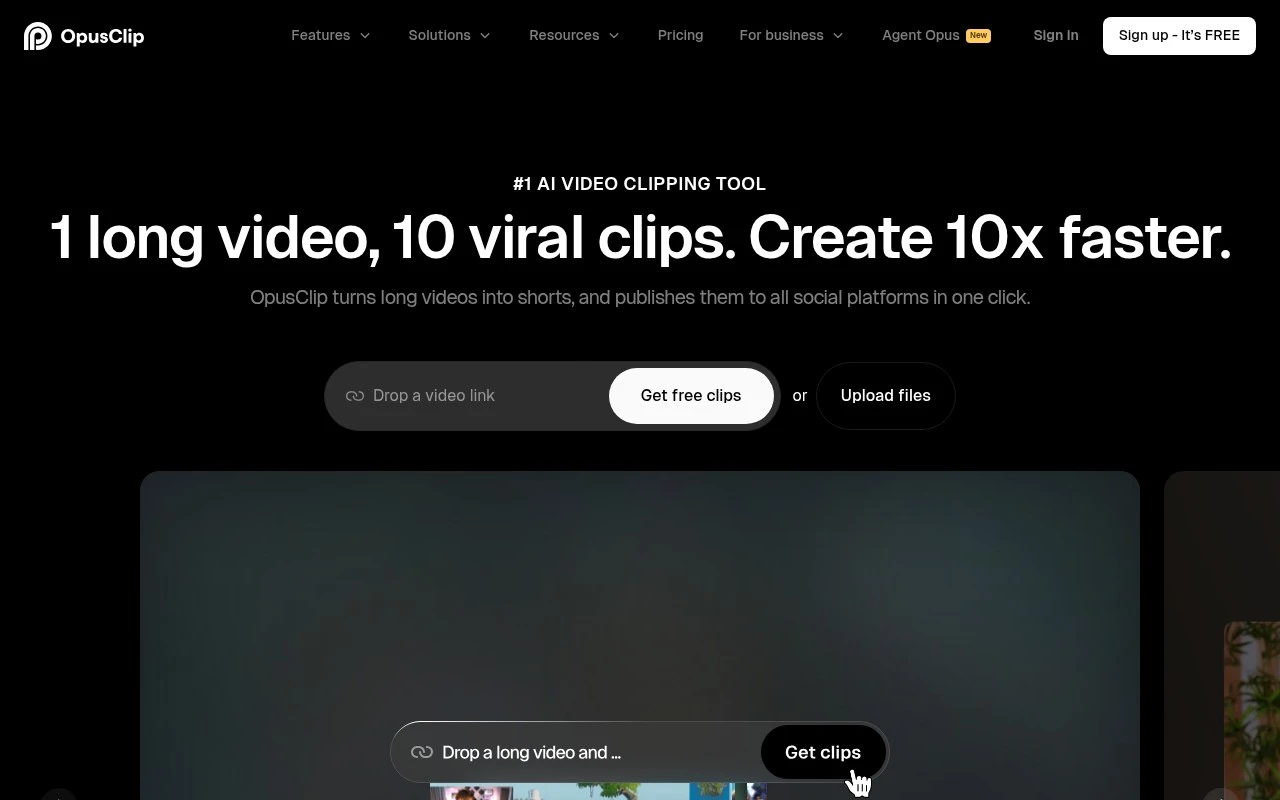
OpusClip is an AI video editing tool that turns long videos into short, shareable clips for platforms such as TikTok, YouTube Shorts, and Instagram Reels. It can identify highlight moments, reframe footage, and add captions for short-form publishing.
Content & Social

FYAI Score

8.8 / 10

Based on 450 reviews

Pricing:

Freemium

Best for:

Creators and social teams repurposing long videos into shorts

Score Breakdown

  • Ease of use8.8 / 10
  • Features8.8 / 10
  • Pricing8.9 / 10
  • Integrations9.2 / 10
  • Support8.5 / 10

PRODUCT PREVIEW

What this AI tool does

OpusClip is an AI video clipping and editing platform that turns existing long-form video into short, social-ready clips for creators, marketers, agencies, and teams. It is designed for content repurposing, especially when a podcast, webinar, interview, livestream, course, or talking-head video needs to become multiple clips for platforms such as TikTok, YouTube Shorts, Instagram Reels, and LinkedIn. At the center of the product is the idea that strong short clips are often hidden inside longer recordings. The platform uses AI models to identify potentially engaging moments, assemble them into shorter segments, and prepare them for short form video creation. Instead of starting with a blank canvas, users begin with footage they already have and let the tool suggest where the social-ready material may be. For creators and marketing teams, OpusClip is built to reduce the repetitive work involved when they edit video for distribution across channels. A user can upload or import a longer video, then review AI-generated clips, adjust text, refine timing, and export versions that fit the rhythm and format of modern feeds. The value is less about replacing editorial judgment and more about giving editors and content teams a faster first pass. Automatic reframing is one of the platform’s defining strengths. The tool can adapt horizontal or wide-format video into vertical layouts while tracking the main subject, which is especially useful for interviews, solo commentary, panels, and presentation-led content. This helps preserve attention on the speaker without requiring manual keyframing for every clip. Across different video genres, the platform is positioned around AI clipping models rather than a single generic trimming workflow. A podcast highlight, a coaching segment, a product explainer, and a webinar takeaway may all need different pacing and context, and the tool is meant to surface segments that make sense for each type of source material. OpusClip is best at content repurposing workflows where the goal is to find, format, and polish useful excerpts from existing video, not to produce a fully original video project from scratch. Team workflows give the product a more operational role for brands and agencies. Beyond generating clips, the platform supports consistent branded output through templates, captions, styling, and review-friendly editing steps. That makes it useful for organizations that want short videos to look recognizably on-brand even when multiple people are involved in the production process. The broader character of the tool is practical and distribution-focused. It does not try to be a full video production suite with every advanced timeline, compositing, or animation feature. Instead, it sits between raw long-form content and the publishing pipeline, helping users turn a single recording into many pieces of usable social content. In practice, OpusClip serves people who already have video assets and need a faster way to extract value from them. It is most relevant when consistency, volume, and speed matter, such as maintaining a creator channel, supporting a podcast, feeding a brand’s social calendar, or helping an agency deliver recurring clips for clients. The platform’s story is therefore one of repurposing at scale, using AI to compress the path from long-form video to polished short-form output.

Use cases

Best for

Content Repurposing

OpusClip turns long videos into social-ready clips by detecting highlights and auto-reframing with subject tracking.

Edit Video

Edit video by trimming clips, adding captions, and adjusting framing with automatic subject tracking for vertical formats.

Short Form Video Creation

Create short form video by generating vertical clips from existing footage with AI clipping, captions, and brand templates.

ANALYSIS

Strengths & limitations

Strengths
  • Well suited to creators repurposing long-form content because AI clipping helps surface usable highlights and reduces manual review time.
  • Strong fit for short-form social workflows because automatic reframing and subject tracking help adapt existing footage for vertical formats.
  • Useful for teams that need repeatable branded output because its workflow features support more consistent clip production across multiple videos.

Limitations
  • Less suitable for teams that need to create videos from scratch because it is primarily built around repurposing existing footage rather than full video production.
  • Less suitable for highly nuanced editorial storytelling because automated clip selection still needs human review for context, pacing, and brand voice.
  • The freemium model can constrain high-volume or team workflows because heavier usage and advanced workflow needs are better aligned with paid access.

Evaluation

FYAI score breakdown

Our structured evaluation across five key criteria

8.8 / 10

Overall score

Based on 450 reviews

  • Ease of use8.8 / 10
  • Features8.8 / 10
  • Pricing8.9 / 10
  • Integrations9.2 / 10
  • Support8.5 / 10

What users say

Findings from public reviews, documentation and community sources.

  • Ease of use

    G2 shows a 4.6/5 rating across 118 reviews, and the G2 review summary says users “consistently praise the ease of use and time-saving capabilities” and the ability to “quickly transform long videos” into clips. OpusClip’s product positioning emphasizes “1 click” clipping and clips taking “minutes” instead of days.

  • Features

    The OpusClip pricing page lists AI clipping, AI copilot, virality score, and animated captions. The OpusClip pricing page also lists multi-language transcription, AI reframe, dubbing, and publishing tools.

  • Pricing

    The OpusClip pricing page lists visible tiers: Free at $0, Starter at $15/mo, Pro at $29/mo, and Business as custom. The OpusClip pricing page compares feature limits, exports, storage, and AI capabilities across plans.

  • Integrations

    The OpusClip pricing page names Video Editing API, Scheduler API, MCP connector, and Zapier integration. Zapier states OpusClip connects with “9000 other apps,” and the OpusClip pricing page names exports to Adobe Premiere Pro and DaVinci Resolve.

  • Support

    The OpusClip pricing page lists “Customer support” and “Discord AI chat” in the plan comparison. The OpusClip pricing page says Business adds “Custom onboarding,” MSA, invoice/ACH options, SSO, SLM, and SOC II Type 2 compliance.

Who is this for?

Best for teams turning long videos into social clips, G2 says users praise the ability to “quickly transform long videos” into clips, and OpusClip positions clipping as “1 click” with clips taking “minutes” instead of days. Best for workflows needing automation and publishing connections, the pricing page names API options and Zapier states OpusClip connects with “9000 other apps.” Less suited to buyers needing fixed enterprise pricing upfront, the pricing page lists Business as custom, so final business costs require a custom quote.

PRODUCT PREVIEW

Feature highlights

AI Clip Finder

Detects key moments and turns long videos into short clips fast

Auto Reframe & Track

Keeps the subject centered with smart reframing for any format

Brand Workflow Tools

Templates and review flows for consistent, team-ready output

COMPARE

Discover curated alternatives worth comparing

Compare similar AI tools based on features, pricing and use cases

8.5/ 10Based on 16 reviews

Wondercraft

Short-form VideoVideo Editing
Creates editable videos and audio from text, prompts, media
Best for:
Video creators
Pricing
Freemium

8.5/ 10Based on 65 reviews

Wisecut

Short-form VideoVideo Editing
Finds highlights, removes pauses, captions and reframes clips
Best for:
Video creators
Pricing
Freemium

8.6/ 10Based on 2,521 reviews

Vizard.ai

Short-form VideoVideo Editing
Extracts short clips, adds captions, and resizes videos
Best for:
Social media managers
Pricing
Freemium

Turn long videos into scroll-stopping clips in minutes. Start posting more consistently and grow engagement with OpusClip today.

FAQ

Frequently asked
questions

Everything you need to know about this AI tool,
its features, pricing, use cases, and limitations.

Who is OpusClip best suited for?
OpusClip is best suited for creators, marketers, media teams, podcasters, and businesses that want to turn existing long-form videos into short social clips. It is especially relevant for teams repurposing podcasts, interviews, vlogs, gaming, sports, or explainer videos for platforms like YouTube Shorts and TikTok.
Does OpusClip have a free plan, and when would I need a paid plan?
OpusClip uses a freemium pricing model, so users can typically start with limited free access and upgrade for more capacity or workflow features. Paid usage is more relevant for teams that publish frequently, need repeatable brand templates, collaborate in workspaces, or want automation through API-based workflows.
How does OpusClip compare with other short-form video tools?
OpusClip focuses on repurposing existing videos into short clips rather than creating original video from text. Compared with similar tools, its fit depends on whether you need AI clip selection, reframing, object tracking, templates, team workflows, and automation, or whether you mainly need manual editing control.
How quickly can a team get started with OpusClip?
OpusClip is not primarily a tool for generating original videos from text, because it depends on existing source video to repurpose. AI-selected clips and reframed outputs may still need human review to check context, pacing, captions, visual framing, brand fit, and platform-specific quality.
What privacy or compliance questions should buyers ask before using OpusClip?
Buyers should review how OpusClip handles uploaded videos, generated clips, team access, retention, and API-based processing before using it with sensitive content. Teams in regulated industries should confirm current security practices, data processing terms, permissions, and compliance documentation directly with OpusClip before rollout.