Curated ToolThis tool is part of our curated AI directory. We only include tools that meet our standards for relevance, usability and real-world value.

Attentive

Uses AI to personalize and automate messaging across SMS and email

Sales & OutreachCRM & Segmentation
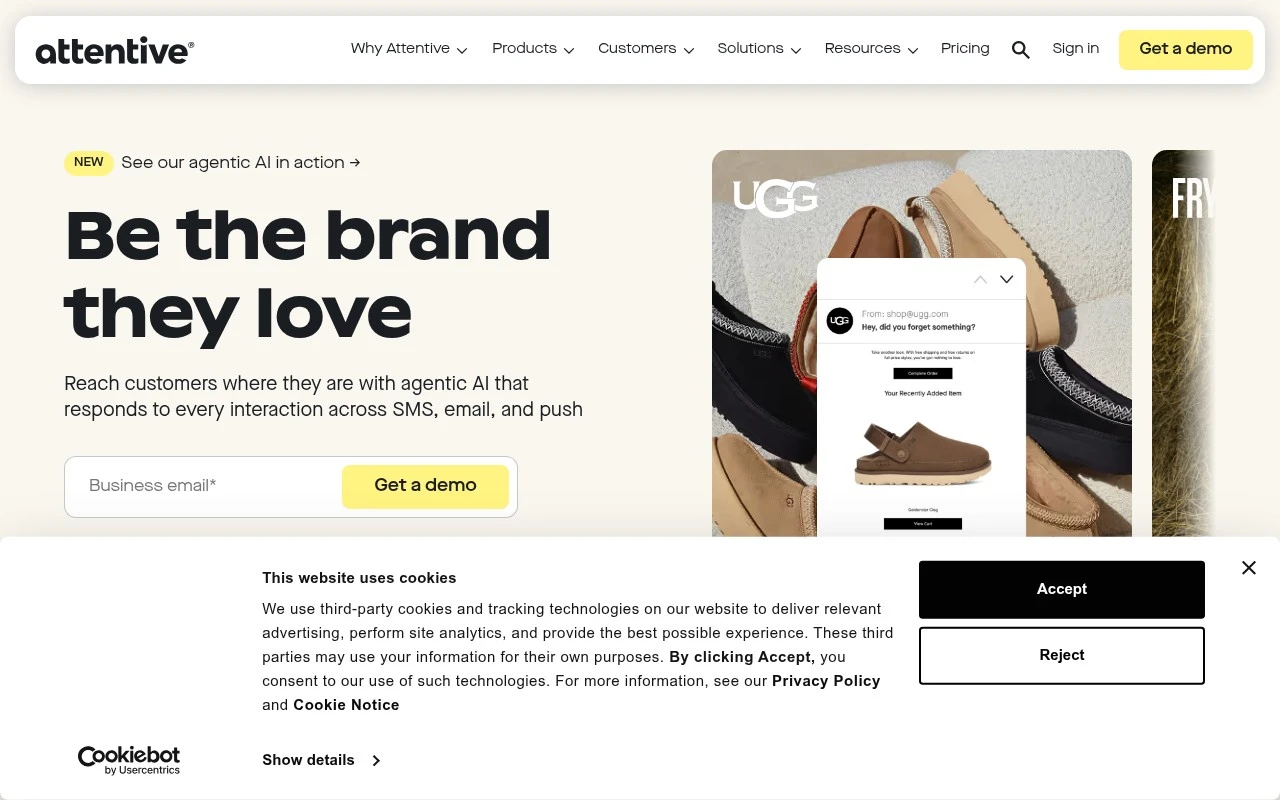
Attentive is an AI-powered SMS and email marketing platform that also supports RCS and push notifications. It is built for brands that want to identify customers across channels, grow opt-in subscriber lists, personalize messages, automate journeys, and report on revenue and engagement from owned messaging programs.

FYAI Score

8.7 / 10

Based on 1.383 reviews

Pricing:

Paid only

Best for:

Ecommerce marketing teams growing revenue with SMS and email

Score Breakdown

  • Ease of use8.7 / 10
  • Features9.1 / 10
  • Pricing7.6 / 10
  • Integrations9.1 / 10
  • Support9.1 / 10

PRODUCT PREVIEW

What this AI tool does

Attentive is an AI tool designed to help users work through information and tasks with less manual effort. It can be used to interpret prompts, generate or refine text, and support everyday workflows where clarity and consistency matter. Because the main use case is not specified, the tool is best understood as a general-purpose assistant that adapts to different contexts. Depending on what you provide, it may help summarize content, draft responses, reorganize notes, or suggest improvements to existing writing. For informational needs, it’s useful to approach attentive by testing it with a few real examples from your work and checking the output for accuracy and tone. As with any AI system, results depend on the quality of the input and may require review before you rely on them.

Use cases

Best for

Marketing Automation

Attentive automates SMS, email, RCS, and push journeys with triggers, personalization, and revenue reporting.

Customer Segmentation

Build segments by channel behavior, engagement, and purchase signals to target messages across SMS and email.

Lead Capture

Capture opt-ins with on-site sign-up units and forms that add subscribers to SMS and email lists with consent.

ANALYSIS

Strengths & limitations

Strengths
  • Combines SMS, email, RCS, and push messaging in one omnichannel marketing platform.
  • Includes AI features for using customer signals, generating on-brand message content, and personalizing campaigns.
  • Emphasizes identity resolution, compliance tooling, deliverability, reporting, integrations, and hands-on support.
Limitations
  • Best suited to brands with active subscriber lists and customer data; it is not a general-purpose marketing or advertising platform.
  • Pricing depends on message volume and subscriber list size, so costs may scale with program growth.
  • The public site describes capabilities at a high level and does not provide enough detail to verify every AI workflow or automation limit.

Evaluation

FYAI score breakdown

Our structured evaluation across five key criteria

8.7 / 10

Overall score

Based on 1.383 reviews

  • Ease of use8.7 / 10
  • Features9.1 / 10
  • Pricing7.6 / 10
  • Integrations9.1 / 10
  • Support9.1 / 10

What users say

Findings from public reviews, documentation and community sources.

  • Ease of use

    SoftwareAdvice lists Attentive at 4.8/5 across 108 reviews, and a highlighted user quote says, "Attentive is very user-friendly" and describes it as a "turnkey" SMS marketing solution.

  • Features

    Attentive’s pricing page lists marketing channels including "SMS, email, RCS, and push," plus AI and unified customer identity.

  • Pricing

    Attentive’s pricing page says plans are based on "message volume, subscriber list size, number of channels, and AI products selected," with "usage-based pricing" and free trials. Attentive’s pricing page describes rates as "custom pricing" rather than listed public plan prices.

  • Integrations

    Attentive’s integrations page states it offers "100+ integrations," and Attentive’s pricing page states it offers "150+ pre-built integrations" plus "flexible APIs" for custom builds.

  • Support

    Attentive’s pricing page says all plans include "Strategic Support," "Onboarding and deliverability," a "Dedicated support team," and "24/5 service." Attentive’s pricing page says priority support and a dedicated customer success manager are available in the full package.

Who is this for?

Best for marketing teams that need messaging across SMS, email, RCS, and push, Attentive’s pricing page lists those channels and also references AI and unified customer identity. Less suited to buyers who need public fixed-tier prices before evaluation, Attentive’s pricing page describes rates as "custom pricing" based on message volume, subscriber list size, number of channels, and AI products selected.

PRODUCT PREVIEW

Feature highlights

Opt-in Growth Tools

Capture SMS/email subscribers with popups, forms, and sign-up units.

AI Personalization

Tailor messages by behavior and profile data to lift conversion.

Revenue Reporting

Track engagement and attributed sales across SMS, email, and more.

COMPARE

Discover curated alternatives worth comparing

Compare similar AI tools based on features, pricing and use cases

7.5/ 10Based on 12.890 reviews

Zoominfo

Lead GenerationCRM & Segmentation
Find and enrich B2B leads with firmographic and contact data
Best for:
Sales teams
Pricing
Paid only

8.6/ 10Based on 6.982 reviews

Zoho CRM

Sales & OutreachAnalytics & Reporting
AI assists CRM tasks: rewrite emails, detect anomalies, predict
Best for:
Sales teams
Pricing
Freemium

8.0/ 10Based on 1.041 reviews

Zoho Campaigns

Lead GenerationCRM & Segmentation
Create, automate, and analyze email and SMS marketing campaigns
Best for:
Marketing teams
Pricing
Freemium

Turn subscribers into repeat buyers with personalized messaging that performs. See why leading ecommerce brands choose attentive to grow revenue and loyalty.

FAQ

Frequently asked
questions

Everything you need to know about this AI tool,
its features, pricing, use cases, and limitations.

What types of marketing teams and use cases is attentive a good fit for?
attentive is best for B2C brands running subscriber-based messaging programs across SMS and other owned channels, especially for lifecycle flows like welcome, browse/cart abandonment, and post-purchase. It’s a stronger fit when you want coordinated messaging across SMS, email, RCS, and push rather than managing each channel in separate tools. If your primary need is sales outreach, internal comms, or basic newsletter email, other platforms may be a better match.
Does attentive offer a free plan, and what drives the cost on paid plans?
attentive doesn’t typically publish a simple self-serve free plan; pricing is usually quote-based. Costs commonly depend on message volume and subscriber list size, plus any add-ons tied to channels or services. If you need predictable month-to-month pricing without a sales process, compare against tools with public tiers.
How does attentive compare with other SMS and omnichannel marketing platforms?
Compared with SMS-first tools, attentive is positioned more as an omnichannel messaging platform that also supports email, RCS, and push in one place. Versus email-first suites, it tends to be more focused on mobile messaging performance, deliverability, and compliance workflows for texting. Your best choice depends on whether SMS is a primary revenue channel and how tightly you need cross-channel orchestration.
How quickly can you implement attentive, and what onboarding work should you expect?
attentive is most effective when you have strong first-party data and a clear channel strategy; without that, personalization and automation benefits can be limited. It’s also not designed as a general-purpose email platform or outbound sales tool, so you may still need other systems for those workflows. Budgeting can be harder upfront because pricing is tied to usage and list size rather than a fixed plan.
What should you evaluate around data privacy, consent, and compliance with attentive?
Because attentive supports SMS and other direct channels, you should confirm how it manages consent capture, opt-out handling, and auditability for your regions and use cases. Review data retention, identity resolution behavior, and what customer attributes are used for segmentation and personalization. Also validate deliverability and compliance tooling aligns with your legal requirements (e.g., TCPA/CTIA practices in the US) and your internal governance.