Curated ToolThis tool is part of our curated AI directory. We only include tools that meet our standards for relevance, usability and real-world value.

Triple Whale

Analyzes ecommerce data to guide and generate marketing actions

Sales & OutreachCRM & Segmentation
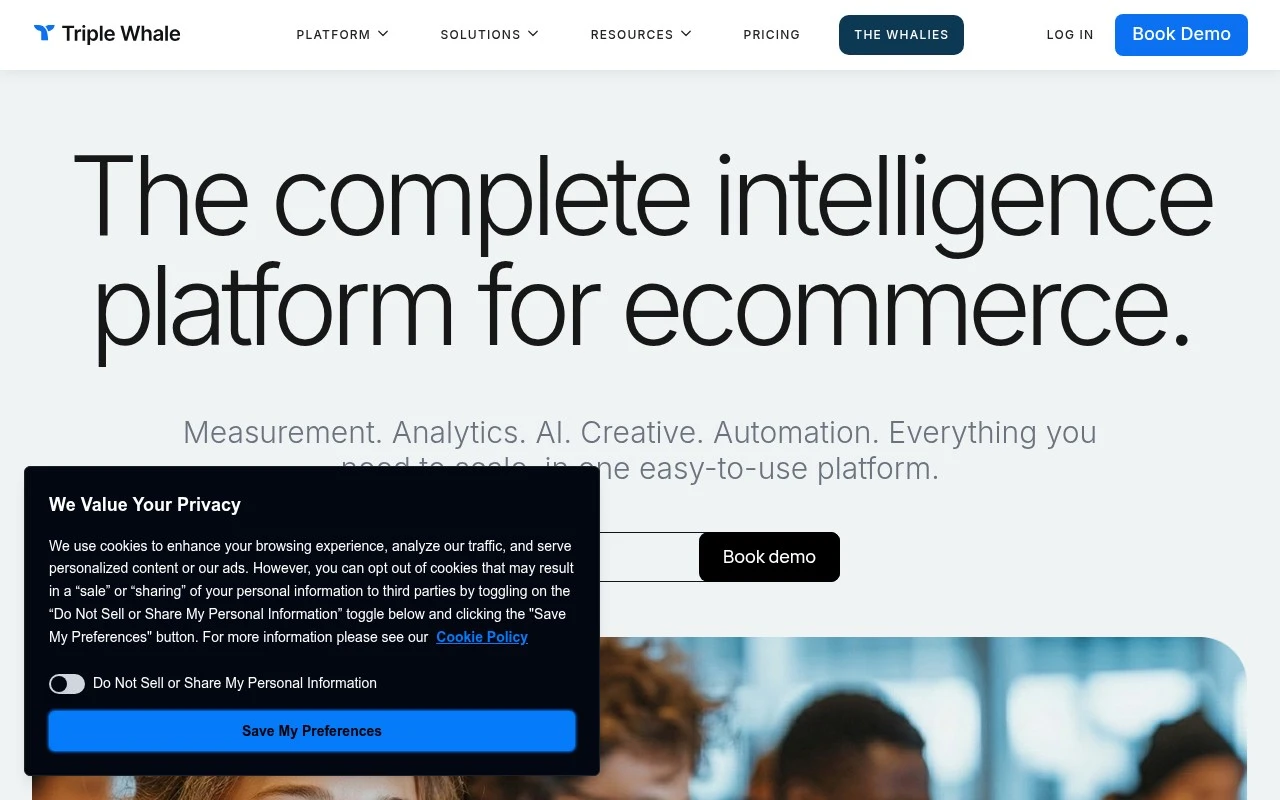
Triple Whale is built for modern ecommerce teams that need a shared operating layer for data, measurement, AI analysis, and action. Its platform connects data from commerce, marketing, sales, and operations systems, then turns that data into ecommerce-focused dashboards, attribution signals, reports, and activation workflows. Its AI layer, Moby 2, is positioned as an ecommerce operator that works from live business context rather than as a generic chatbot.

FYAI Score

8.2 / 10

Based on 481 reviews

Pricing:

Paid only

Best for:

DTC ecommerce teams needing unified measurement and action

Score Breakdown

  • Ease of use7.3 / 10
  • Features8.9 / 10
  • Pricing8.5 / 10
  • Integrations8.5 / 10
  • Support8.0 / 10

PRODUCT PREVIEW

What this AI tool does

Triple Whale is an analytics and attribution tool designed to help teams understand how their marketing and sales efforts translate into revenue. It brings performance data into a single view so you can compare channels, track key metrics over time, and reduce the guesswork that comes from relying on multiple dashboards. The platform is commonly used by ecommerce brands and agencies that need clearer reporting on customer acquisition and retention. By connecting data sources such as ad platforms and store activity, it supports more consistent decision-making around budget allocation, campaign evaluation, and overall business performance. If you’re researching tools for informational purposes, triplewhale can be useful to evaluate when you want a more unified approach to attribution and reporting, especially when standard platform reports don’t align. It’s typically assessed alongside other analytics solutions based on data integrations, reporting needs, and how teams prefer to measure profitability.

Use cases

Best for

Business Intelligence

Triple Whale unifies ecommerce, ad, and ops data into dashboards and reports for shared business performance tracking.

Analyze Data

It connects marketing and commerce sources, then analyzes attribution and performance signals to explain revenue changes.

Customer Segmentation

It builds customer segments from order and marketing data so you can activate audiences in connected ad platforms.

ANALYSIS

Strengths & limitations

Strengths
  • Purpose-built for ecommerce measurement and marketing performance rather than general-purpose analytics.
  • Combines data unification, business intelligence, attribution, audience activation, and AI workflows in one platform.
  • Moby 2 can use connected business context to support practical ecommerce tasks such as ad campaign management, creative generation, reporting, customer segmentation, and forecasting.
Limitations
  • Best suited to ecommerce businesses; it is not positioned as a general analytics or AI platform for all industries.
  • Its usefulness depends on connecting the relevant commerce, marketing, sales, and operational systems and maintaining reliable data inputs.
  • Some claims around performance lift, ROI, and AI execution are marketing claims from the vendor and should be validated against a specific brand’s stack and workflow.

Evaluation

FYAI score breakdown

Our structured evaluation across five key criteria

8.2 / 10

Overall score

Based on 481 reviews

  • Ease of use7.3 / 10
  • Features8.9 / 10
  • Pricing8.5 / 10
  • Integrations8.5 / 10
  • Support8.0 / 10

What users say

Findings from public reviews, documentation and community sources.

  • Ease of use

    Triple Whale says users can “connect every platform and channel… in minutes, not hours” with “No data mapping.” On Reddit, a user described Triple Whale as “super bloated” for narrower attribution needs.

  • Features

    Triple Whale’s site says the product covers real-time business data, attribution, dashboards, and reporting. Triple Whale’s site describes Moby handling “channel budget reallocations, creative briefs, audience suggestions, lifecycle triggers, inventory recommendations,” plus image/video generation and live campaign actions.

  • Pricing

    Triple Whale’s pricing page lists Free at “$0/month,” Foundation at “$219/month,” Automate at “$749/month,” and Enterprise via sales. Triple Whale’s pricing page also references annual billing with “two months free.”

  • Integrations

    Triple Whale’s site claims “60+ integrations across ecommerce and retail” and lists coverage for “Ecommerce Platforms, Marketing Channels, and Amazon.” Triple Whale’s site gives examples across Meta, Google, TikTok, Klaviyo, Shopify, Slack, and custom enterprise integrations.

  • Support

    Triple Whale’s pricing page includes “Weekly Product Training Sessions,” and Enterprise includes “custom onboarding & migration” plus “dedicated success coverage.”

Who is this for?

Best for ecommerce teams managing multiple channels, Triple Whale claims “60+ integrations across ecommerce and retail” across “Ecommerce Platforms, Marketing Channels, and Amazon,” so store and marketing-channel data can be connected in one platform. Less suited to teams with narrower attribution needs, on Reddit, a user described Triple Whale as “super bloated,” which can mean extra product surface area to work through.

PRODUCT PREVIEW

Feature highlights

Unified data layer

Connect commerce, ads, ops, and sales data into one source of truth.

Attribution & signals

Get ecommerce-focused attribution to guide spend and channel strategy.

Moby 2 AI operator

Ask questions on live business context and get actionable insights.

COMPARE

Discover curated alternatives worth comparing

Compare similar AI tools based on features, pricing and use cases

7.5/ 10Based on 12.890 reviews

Zoominfo

Lead GenerationCRM & Segmentation
Find and enrich B2B leads with firmographic and contact data
Best for:
Sales teams
Pricing
Paid only

8.6/ 10Based on 6.982 reviews

Zoho CRM

Sales & OutreachAnalytics & Reporting
AI assists CRM tasks: rewrite emails, detect anomalies, predict
Best for:
Sales teams
Pricing
Freemium

8.0/ 10Based on 1.041 reviews

Zoho Campaigns

Lead GenerationCRM & Segmentation
Create, automate, and analyze email and SMS marketing campaigns
Best for:
Marketing teams
Pricing
Freemium

See what’s really driving revenue across your store. Start using Triple Whale today to make faster, smarter marketing decisions with confidence.

FAQ

Frequently asked
questions

Everything you need to know about this AI tool,
its features, pricing, use cases, and limitations.

When is Triple Whale a good fit, and when should I pick a simpler analytics tool?
Triple Whale is best for Shopify-first e-commerce teams that need channel attribution, LTV/cohort views, and daily decision dashboards across paid media. It’s a stronger fit once you’re spending enough on ads that misattribution is costly. If you mainly need basic GA4 reporting or a lightweight dashboard, a simpler tool may be easier to maintain.
Does Triple Whale have a free plan, and what do paid tiers typically unlock?
Triple Whale is generally positioned as a paid product, with pricing tied to store scale and feature access rather than a robust free tier. Paid plans typically unlock deeper attribution views, more advanced reporting (e.g., cohorts/LTV), and additional integrations or seats. If you need a long-term free option, you’ll likely end up relying on native platform analytics instead.
How does Triple Whale compare with Northbeam, GA4, or Shopify’s built-in analytics?
Compared with GA4 and Shopify analytics, Triple Whale is more commerce-operator focused, with clearer paid channel performance views and LTV-style reporting in one place. Versus Northbeam, the decision often comes down to preferred attribution methodology, reporting workflows, and which ad platforms/connectors you rely on most. If your team lives in GA4 and only needs web analytics, Triple Whale may feel redundant.
How long does it take to set up Triple Whale, and what onboarding work should I expect?
There’s a learning curve if you’re not used to attribution concepts, and different models can produce numbers that don’t match platform-reported ROAS. Cost can be a hurdle for smaller brands, especially if you only need a few core reports. If you run on a niche commerce stack, integration coverage may be a deciding constraint.
What should I check about data handling, privacy, and compliance when using Triple Whale?
Confirm which customer and order fields Triple Whale ingests from your store and ad accounts, and whether any data is used for product improvement or shared with subprocessors. Review data retention, deletion workflows, and access controls (roles, SSO if available) to match your internal policies. If you operate in regulated regions, verify the vendor’s DPA, hosting details, and how consent/PII is handled in reporting.