Curated ToolThis tool is part of our curated AI directory. We only include tools that meet our standards for relevance, usability and real-world value.

Segmentify

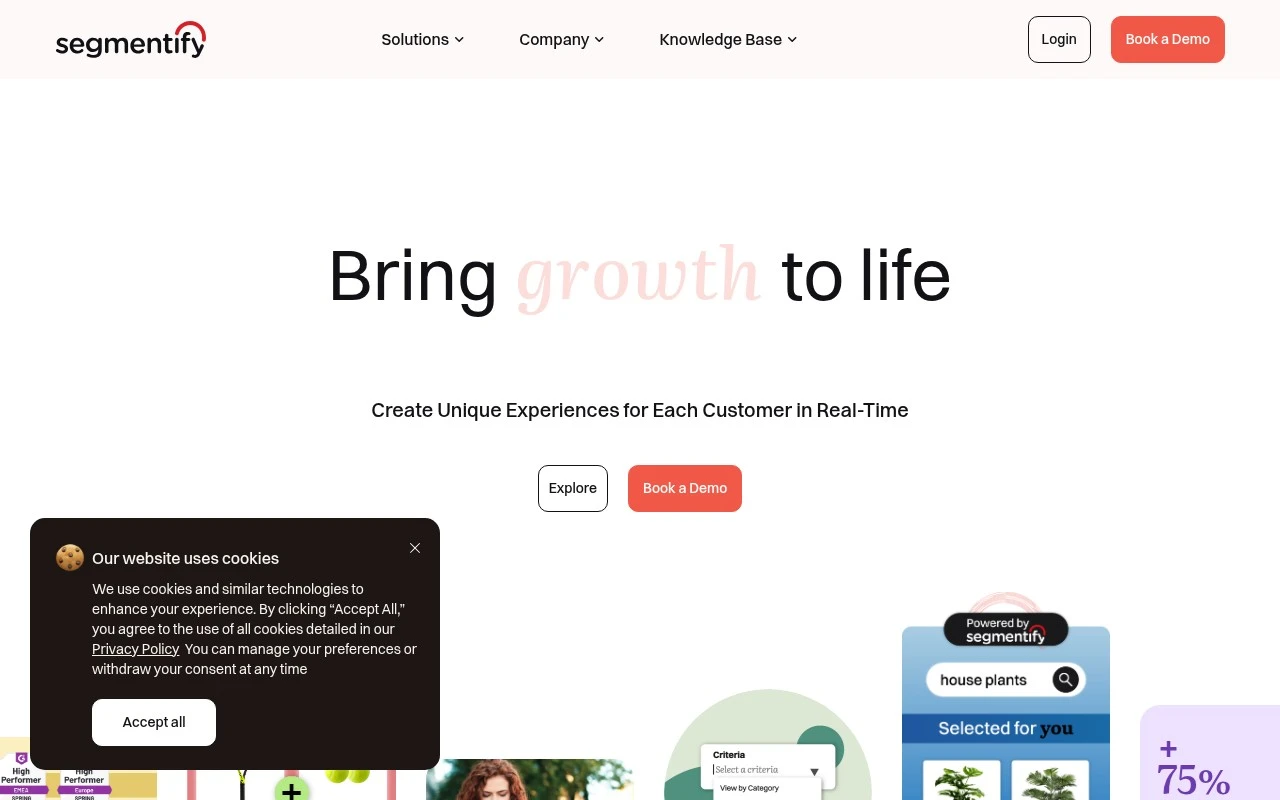
Segmentify is an AI-powered e-commerce personalization platform that provides product recommendations, personalized search, and customer segmentation based on shopper behavior. It helps online retailers tailor site experiences and marketing messages to different customer groups.
Sales & OutreachCRM & Segmentation

FYAI Score

8.1 / 10

Based on 73 reviews

Pricing:

Enterprise

Best for:

E-commerce teams optimizing on-site personalization and revenue

Score Breakdown

  • Ease of use8.6 / 10
  • Features7.6 / 10
  • Pricing7.2 / 10
  • Integrations8.3 / 10
  • Support9.4 / 10

PRODUCT PREVIEW

What this AI tool does

Segmentify is an AI-powered e-commerce personalisation platform for online retailers that want to tailor product discovery, recommendations, search, and on-site experiences in real time. Segmentify is best at helping merchants use customer segmentation and behavioural data to improve conversion rate optimization, average order value, retention, and customer lifetime value. It is positioned less as a single widget and more as a customer journey layer that reacts to what each shopper is doing as they browse. For online retailers, the main value is relevance at the moment of intent. A visitor who lands on a category page, searches for a product, abandons a basket, or returns after a previous session can be treated differently based on context. The platform brings those signals together so the store can show more suitable products, messages, and incentives without relying only on static merchandising rules. Real-time personalisation sits at the centre of the product story. Product recommendations can adapt to browsing behaviour, purchase history, trends, stock priorities, or similarities between shoppers. Instead of showing the same bestsellers to everyone, the tool helps retailers present items that are more likely to fit a particular customer, which is especially useful for fashion, beauty, electronics, homeware, and other catalogue-heavy stores. Search and discovery are also part of how the platform shapes the buying journey. Personalised search can help shoppers get to relevant products faster, while recommendation placements can support cross-sell and upsell moments across home pages, product pages, basket pages, and email or campaign flows. This makes Segmentify useful not only for finding products, but for guiding the route from interest to purchase. Customer segmentation gives teams a way to move beyond broad audience assumptions. Retailers can group visitors by behaviour, lifecycle stage, purchase intent, preferences, or engagement patterns, then use those segments to tailor campaigns and on-site experiences. In practice, this can support anything from rewarding loyal customers to recovering hesitant shoppers or improving lead capture for visitors who are not ready to buy yet. Gamified experiences add a more interactive layer to the platform. Rather than relying only on banners or pop-ups, retailers can use mechanics such as incentives, progress-based prompts, or engagement campaigns to encourage sign-ups, repeat visits, and purchases. Used carefully, these experiences can make lead capture and retention feel more contextual rather than interruptive. Analytics helps explain whether personalisation is improving commercial outcomes. Teams can monitor how recommendations, segments, searches, and campaigns affect engagement and revenue, then refine their approach over time. This feedback loop is important because the platform is not just about adding AI to a storefront, it is about continuously learning which experiences move shoppers closer to purchase. In practice, Segmentify fits e-commerce teams that want a specialised personalisation and conversion layer without building recommendation engines, segmentation logic, and testing infrastructure from scratch. It is most relevant for retailers with enough traffic and catalogue depth to benefit from behavioural targeting. For those businesses, the platform’s character is clear: it turns customer data into real-time retail experiences that feel more individual, measurable, and commercially focused.

Use cases

Best for

Product Recommendations

Segmentify serves real time product recommendations on pages like home, category, and cart using shopper behavior and product data.

Conversion Rate Optimization

It runs personalized search, banners, and gamified widgets that adapt per visitor to test and lift on site conversion flows.

Customer Segmentation

It builds customer segments from browsing, purchase, and engagement events so campaigns and onsite content target specific cohorts.

ANALYSIS

Strengths & limitations

Strengths
  • Strong fit for product-led online retailers because it combines recommendations, personalised search, segmentation, analytics, and engagement tools around the e-commerce buying journey.
  • Useful for conversion and retention teams because real-time personalisation can adapt product discovery and offers to shopper behaviour during the session.
  • Well suited to retailers with broad catalogues because automated recommendations and search optimisation help surface relevant products without relying only on manual merchandising.

Limitations
  • Less suitable for non-retail, service-based, or content-led businesses because its capabilities are centred on product catalogues, shopping behaviour, and e-commerce conversion goals.
  • Custom pricing makes it less convenient for teams that need instant plan comparison or fixed public costs before speaking with sales.
  • Smaller or early-stage stores may face more setup effort than they need because meaningful personalisation depends on catalogue data, behavioural tracking, and enough traffic to optimise experiences.

Evaluation

FYAI score breakdown

Our structured evaluation across five key criteria

8.1 / 10

Overall score

Based on 73 reviews

  • Ease of use8.6 / 10
  • Features7.6 / 10
  • Pricing7.2 / 10
  • Integrations8.3 / 10
  • Support9.4 / 10

What users say

Findings from public reviews, documentation and community sources.

  • Ease of use

    G2’s 73-review product page says users “consistently praise the ease of use” and note how quickly they can implement Segmentify. Segmentify’s own pricing FAQ says integration experts handle setup and users do not need to be tech-savvy.

  • Features

    Segmentify’s site describes an ecommerce customer-engagement platform with real-time personalisation, product recommendations, personalised search, and cross-channel marketing.

  • Pricing

    Segmentify’s pricing page presents an Opportunity Analysis/contact-sales model, a 14-day free trial, annual plans, and three product lines: Growth Solution, Search & Discovery, and Cross-Channel Marketing. Segmentify’s pricing page handles pricing through sales conversations rather than published plan amounts.

  • Integrations

    Slashdot lists Segmentify integrations including Klaviyo, Shopify, Magento, BigCommerce, PrestaShop, dotdigital Engagement Cloud, Styla, and Mailchimp Transactional Email. Segmentify developer documentation references custom integration via REST API and React-Native integration.

  • Support

    G2’s review summary says users consistently praise Segmentify’s “responsive support.” Segmentify’s product page describes a Dedicated Success Manager, review meetings, video calls with the Success Team, and daily optimisation by the Success Team.

Who is this for?

Best for ecommerce teams that want personalisation and discovery tools, Segmentify’s site describes real-time personalisation, product recommendations, personalised search, and cross-channel marketing. Best for teams that want guided onboarding, Segmentify’s pricing FAQ says integration experts handle setup and users do not need to be tech-savvy. Less suited to buyers who need published plan amounts before contacting sales, Segmentify’s pricing page uses an Opportunity Analysis/contact-sales model rather than published plan amounts.

PRODUCT PREVIEW

Feature highlights

Product Recommendations

Serve personalized product picks across pages to boost AOV.

Personalized Search

Adapt results and ranking per shopper intent to improve conversion.

Segmentation & Analytics

Build segments and track uplift to optimize campaigns in real time.

COMPARE

Discover curated alternatives worth comparing

Compare similar AI tools based on features, pricing and use cases

7.5/ 10Based on 12,890 reviews

Zoominfo

Lead GenerationCRM & Segmentation
Finds prospects, enriches accounts, and flags buyer signals
Best for:
Sales teams
Pricing
Paid only

8.6/ 10Based on 6,982 reviews

Zoho CRM

Sales & OutreachAnalytics & Reporting
Rewrites emails, detects anomalies, and builds CRM modules
Best for:
Sales teams
Pricing
Freemium

8.0/ 10Based on 1,041 reviews

Zoho Campaigns

Lead GenerationCRM & Segmentation
Builds email and SMS campaigns, automates and analyzes results
Best for:
Marketing teams
Pricing
Freemium

Turn browsing into buying with 1:1 shopping experiences. See why fast-growing retailers choose Segmentify to lift conversions and revenue.

FAQ

Frequently asked
questions

Everything you need to know about this AI tool,
its features, pricing, use cases, and limitations.

Who is Segmentify best suited for?
Segmentify is best suited for e-commerce brands that want to improve conversion, average order value, retention, and lifetime value through personalised shopping journeys. It fits online retail teams in product-led categories such as fashion, electronics, beauty, sports, and home decor that need recommendations, search personalisation, customer segmentation, and engagement campaigns.
Does Segmentify have a free plan or paid plans?
Segmentify uses custom pricing, so buyers should expect to request pricing directly rather than choose from public self-serve plans. Plan limits such as included modules, traffic volume, recommendation usage, support, integrations, and onboarding scope should be confirmed with Segmentify before purchase.
How does Segmentify compare with other e-commerce personalisation tools?
Segmentify is more focused on e-commerce personalisation than broad customer engagement platforms. Its strength is combining product recommendations, personalised search, customer segmentation, and interactive engagement in one retail-oriented platform. The right choice depends on your store size, technical setup, budget, integration needs, and whether personalisation is mainly on-site or across more channels.
How much work is needed to set up Segmentify?
Segmentify’s main trade-off is that it appears best suited to e-commerce teams rather than non-retail customer engagement use cases. Buyers should also validate technical details such as supported integrations, data requirements, implementation complexity, model controls, reporting depth, and operational workload before committing.
What should buyers check about Segmentify’s data privacy and compliance?
Buyers should review how Segmentify collects, stores, processes, and uses customer behaviour data for segmentation, recommendations, search personalisation, and engagement triggers. E-commerce teams should confirm GDPR or regional privacy requirements, consent handling, data retention, security controls, data processing terms, and whether customer data is shared with any subprocessors.