Curated ToolThis tool is part of our curated AI directory. We only include tools that meet our standards for relevance, usability and real-world value.

Seamless

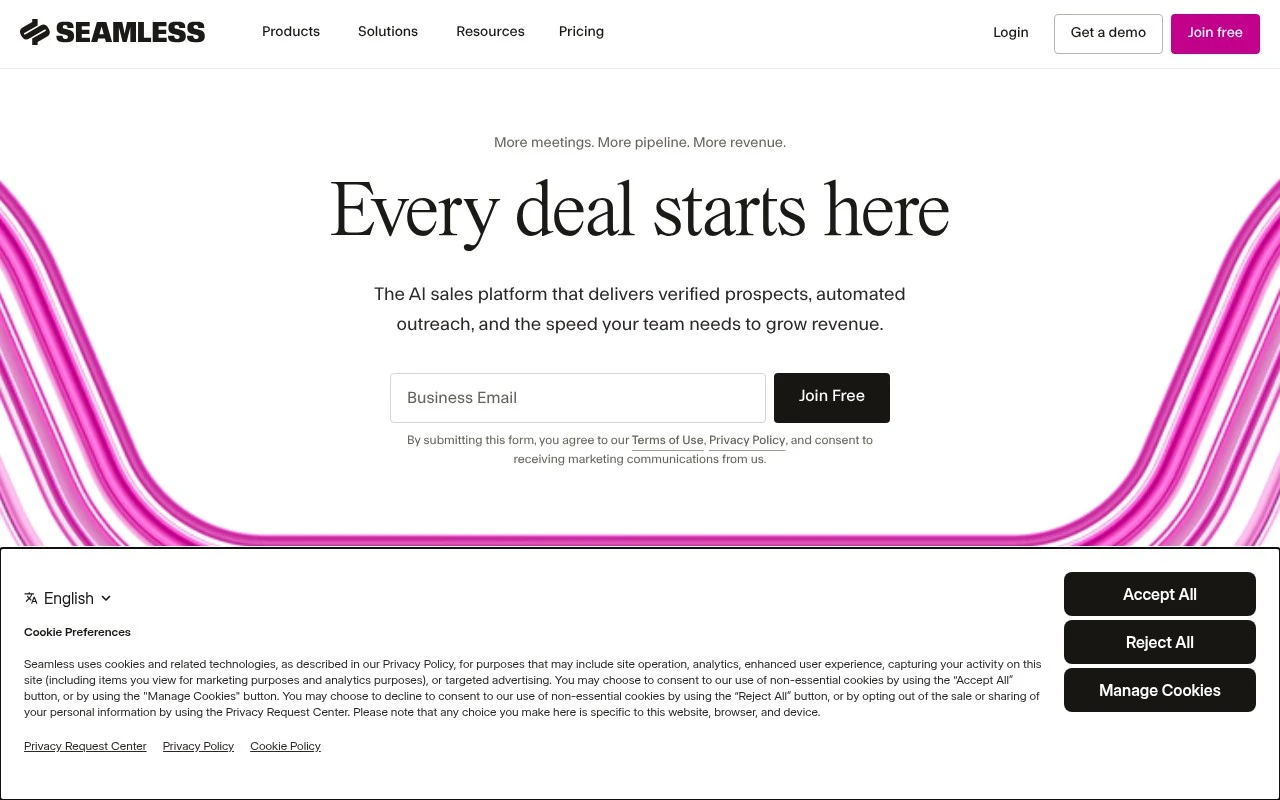
Seamless is a sales intelligence platform that helps teams find B2B contacts, company data, verified emails, and phone numbers for prospecting. It also supports lead list building and CRM enrichment for sales outreach workflows.
Sales & OutreachCRM & Segmentation

FYAI Score

8.2 / 10

Based on 565 reviews

Pricing:

Freemium

Best for:

Sales and GTM teams prospecting and launching outbound at scale

Score Breakdown

  • Ease of use7.5 / 10
  • Features8.6 / 10
  • Pricing7.6 / 10
  • Integrations9.2 / 10
  • Support8.5 / 10

PRODUCT PREVIEW

What this AI tool does

Seamless is a revenue-focused prospecting and engagement platform for sales, marketing, and go-to-market teams that need to find potential buyers, verify contact data, and turn prospect research into outreach. It brings together contact discovery, data enrichment, revenue intelligence, AI agents, and engagement automation so teams can move from identifying an account to contacting the right person with less manual work. For go-to-market teams, the main value is speed and continuity. Instead of researching prospects in one tool, checking contact details in another, and launching outreach somewhere else, users can build a more connected workflow around buyer discovery and action. This makes the platform especially relevant for outbound sales teams, demand generation teams, business development representatives, and revenue operations groups. At the centre of the product is a contact data engine designed to help users identify people and companies that match their target market. The platform supports prospecting by surfacing names, roles, company information, and contact details, then helping teams keep that information current. In practical terms, Seamless helps teams reduce the gap between knowing which accounts they want and having usable data to engage them. Revenue signals give the platform a broader role than simple list building. Buying triggers, company changes, intent-style signals, and account updates can help teams understand when a prospect may be more relevant to contact. When combined with lead scoring, these signals can help sellers and marketers prioritise outreach based on timing, fit, and likely value rather than working through static lists. AI agents and automation extend the tool from research into execution. The platform can assist with repetitive prospecting tasks, support message preparation, and help launch engagement workflows based on selected contacts or target accounts. This positions it as a system for revenue teams that want AI to handle parts of the operational workload while humans stay focused on strategy, qualification, and relationship building. CRM automation is an important part of how the platform fits into a wider sales stack. Data captured or refreshed through the platform can support cleaner records, better segmentation, and more consistent follow-up across sales workflows. For teams that depend on a CRM as their source of truth, this connection matters because prospecting data is only useful if it can be applied where sellers already work. The platform’s character is practical rather than experimental. It is not mainly a creative AI tool or a general research assistant, but a revenue operations system built around pipeline generation. Its AI capabilities are most meaningful when they shorten the path from account identification to personalised, timely outreach. Seamless is best at helping revenue teams connect prospect discovery, contact data, trigger-based prioritisation, and AI-assisted engagement in one operating flow. It is most useful for organisations with active outbound motions, defined buyer profiles, and a need to scale prospecting without relying entirely on manual research. For teams that already know who they want to reach but need faster access to the right contacts and moments, the platform provides a structured way to turn market opportunity into action. As a directory category, the tool sits at the intersection of sales intelligence, prospecting software, data enrichment, and engagement automation. Its value comes from combining those functions into a workflow that supports both individual sellers and revenue teams. The result is a platform designed to make prospecting more data-driven, more current, and more directly connected to outreach execution.

Use cases

Best for

Lead Scoring

Scores prospects using enriched contact data and revenue triggers to prioritize who to outreach first.

CRM Automation

Seamless refreshes contact records and pushes enriched leads into your CRM to automate list building and follow ups.

ANALYSIS

Strengths & limitations

Strengths
  • Strong fit for outbound sales teams because it combines prospect discovery, contact enrichment, buyer signals, and outreach activation in one revenue workflow.
  • Useful for revenue operations and sales leaders because AI agents and automation support repeatable prospecting workflows across roles rather than only one-off list building.
  • Freemium entry helps smaller teams test contact search and enrichment before committing to broader paid prospecting and engagement use.

Limitations
  • Less suitable for teams that only need a lightweight contact lookup tool because its broader engagement, automation, and agent features add workflow complexity.
  • Less suitable for companies already standardized on separate sales engagement and data tools because overlapping capabilities can create duplication unless workflows are clearly integrated.
  • High-volume or multi-seat outbound teams should expect costs and usage management to grow beyond the freemium entry point because prospecting, enrichment, and automation scale with team activity.

Evaluation

FYAI score breakdown

Our structured evaluation across five key criteria

8.2 / 10

Overall score

Based on 565 reviews

  • Ease of use7.5 / 10
  • Features8.6 / 10
  • Pricing7.6 / 10
  • Integrations9.2 / 10
  • Support8.5 / 10

What users say

Findings from public reviews, documentation and community sources.

  • Ease of use

    The Seamless pricing page describes Connect as “Unified prospecting, outreach, and sales automation into one beautifully simple experience.” The same pricing page presents a platform spanning data, outreach, automation, and AI agents.

  • Features

    The Seamless site lists “1.8B+ verified business emails and 414M+ phone numbers” and “100+ live data points per profile.” The Seamless site also names Prospector, Buyer Intent, Job Changes, and CRM Enrich.

  • Pricing

    The Seamless pricing page lists a free entry point with “1 User” and “50 Credits.” The same pricing page lists Pro and Enterprise paid plans as “Contact sales.”

  • Integrations

    The Seamless pricing page says Seamless can “Connect instantly with 6,000+ tools.” The Seamless pricing page names Salesforce, HubSpot, Salesloft, and Zoho among supported connections, alongside an “API” for CRM, product, or revenue workflows.

  • Support

    The Seamless pricing page lists “Self-serve Knowledge Base,” “Email Support,” “Live Chat Support,” and “Dedicated Success Manager.” The same page specifies priority support hours of “9am - 5pm ET Monday through Friday” and phone support upon request for Enterprise customers.

Who is this for?

Best for sales and marketing teams that want prospecting and outreach in one system, the Seamless site lists “1.8B+ verified business emails and 414M+ phone numbers,” plus Prospector, Buyer Intent, Job Changes, and CRM Enrich. Best for connected revenue stacks because the pricing page says Seamless can “Connect instantly with 6,000+ tools” and offers an “API” for CRM, product, or revenue workflows. Less suited to buyers who need public paid-plan pricing before evaluation, the pricing page lists Pro and Enterprise as “Contact sales,” so direct package-price comparison is limited.

PRODUCT PREVIEW

Feature highlights

Contact Data Engine

Find, verify, and refresh emails and direct dials as you prospect.

Buyer & Trigger Signals

Spot revenue triggers to prioritize accounts and time outreach.

AI Outreach Automation

Use AI agents and workflows to launch sequences and follow-ups.

COMPARE

Discover curated alternatives worth comparing

Compare similar AI tools based on features, pricing and use cases

7.5/ 10Based on 12,890 reviews

Zoominfo

Lead GenerationCRM & Segmentation
Finds prospects, enriches accounts, and flags buyer signals
Best for:
Sales teams
Pricing
Paid only

8.6/ 10Based on 6,982 reviews

Zoho CRM

Sales & OutreachAnalytics & Reporting
Rewrites emails, detects anomalies, and builds CRM modules
Best for:
Sales teams
Pricing
Freemium

8.0/ 10Based on 1,041 reviews

Zoho Campaigns

Lead GenerationCRM & Segmentation
Builds email and SMS campaigns, automates and analyzes results
Best for:
Marketing teams
Pricing
Freemium

Fill your pipeline faster with verified B2B contacts. See why revenue teams choose Seamless to reach the right buyers and book more meetings.

FAQ

Frequently asked
questions

Everything you need to know about this AI tool,
its features, pricing, use cases, and limitations.

Who is Seamless best for?
Seamless is best for B2B revenue teams that need prospect contact data, CRM enrichment, buyer signals, and outbound workflows in one platform. It fits SDRs, account executives, sales leaders, revenue operations, marketers, recruiters, and business owners focused on building pipeline, rather than teams seeking consumer leads or general research.
Does Seamless have a free plan, and what do paid plans add?
Seamless uses a freemium model, so teams can start with a free option and upgrade for broader access and scale. Paid access is typically evaluated around prospecting volume, contact data access, enrichment, workflow automation, integrations, and team usage. Buyers should check seamless.ai for current plan limits and feature availability.
How does Seamless compare with other B2B prospecting tools?
Seamless differs from many standalone contact databases by combining prospect search, enrichment, buyer signals, outreach workflows, integrations, APIs, and AI agents. Some alternatives may focus more narrowly on data, sequencing, CRM operations, or intent signals. The better choice depends on team size, budget, data needs, and outbound workflow complexity.
How quickly can a team get started with Seamless?
The main trade-offs with Seamless are its B2B focus, limited public detail on plan limits, and the need to manage data quality and outreach risk. It is not designed as a general-purpose marketing or consumer lead tool, and teams should still validate records, monitor deliverability, and control automation carefully.
What should buyers check about privacy and compliance before using Seamless?
Buyers should confirm how Seamless handles contact data, consent, retention, CRM syncing, outreach permissions, and regional privacy obligations before scaling campaigns. Because the platform supports prospect data and automated engagement, teams should align usage with internal policies, applicable email and data protection laws, and their own deliverability standards.