Curated ToolThis tool is part of our curated AI directory. We only include tools that meet our standards for relevance, usability and real-world value.

Postly

Postly is a social media management platform for creating, scheduling, approving, and publishing content across multiple social networks. It includes a content calendar, team collaboration workflows, and AI-assisted writing for social posts.
Marketing AutomationContent & Social

FYAI Score

8.4 / 10

Based on 191 reviews

Pricing:

Freemium

Best for:

Social media teams running multi-channel campaigns with performance insights

Score Breakdown

  • Ease of use8.0 / 10
  • Features7.9 / 10
  • Pricing8.9 / 10
  • Integrations9.0 / 10
  • Support8.6 / 10

PRODUCT PREVIEW

What this AI tool does

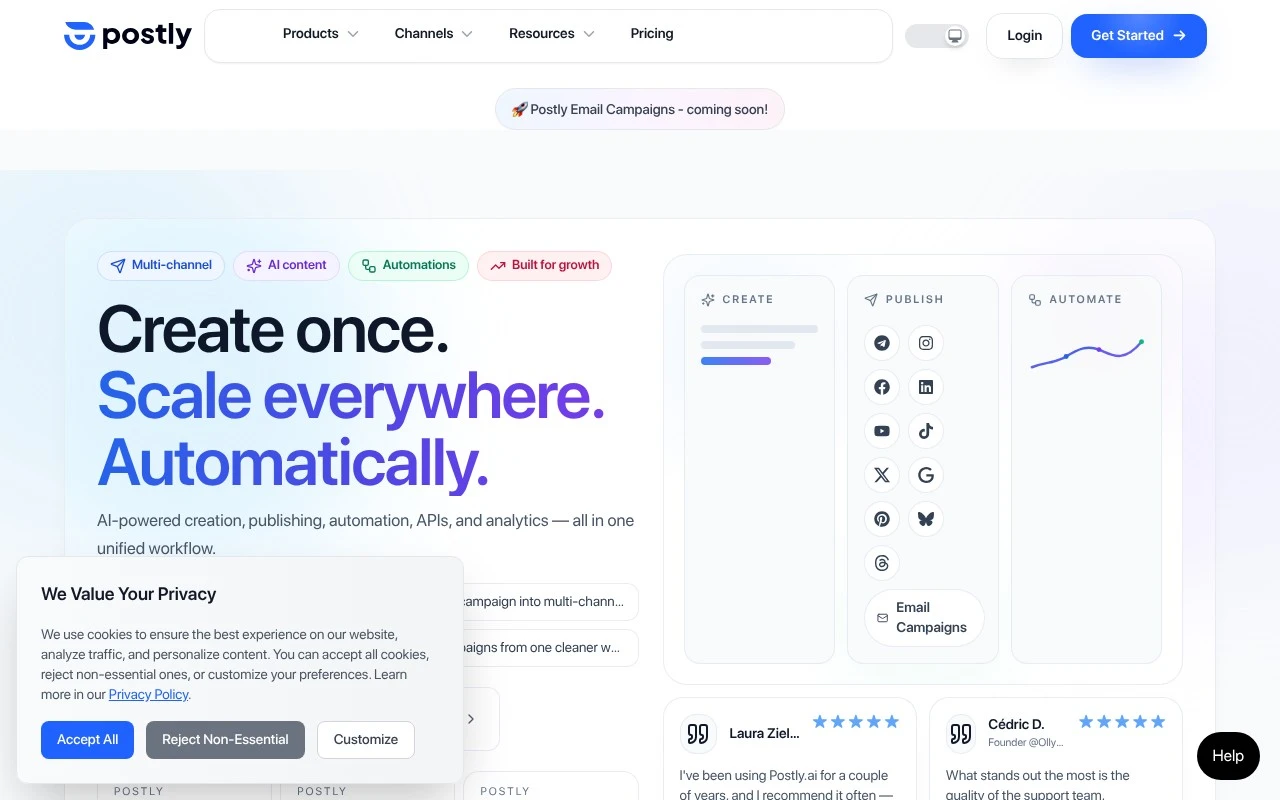
Postly is an AI-powered social media publishing workspace for teams, creators, agencies, and developers that want to plan, create, schedule, automate, and learn from campaigns in one place. Postly combines social scheduling, social media content creation, campaign analytics, competitor analysis, and automation so publishing work is connected to performance insight rather than handled as a set of separate tasks. For social teams, the platform is designed around the everyday rhythm of content operations. Users can move from idea to scheduled post, coordinate campaign timing, and keep multiple channels organised without turning the publishing calendar into a manual spreadsheet process. This makes it useful for brands that need consistency, not just occasional posting. AI content creation sits at the centre of the workflow, helping users draft, refine, and adapt content for different audiences and formats. The tool can support content repurposing by turning a larger idea into platform-specific captions, short form content, or campaign variations. For marketers who need to maintain volume without losing context, this reduces the gap between planning and execution. Campaign intelligence gives Postly a role beyond basic scheduling. Postly is best at connecting content execution with performance learning, using analytics and competitor analysis to help teams understand what is working, what is changing in their market, and where future campaigns can improve. Instead of treating reports as an afterthought, it brings feedback closer to the publishing workflow. Automation is another important part of the product story. Regular scheduling workflows are supported, but the platform also offers developer API access and MCP-based automation for teams that want to connect publishing activity with broader systems. That matters for organisations where social media is linked to approvals, data pipelines, campaign triggers, or custom internal tools. Agencies and multi-brand operators can use the workspace to manage recurring social activity across different clients or business units. The value is not only in posting to channels, but in standardising how campaigns are prepared, approved, launched, and measured. This helps reduce operational friction when multiple stakeholders are involved. Content teams may also use the platform as a bridge between strategic planning and short form creation. A campaign theme can become several post concepts, caption variations, creative prompts, or performance-led iterations. Where teams are experimenting with formats such as short form video creation, generate images workflows, or campaign-specific creative testing, the platform provides a place to coordinate the output and connect it back to results. The broader positioning is that Postly is not just a queue for scheduled posts. It is a publishing system for people who want AI assistance, marketing automation, analytics, and competitive awareness in the same environment where content goes live. That makes it especially relevant for teams that need to scale social execution while still learning from each campaign cycle.

Use cases

Best for

Marketing Automation

Postly automates social publishing by scheduling posts and triggering workflows via its API and MCP-based automation.

Competitor Analysis

Postly runs competitor analysis by tracking rivals’ social posts and comparing engagement and campaign performance metrics.

Generate Images

Postly generates images for social posts using AI creation tools inside its publishing workspace.

ANALYSIS

Strengths & limitations

Strengths
  • Combines scheduling, AI content creation, analytics, competitor analysis, and automation in one workspace, which suits teams trying to reduce tool switching across social campaigns.
  • Best suited to campaign-driven social teams because AI briefs, captions, CTAs, hashtags, creative generation, insights, and next-action recommendations connect content planning with performance learning.
  • Useful for mixed technical and non-technical teams because standard publishing workflows sit alongside developer API access and MCP-based automation.

Limitations
  • Less suitable for teams that only need a simple queue-based scheduler because the combined AI, analytics, competitor intelligence, and automation workspace adds workflow complexity.
  • Freemium access can become limiting for higher-volume teams because advanced publishing, analytics, automation, or collaboration needs are likely to require a paid plan.
  • Less suitable as a full marketing operations platform because its scope centers on social publishing and campaign intelligence rather than CRM, email marketing, or ad-buying workflows.

Evaluation

FYAI score breakdown

Our structured evaluation across five key criteria

8.4 / 10

Overall score

Based on 191 reviews

  • Ease of use8.0 / 10
  • Features7.9 / 10
  • Pricing8.9 / 10
  • Integrations9.0 / 10
  • Support8.6 / 10

What users say

Findings from public reviews, documentation and community sources.

  • Ease of use

    G2’s product-review signal says users “consistently praise Postly for its ease of use and bulk post scheduling capabilities.”

  • Features

    Postly’s own page describes “campaign planning, AI-assisted creation, approvals, publishing, analytics, and competitor signals,” and lists AI text/image/video generation, Brand Kit, and recurring automation.

  • Pricing

    Postly’s pricing page lists “5 channels” at “$16.00 /mon” billed yearly, a “7-day Free Trial,” and optional add-ons such as AI Studio at “$24.00 /mon.” Postly’s pricing page also references cheaper per-channel bands as usage grows.

  • Integrations

    Postly’s homepage lists “19+ publishing destinations” across social, email/newsletters, messaging, blogs, and bio pages, including X/Twitter, Instagram, Mailchimp, and WordPress. Postly’s homepage also states “API and MCP” with signed webhooks and ChatGPT / Claude MCP integrations.

  • Support

    Capterra’s product-review signal includes the user comment that “Their customer support has been very helpful and the platform has felt very stable.” Postly’s site includes a customer quote saying the support team is “responsive, helpful, and genuinely invested in solving issues quickly.”

Who is this for?

Best for publishing-heavy marketing teams, Postly’s homepage lists “19+ publishing destinations,” and the pricing page lists “5 channels” at “$16.00 /mon” billed yearly. Best for teams that need campaign workflows beyond scheduling, Postly’s own page describes “campaign planning, AI-assisted creation, approvals, publishing, analytics, and competitor signals.” Less suited to teams wanting all AI capabilities bundled into the core price, Postly’s pricing page lists optional add-ons such as AI Studio at “$24.00 /mon.”

PRODUCT PREVIEW

Feature highlights

Smart Scheduling

Plan, queue, and publish across channels from one workspace.

AI Content Studio

Generate on-brand posts and variations in seconds for campaigns.

Campaign Intelligence

Connect analytics and competitor insights to improve future posts.

COMPARE

Discover curated alternatives worth comparing

Compare similar AI tools based on features, pricing and use cases

7.5/ 10Based on 12,890 reviews

Zoominfo

Lead GenerationCRM & Segmentation
Finds prospects, enriches accounts, and flags buyer signals
Best for:
Sales teams
Pricing
Paid only

8.6/ 10Based on 6,982 reviews

Zoho CRM

Sales & OutreachAnalytics & Reporting
Rewrites emails, detects anomalies, and builds CRM modules
Best for:
Sales teams
Pricing
Freemium

8.0/ 10Based on 1,041 reviews

Zoho Campaigns

Lead GenerationCRM & Segmentation
Builds email and SMS campaigns, automates and analyzes results
Best for:
Marketing teams
Pricing
Freemium

Bring order to your social presence with Postly. Plan ahead, stay consistent, and prove what’s working with clear results your team can trust.

FAQ

Frequently asked
questions

Everything you need to know about this AI tool,
its features, pricing, use cases, and limitations.

Who is Postly best suited for?
Postly is best suited for teams that need one workspace to plan, create, publish, automate, and analyze multi-channel marketing campaigns. It fits marketing teams, social media managers, agencies, creators, no-code operators, and developers managing social content, email, blogs, messaging, WordPress, Bio Pages, and campaign analytics.
Does Postly have a free plan, and what should I check before upgrading?
Postly uses a freemium pricing model, so users can start with a free option and upgrade for broader capability or higher usage. Before choosing a paid plan, review current limits for connected channels, scheduled posts, AI generation, team seats, analytics access, automation features, API usage, and competitor monitoring.
How does Postly compare with other social media and marketing automation tools?
Postly is broader than a basic social scheduler because it combines AI content creation, publishing, automation, analytics, competitive monitoring, and developer access in one platform. Similar tools may be simpler for single-channel posting, so the better choice depends on team size, workflow complexity, budget, and whether multi-channel campaign coordination matters.
How long does it take to set up Postly?
Postly’s main trade-off is that its broad feature set may be more complex than needed for teams that only want simple post scheduling. Buyers should also validate plan limits, channel-specific support, AI generation rules, automation constraints, and analytics depth because advanced campaign intelligence and developer workflows usually require thoughtful configuration.
What should teams consider about privacy and compliance before using Postly?
Teams should review how Postly handles account connections, generated content, campaign data, analytics, webhooks, API access, and user permissions before using it for sensitive workflows. Buyers in regulated environments should confirm current security practices, data retention terms, access controls, compliance documentation, and any requirements for customer data processed through AI or automation features.