Curated ToolThis tool is part of our curated AI directory. We only include tools that meet our standards for relevance, usability and real-world value.

Ocoya

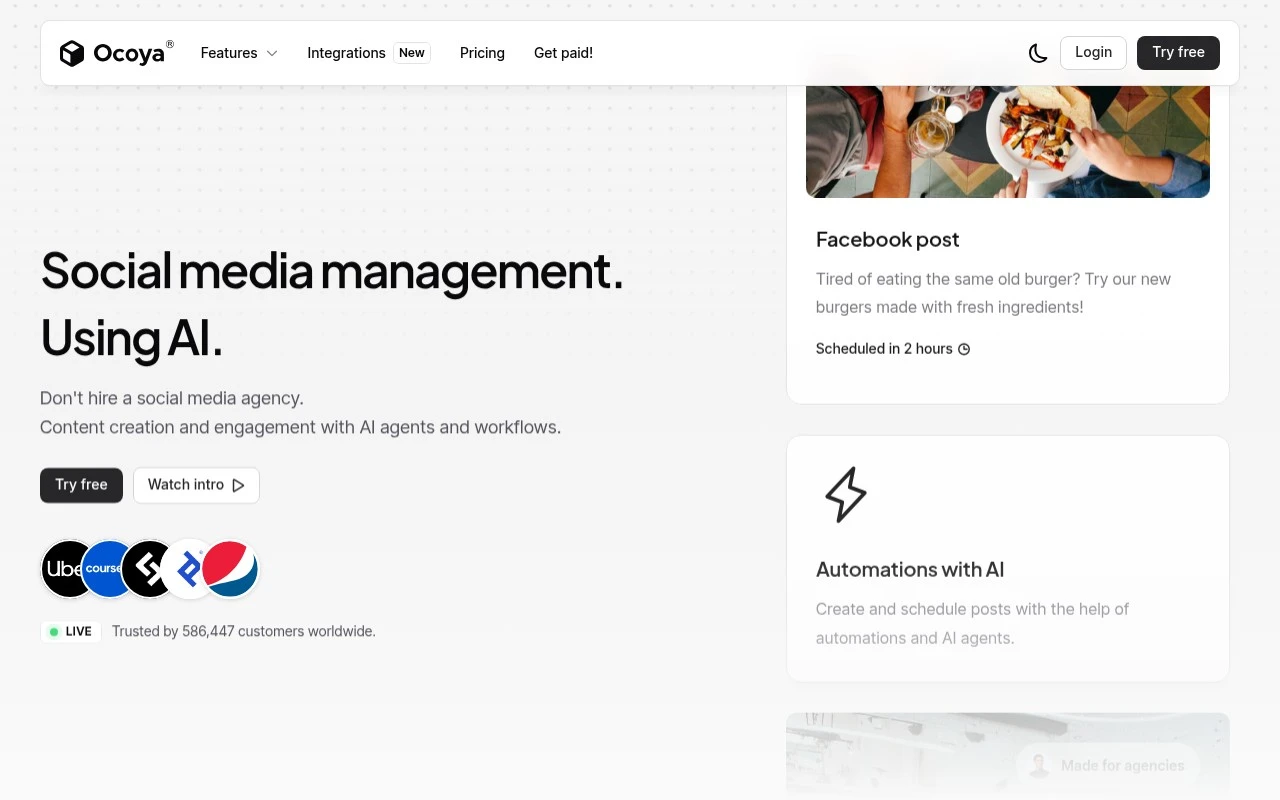
Creates social media content with AI and schedules posts

Social Media
Ocoya is an AI-powered social media management tool focused on content creation and post scheduling. It is meant for users who need to maintain a digital presence and want AI help generating social content and automating parts of their publishing workflow.

FYAI Score

7.9 / 10

Based on 367 reviews

Pricing:

Paid only

Best for:

Social media managers and small teams publishing content across channels

Score Breakdown

  • Ease of use8.0 / 10
  • Features7.7 / 10
  • Pricing8.4 / 10
  • Integrations8.0 / 10
  • Support7.2 / 10

PRODUCT PREVIEW

What this AI tool does

Ocoya is an AI-assisted tool designed to help teams plan, write, and publish social media content with less manual effort. It brings common steps—drafting captions, preparing visuals, and organizing a posting schedule—into one workflow, which can be useful for small businesses, creators, and marketing teams managing multiple channels. In practice, it supports content creation by generating text variations and helping adapt messaging to different platforms and tones. It also aims to simplify day-to-day social media management by keeping drafts, approvals, and publishing tasks in a single place. If you’re comparing tools for social media content and scheduling, ocoya may be relevant when you want AI writing support alongside a structured calendar-based process. As with any AI tool, results typically improve when you provide clear prompts, brand guidelines, and examples of the style you want.

Use cases

Best for

AI Social Copywriting

Ocoya generates social media captions and post text using AI writing tools you can edit before publishing.

Post Scheduling

Schedule posts in advance by selecting a social account, date, and time, then queueing the content for publishing.

Content Planning Automation

Automate recurring social workflows by using templates and a content calendar to plan and reuse posts over time.

ANALYSIS

Strengths & limitations

Strengths
  • Combines social media content creation and scheduling in one tool.
  • Uses AI to support faster social content production.
  • Fits teams or individuals managing regular social media activity.
Limitations
  • The available official page text does not specify supported social networks or integrations.
  • Detailed capabilities such as analytics, approval workflows, or collaboration features are not established from the provided source.
  • AI-generated social content may still require human editing for brand voice and accuracy.

Evaluation

FYAI score breakdown

Our structured evaluation across five key criteria

7.9 / 10

Overall score

Based on 367 reviews

  • Ease of use8.0 / 10
  • Features7.7 / 10
  • Pricing8.4 / 10
  • Integrations8.0 / 10
  • Support7.2 / 10

What users say

Findings from public reviews, documentation and community sources.

  • Ease of use

    Software Advice summarizes reviewer pros for Ocoya as including "Ease of use is high." G2 says users praise Ocoya for "ease of use and all-in-one functionality."

  • Features

    Ocoya’s own site describes AI-assisted social scheduling and creation, "AI agent templates" for social media/DMs/engagement, workflows with triggers, and RSS/product-release automations.

  • Pricing

    Ocoya’s pricing page lists monthly tiers at Bronze $15, Silver $39, Gold $79, and Diamond $159, with stated limits for workspaces, users, social profiles, and credits. Ocoya’s pricing page also lists a 7-day free trial and yearly plans that "save 20%."

  • Integrations

    Ocoya’s integrations page lists Facebook, Instagram, X, LinkedIn, Pinterest, Threads, TikTok, Google Business, YouTube Shorts, Discord, Telegram, and Slack. Ocoya’s homepage says it supports "Over 30+ integrations including social, design, ecommerce and even our API," and several listed integrations are marked beta.

  • Support

    Ocoya’s pricing page includes an FAQ covering trial access, plan changes, nonprofit discounts, VAT, credits, and workspaces. The broader B2B review profile cited for Ocoya is 4.6/5 across 367 reviews.

Who is this for?

Best for social media teams that want creation and scheduling in one workflow, Ocoya’s own site describes AI-assisted social scheduling and creation, "AI agent templates," workflows with triggers, and RSS/product-release automations. Less suited to teams that do not want credit-based usage planning, Ocoya’s pricing page lists limits for credits, and usage is credit-based on most tiers.

PRODUCT PREVIEW

Feature highlights

AI Post Generator

Create captions and content ideas tailored to your brand in seconds.

Smart Scheduling

Plan, queue, and auto-publish posts to stay consistent every week.

Design Templates

Turn text into on-brand visuals with ready-made social templates.

COMPARE

Discover curated alternatives worth comparing

Compare similar AI tools based on features, pricing and use cases

7.5/ 10Based on 12.890 reviews

Zoominfo

Lead GenerationCRM & Segmentation
Find and enrich B2B leads with firmographic and contact data
Best for:
Sales teams
Pricing
Paid only

8.6/ 10Based on 6.982 reviews

Zoho CRM

Sales & OutreachAnalytics & Reporting
AI assists CRM tasks: rewrite emails, detect anomalies, predict
Best for:
Sales teams
Pricing
Freemium

8.0/ 10Based on 1.041 reviews

Zoho Campaigns

Lead GenerationCRM & Segmentation
Create, automate, and analyze email and SMS marketing campaigns
Best for:
Marketing teams
Pricing
Freemium

Create more high-performing social content in less time. See why busy marketing teams choose Ocoya to stay consistent and grow engagement.

FAQ

Frequently asked
questions

Everything you need to know about this AI tool,
its features, pricing, use cases, and limitations.

Who is Ocoya a good fit for, and when should I pick something else?
Ocoya fits small teams and agencies that need to generate social captions quickly, schedule across multiple channels, and review basic performance analytics in one place. It’s most useful when you want a single workflow for ideation → copy → scheduling. If you need highly customized brand voice controls, complex approval workflows, or deep reporting, you may find more specialized social suites a better match.
Does Ocoya have a free plan, and what are the practical limits versus paid tiers?
Ocoya typically offers a free trial rather than a fully free plan, and ongoing use requires a paid subscription. The main differences between tiers are usually the number of social profiles/workspaces, post limits, and how much AI content generation you can use. If you’re comparing tools, check whether the plan you’re considering includes the channels you publish to and enough scheduled posts for your cadence.
How does Ocoya compare with tools like Buffer, Hootsuite, or Later?
Ocoya leans more into AI-assisted copy and content creation alongside scheduling, while tools like Buffer often prioritize straightforward publishing and queues. Hootsuite-style platforms can offer broader enterprise features (teams, governance, deeper integrations) but may be heavier and pricier. If your priority is fast content generation plus scheduling, Ocoya can be competitive; if you need advanced listening, approvals, or extensive integrations, compare carefully.
How fast can I get Ocoya running for a real posting workflow?
Ocoya can save time, but generated captions may need manual edits for tone, accuracy, and platform-specific nuances. Customization can feel limited if you require strict brand phrasing or highly differentiated messaging per audience segment. Also verify that its integrations cover your existing marketing stack to avoid extra steps in your workflow.
What should I consider about data privacy, account access, and compliance when using Ocoya?
Using Ocoya means granting access to your social accounts and storing content drafts, media, and analytics data in the platform. Review its privacy policy and data processing terms to confirm how data is stored, retained, and whether subprocessors are involved, especially if you have GDPR/CCPA obligations. If you operate in regulated environments, confirm role-based access controls, auditability, and whether you can export or delete data on request.