Curated ToolThis tool is part of our curated AI directory. We only include tools that meet our standards for relevance, usability and real-world value.

Leadpages

Leadpages is a lead generation platform for building landing pages, websites, pop-ups, and alert bars without coding. It includes templates, form capture, A/B testing, and integrations with email marketing, CRM, and payment tools.
Lead GenerationLanding Pages

FYAI Score

8.3 / 10

Based on 437 reviews

Pricing:

Paid only

Best for:

Small businesses and marketers building landing pages to grow leads

Score Breakdown

  • Ease of use8.8 / 10
  • Features9.1 / 10
  • Pricing7.6 / 10
  • Integrations8.2 / 10
  • Support7.1 / 10

PRODUCT PREVIEW

What this AI tool does

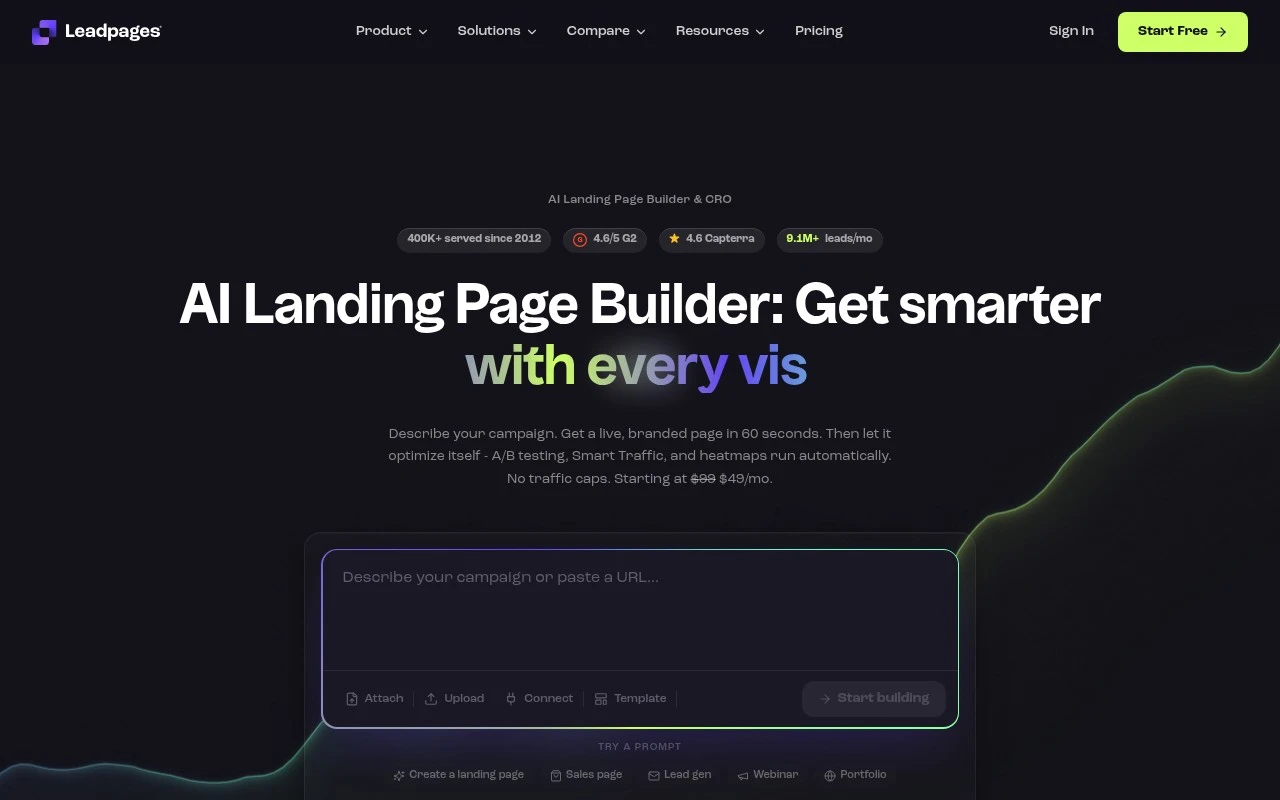
Leadpages is an AI landing page and conversion optimization platform for marketers, small businesses, agencies, and ecommerce teams that need to launch campaigns quickly and improve lead capture without heavy development work. Its core promise is to help users build landing page experiences, publish them under a brand, and keep improving them based on real visitor behavior. At its center is an AI landing page builder that turns a campaign description into a structured, branded page. Instead of starting from a blank canvas, users can describe an offer, audience, or goal, then refine the generated layout, copy, forms, and calls to action inside a no-code editor. This makes the platform useful for teams that need speed but still want control over the final message and design. For growth teams, Leadpages is best at connecting page creation with conversion rate optimization. It is not only a place to publish a campaign page, but a system for learning which version performs better through A/B testing, Smart Traffic, heatmaps, visitor intelligence, personalization, and conversion tracking. That positioning gives it a practical role between website builders, form tools, and analytics software. Lead capture is one of the clearest use cases. Forms, pop-ups, alert bars, and embedded page elements help turn anonymous visitors into contacts, subscribers, registrants, or customers. Because those capture points can connect to email marketing, CRM, advertising, and ecommerce tools, the landing page becomes part of a wider campaign workflow rather than an isolated asset. The integration layer is important to the product’s character. Leadpages connects with tools such as HubSpot, Salesforce, Mailchimp, Shopify, Klaviyo, ActiveCampaign, Google Ads, and Meta Ads, allowing campaign data to move into the systems where teams already manage leads, ads, sales, and retention. Embedded Stripe checkout also lets users sell directly from a page, which broadens the platform from lead generation into simple transaction flows. Beyond standalone campaign pages, the platform also supports websites and blogs. That matters for smaller organizations that may not want separate tools for a homepage, content presence, and campaign funnels. A business can use it for a focused product launch, a webinar registration page, a downloadable guide, a service inquiry flow, or a lightweight site that is built around measurable conversion goals. In practice, Leadpages is designed for people who care less about custom engineering and more about getting a campaign live, connected, and measurable. The AI layer helps with speed, the editor supports hands-on refinement, and the optimization tools help teams understand what visitors do after the page is published. Its strongest fit is for organizations that want a practical no-code system for turning traffic into leads, signups, purchases, and testable campaign results.

Use cases

Best for

Build Landing Page

Generate a branded landing page from a campaign description using Leadpages AI, then publish it with your domain and integrations.

Conversion Rate Optimization

Run A/B tests, Smart Traffic routing, and heatmaps to compare variants and track which page elements drive conversions.

Lead Capture

Add embedded forms and Stripe checkout to capture leads, then sync submissions to tools like HubSpot or Mailchimp.

ANALYSIS

Strengths & limitations

Strengths
  • Best for fast campaign launches because AI can turn a campaign brief into a branded landing page and reduce manual build time.
  • Strong fit for conversion-focused teams because A/B testing, Smart Traffic, heatmaps, personalization, visitor intelligence, and conversion tracking sit in the same workflow.
  • Useful for growth stacks because forms, CRM, email, ad platform, ecommerce, and Stripe checkout integrations connect landing pages directly to lead capture and sales processes.

Limitations
  • Less suitable for hobby projects or teams that need a permanently free landing page tool because Leadpages is paid-only.
  • Less suitable for complex websites or custom web applications because its core strength is campaign landing pages, lead capture, and conversion optimization rather than full product development.
  • AI-generated pages and automated variants still need human review for brand, legal, and offer accuracy, so regulated teams should plan editorial approval before publishing.

Evaluation

FYAI score breakdown

Our structured evaluation across five key criteria

8.3 / 10

Overall score

Based on 437 reviews

  • Ease of use8.8 / 10
  • Features9.1 / 10
  • Pricing7.6 / 10
  • Integrations8.2 / 10
  • Support7.1 / 10

What users say

Findings from public reviews, documentation and community sources.

  • Ease of use

    G2's product-review signal says users "consistently praise the ease of use and intuitive design" and highlight how quickly they can create professional-looking landing pages. Leadpages' own page says users can get a "live, branded page in 60 seconds."

  • Features

    Leadpages' own page lists landing-page and CRO features including "AI Page Creation," "A/B Testing," "Self-Improving Pages," and "Heatmaps." Leadpages' own page also references websites/blogs and Stripe checkout.

  • Pricing

    Leadpages' pricing page shows entry pricing as "Starting at $99/mo" with a displayed promotional "$49/mo." Leadpages' pricing page also references a "7-day free trial" and "No traffic caps."

  • Integrations

    Leadpages' own page names integrations including "Google Ads," "Meta Ads," "Shopify," and "Mailchimp." Leadpages' own page also lists "webhooks" and "CSV export."

  • Support

    A Reddit discussion in r/PPC includes a negative customer-service report saying Leadpages had "grubby customer service" and would "never return money for lapsed" service.

Who is this for?

Best for marketers who need landing pages launched quickly, G2 says users praise the ease of use, and Leadpages says users can get a "live, branded page in 60 seconds." Best for campaigns that need conversion testing because Leadpages lists "A/B Testing," "Self-Improving Pages," and "Heatmaps." Less suited to buyers who need detailed support confidence before purchase, a Reddit discussion includes a customer-service report saying Leadpages had "grubby customer service" and would "never return money for lapsed" service.

PRODUCT PREVIEW

Feature highlights

AI Landing Pages

Turn a campaign brief into a branded landing page fast.

Conversion Testing

Run A/B tests and Smart Traffic to lift conversions.

Forms & Integrations

Capture leads and sync to CRM, email, ads, and checkout.

COMPARE

Discover curated alternatives worth comparing

Compare similar AI tools based on features, pricing and use cases

7.5/ 10Based on 12,890 reviews

Zoominfo

Lead GenerationCRM & Segmentation
Finds prospects, enriches accounts, and flags buyer signals
Best for:
Sales teams
Pricing
Paid only

8.6/ 10Based on 6,982 reviews

Zoho CRM

Sales & OutreachAnalytics & Reporting
Rewrites emails, detects anomalies, and builds CRM modules
Best for:
Sales teams
Pricing
Freemium

8.0/ 10Based on 1,041 reviews

Zoho Campaigns

Lead GenerationCRM & Segmentation
Builds email and SMS campaigns, automates and analyzes results
Best for:
Marketing teams
Pricing
Freemium

Join thousands of businesses turning clicks into leads. Launch pages that convert faster, grow your list, and start generating more sales with Leadpages today.

FAQ

Frequently asked
questions

Everything you need to know about this AI tool,
its features, pricing, use cases, and limitations.

Who is Leadpages best suited for?
Leadpages is best suited for marketers, small businesses, agencies, founders, and growth teams that need to build and optimize campaign landing pages quickly. It is a strong fit for lead generation, sales offers, webinars, ecommerce promotions, and ad-to-page conversion campaigns where forms, testing, analytics, and integrations matter.
Is Leadpages free or paid?
Leadpages is a paid landing page and conversion optimization platform. Buyers should expect a subscription-style purchase rather than a fully free product. Because plan details and pricing can change, teams should confirm current pricing, included features, usage limits, and billing terms directly on the Leadpages website before choosing a plan.
How does Leadpages compare with other landing page builders?
Leadpages is more conversion-focused than many general website builders because it combines landing page creation with lead capture, A/B testing, Smart Traffic routing, heatmaps, analytics, personalization, and checkout embeds. The best alternative depends on whether a team prioritizes broader website design, deeper analytics, lower cost, or a simpler page builder.
How quickly can I build a landing page with Leadpages?
Leadpages is strongest for marketing and conversion pages, so it may be more specialized than necessary for a general-purpose website. Its optimization features also depend on traffic volume and conversion data. A/B tests, Smart Traffic routing, and heatmaps are most useful when enough visitors interact with pages to produce meaningful signals.
What should I check before using Leadpages for customer data?
Teams should review Leadpages’ current privacy, security, data processing, and compliance documentation before collecting leads or payments through the platform. Important checks include where form data is stored, how integrations transfer data, user access controls, retention settings, consent requirements, and whether the platform meets the buyer’s internal compliance standards.