Curated ToolThis tool is part of our curated AI directory. We only include tools that meet our standards for relevance, usability and real-world value.

Later

Analyzes creator trends and campaign performance using EdgeAI

Marketing AutomationAnalytics & Reporting
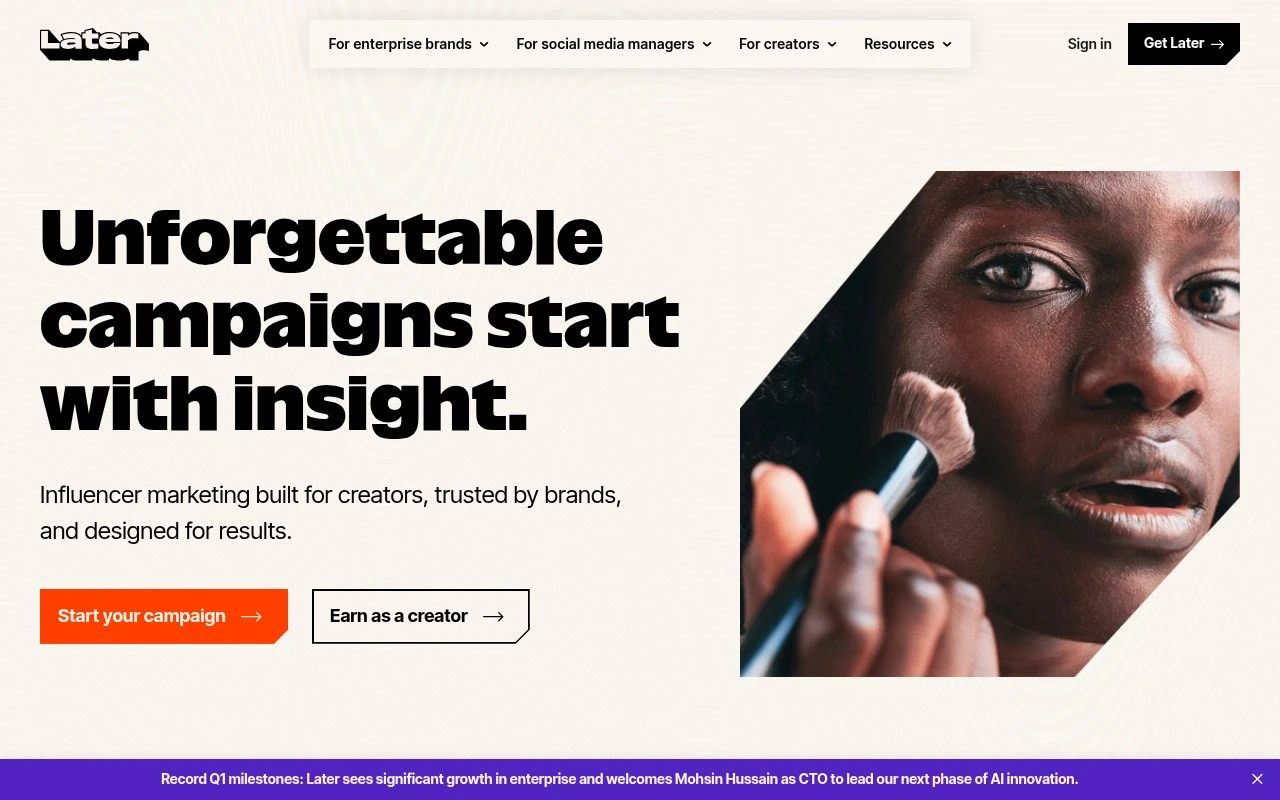
Later combines influencer marketing software, full-service creator campaign support, creator monetization through Mavely, and social media management. Its official site positions it as a platform for brands that want to run measurable influencer campaigns and for social teams that need to plan, publish, and analyze content. A distinctive part of its positioning is Later EdgeAI, which uses creator behavior, trend, Link in Bio transaction, and verified purchase data to support creator selection and campaign decisions.

FYAI Score

8.2 / 10

Based on 848 reviews

Pricing:

Freemium

Best for:

Brands and social teams running measurable influencer campaigns

Score Breakdown

  • Ease of use8.3 / 10
  • Features8.3 / 10
  • Pricing8.5 / 10
  • Integrations7.6 / 10
  • Support8.0 / 10

PRODUCT PREVIEW

What this AI tool does

Later is an AI tool designed to help you capture ideas and turn them into usable content with less manual effort. It supports common writing and planning tasks by taking a short prompt or rough notes and producing a clearer draft you can refine. This tool is useful when you need to move from an outline to a first version quickly, or when you want help rephrasing, summarizing, or organizing information into a more readable format. It’s intended for informational use, giving you a starting point that you can review and adjust to match your goals and voice.

Use cases

Best for

Marketing Automation

Later schedules and auto publishes social posts, then tracks performance analytics to optimize your content calendar.

Affiliate Tracking

Later uses Mavely affiliate links to track creator driven sales and verified purchases from Link in Bio traffic.

Report Generation

Later generates campaign reports with creator performance metrics, spend, and attributed sales for measurable influencer programs.

ANALYSIS

Strengths & limitations

Strengths
  • Covers both influencer campaign management and day-to-day social media planning in one ecosystem.
  • Supports creator discovery and vetting with signals such as brand fit, risk, past performance, sales, and ROI.
  • Offers full-service campaign programs for brands that want expert help with strategy, creator sourcing, management, tracking, and optimization.
Limitations
  • The official site provides high-level capability claims but limited detail on exact workflows, supported social networks, integrations, or reporting depth.
  • Creator earning is presented through Mavely, so creators may need to use a related product rather than the same brand-facing campaign tools.
  • Its strongest fit appears to be influencer and social campaigns; it is not presented as a general-purpose marketing automation or CRM platform.

Evaluation

FYAI score breakdown

Our structured evaluation across five key criteria

8.2 / 10

Overall score

Based on 848 reviews

  • Ease of use8.3 / 10
  • Features8.3 / 10
  • Pricing8.5 / 10
  • Integrations7.6 / 10
  • Support8.0 / 10

What users say

Findings from public reviews, documentation and community sources.

  • Ease of use

    G2 shows 4.5/5 for Later, and a G2 reviewer says Later “streamlines the scheduling and posting process.” Capterra describes Later’s planning and scheduling as “straightforward and visual.”

  • Features

    Later’s pricing page lists auto-publish, multi-profile scheduling, a visual planner, and best-time recommendations. Later’s homepage positions the product across influencer marketing, social media management, Link in Bio, AI-powered insights, creator analysis, and ROI tracking.

  • Pricing

    Later’s pricing page lists Starter at $18.75/month, Growth at $37.50/month, and Scale at $82.50/month when billed yearly, plus a 14-day free trial. Later’s pricing page lists limits for profiles, posts, users, analytics history, and AI credits, and states add-on pricing for extra social sets, users, and AI credits.

  • Integrations

    Later’s help article says Later Influence is integrated with the Facebook Graph API, Instagram API, TikTok One API, and Pinterest Analytics API.

  • Support

    Later’s pricing table lists “Basic customer support” on Starter and “Priority support” on Scale.

Who is this for?

Best for social teams that plan and publish across multiple profiles, Later’s pricing page lists auto-publish, multi-profile scheduling, a visual planner, and best-time recommendations. Less suited to Starter-plan teams that need priority support, Later’s pricing table lists “Basic customer support” on Starter and “Priority support” on Scale.

PRODUCT PREVIEW

Feature highlights

Later EdgeAI

Find creators using trend, behavior, and verified purchase signals.

Influencer campaigns

Plan, manage, and measure creator campaigns with full-service support.

Plan & publish

Schedule posts, manage calendars, and analyze performance in one place.

COMPARE

Discover curated alternatives worth comparing

Compare similar AI tools based on features, pricing and use cases

7.5/ 10Based on 12.890 reviews

Zoominfo

Lead GenerationCRM & Segmentation
Find and enrich B2B leads with firmographic and contact data
Best for:
Sales teams
Pricing
Paid only

8.6/ 10Based on 6.982 reviews

Zoho CRM

Sales & OutreachAnalytics & Reporting
AI assists CRM tasks: rewrite emails, detect anomalies, predict
Best for:
Sales teams
Pricing
Freemium

8.0/ 10Based on 1.041 reviews

Zoho Campaigns

Lead GenerationCRM & Segmentation
Create, automate, and analyze email and SMS marketing campaigns
Best for:
Marketing teams
Pricing
Freemium

Plan your content with confidence and stay consistently active on social. See why teams choose Later to save time and grow their presence.

FAQ

Frequently asked
questions

Everything you need to know about this AI tool,
its features, pricing, use cases, and limitations.

What types of teams or workflows is Later a good fit for?
Later works best for marketing teams and creators who plan content visually and want a straightforward approval-to-scheduling flow. It’s especially useful if your process relies on a calendar view and consistent posting across a few core social channels. If you need deep listening, complex customer support workflows, or heavy automation, you may find it limiting compared to broader social suites.
How far can you get with Later’s free plan, and when do you need to upgrade?
Later’s free plan is typically best for light scheduling needs and testing the workflow, but it can feel restrictive once you manage multiple profiles or need more volume and features. Upgrading is usually necessary for teams that require more scheduled posts, additional social profiles, and more robust analytics and collaboration options. If you’re comparing tools, check whether the features you care about (analytics depth, team access, platform coverage) are locked behind paid tiers.
How does Later compare with tools like Buffer, Hootsuite, or Sprout Social?
Later tends to prioritize a visual planning experience and simple scheduling, while Buffer is often favored for a lightweight, streamlined publisher. Hootsuite and Sprout Social generally offer broader platform coverage and more advanced reporting and team workflows, but at a higher cost and with more complexity. If analytics and governance are your top criteria, the more enterprise-leaning suites may be a better match than Later.
How quickly can you set up Later and start scheduling posts?
Later can be less compelling if you need highly specialized analytics, advanced social listening, or complex multi-team governance. Some users also run into constraints around which platforms and features are supported compared to larger suites. If your strategy spans many networks or requires deep reporting, you may need a complementary analytics tool or a different platform.
What should we consider about data handling, privacy, and compliance when using Later?
Later requires connecting your social accounts, which means it stores tokens/permissions needed to publish and pull performance data; review what access it requests per network. For compliance, confirm where data is stored, how long it’s retained, and what controls exist for user roles, auditability, and account offboarding. If you operate in regulated environments, compare Later’s security documentation and contractual options (e.g., DPA) against alternatives before standardizing.