Curated ToolThis tool is part of our curated AI directory. We only include tools that meet our standards for relevance, usability and real-world value.

Kajabi

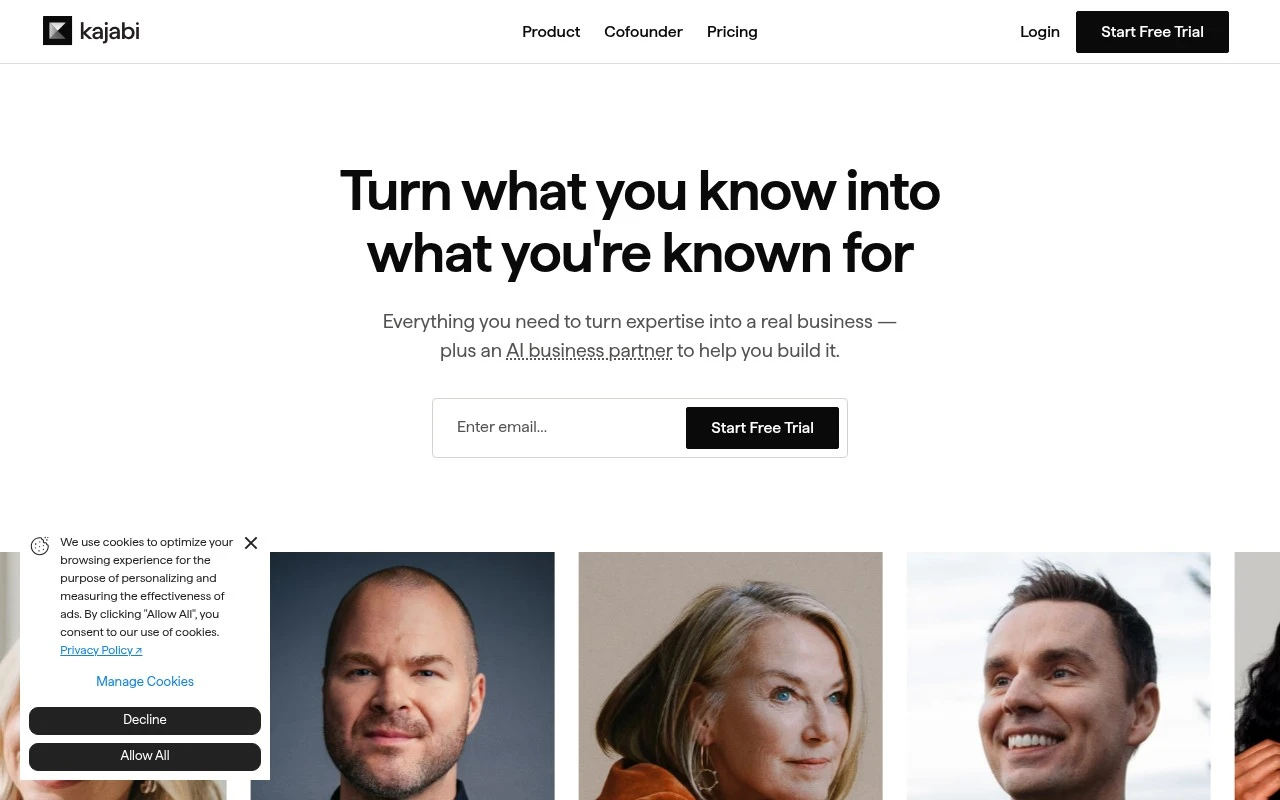
Kajabi is a platform for creating, marketing, and selling online courses, memberships, coaching programs, and other digital products. It includes tools for website pages, email campaigns, checkout, and customer management.
Sales & OutreachEmail Marketing & Deliverability

FYAI Score

7.7 / 10

Based on 2,326 reviews

Pricing:

Paid

Best for:

Creators and coaches selling courses, memberships, and programs

Score Breakdown

  • Ease of use7.3 / 10
  • Features8.3 / 10
  • Pricing7.5 / 10
  • Integrations7.6 / 10
  • Support7.8 / 10

PRODUCT PREVIEW

What this AI tool does

Kajabi is an all-in-one business platform for experts, creators, coaches, educators, and entrepreneurs who want to package knowledge into digital products and sell them online. It brings course creation, memberships, coaching programmes, communities, email, payments, pages, funnels, and customer management into one connected system. The central idea is simple: help a knowledge-based business move from audience building to product delivery without relying on a scattered collection of separate tools. For independent experts, the platform is less about publishing content in isolation and more about building a complete commercial experience around that content. A creator can shape lessons, offers, landing pages, checkout flows, email journeys, and member access from the same place. This makes it especially relevant for people who are selling expertise rather than physical inventory. At its core, Kajabi is best known for helping users create and deliver digital learning products such as online courses, coaching packages, memberships, and gated content libraries. The platform handles the structure around those products, including modules, access rules, customer accounts, payment collection, and the branded experience a learner sees after purchase. Instead of treating content and commerce as separate systems, it connects them as parts of the same customer journey. Marketing is a major part of the product story. Users can build landing page flows for lead capture, publish opt-in pages, create email campaign sequences, and use marketing automation to follow up with prospects or customers based on their behaviour. This matters because many experts do not simply need a place to host videos, they need a way to turn attention into subscribers, subscribers into buyers, and buyers into long-term community members. The platform also positions itself as a practical operating system for creator-led businesses. Payments, offers, coupons, order forms, analytics, customer records, website pages, and automations live close to the content itself. That reduces the operational friction that often appears when a business connects a course host, email provider, page builder, checkout tool, community platform, and analytics dashboard by hand. Beyond courses, the broader use case includes newsletters, podcasts, communities, memberships, and coaching experiences. A creator might use it to sell a self-paced programme, run a paid community, publish premium audio content, or support clients through a structured coaching offer. The common thread is monetised knowledge, delivered through a branded digital environment. AI has become part of Kajabi’s newer positioning. Kajabi promotes AI capabilities such as an AI business partner, AI teammates trained on a user’s own content, and connectivity with AI tools through MCP. In practice, this points toward a platform that is not only storing business assets, but also helping users generate, organise, repurpose, and act on the knowledge inside those assets. For teams with a growing library of content, the AI direction is especially notable. If a business has years of lessons, posts, scripts, frameworks, emails, and customer resources, AI teammates trained on that material can become a way to retrieve ideas, draft new materials, or support workflows with more context. The value is not just generic generation, but assistance that is tied to the creator’s own body of work. Its character is that of a consolidated, business-first platform rather than a narrow content tool. Kajabi is designed for users who want control over both the learning experience and the revenue engine behind it. The trade-off is that it encourages creators to operate inside a broad ecosystem, but the benefit is a more unified path from idea to product, from campaign to sale, and from first purchase to ongoing customer relationship.

Use cases

Best for

Marketing Automation

Set up Kajabi email sequences and automations that trigger when someone opts in, purchases, or completes a lesson.

Build Landing Page

Build a landing page in Kajabi using templates, drag and drop sections, and embedded checkout or opt-in forms.

Lead Capture

Capture leads with Kajabi forms that collect email addresses and tag subscribers for follow-up campaigns.

ANALYSIS

Strengths & limitations

Strengths
  • Best suited to experts selling courses, coaching, memberships or communities because product delivery, payments, marketing, automations and customer experience live in one platform.
  • Useful for creators who want AI assistance inside their business workflow because Kajabi positions Cofounder, Expert Agents and MCP connectivity around planning, launching and operating within Kajabi.
  • Strong fit for solo operators and small expert-led teams because it reduces the need to connect separate tools for landing pages, funnels, email, payments and content access.

Limitations
  • Less suitable for teams that only need one marketing function because Kajabi is a paid all-in-one platform rather than a lightweight single-purpose tool.
  • Less suitable for businesses with a deeply customized existing stack because moving products, customer journeys, automations and payments into Kajabi can create platform dependency.
  • Less suitable for general online stores or highly bespoke marketplaces because Kajabi is shaped around monetizing expertise through digital products, programs, memberships and client experiences.

Evaluation

FYAI score breakdown

Our structured evaluation across five key criteria

7.7 / 10

Overall score

Based on 2,326 reviews

  • Ease of use7.3 / 10
  • Features8.3 / 10
  • Pricing7.5 / 10
  • Integrations7.6 / 10
  • Support7.8 / 10

What users say

Findings from public reviews, documentation and community sources.

  • Ease of use

    Kajabi's product page positions Kajabi as an all-in-one system that replaces “six separate tools,” and Kajabi's page offers a product demo plus a weekly live Q&A with a Kajabi expert. Kajabi's product page quotes a customer saying that “within a day” they realized “how much easier everything was.”

  • Features

    Kajabi's product page lists courses, coaching, communities, and memberships as part of its creator-business stack. Kajabi's product page also lists email, automations, landing pages, and funnels.

  • Pricing

    Kajabi's pricing page presents four plan tiers, Starter, Basic, Growth, and Pro, with a 30-day free trial, product/contact limits, and AI credit allowances. Kajabi's pricing page lists payment/provider fee rates such as Kajabi Payments at 2.9% + $0.30 on lower tiers, and Reddit sentiment frames Kajabi as potentially excessive in “price/functionality” for some users.

  • Integrations

    Kajabi's pricing page explicitly includes “API,” “3rd Party Integrations,” “Webhooks,” and “Payment Integrations.” Kajabi's pricing page also includes custom domains and a custom code editor.

  • Support

    Kajabi promotes a weekly live Q&A where “an expert will walk you through the basics, discover tips, and explore best practices.” Trustpilot lists Kajabi at 3.5/5 across 2,326 reviews.

Who is this for?

Best for expert-led digital product businesses that want courses, coaching, communities, memberships, email, automations, landing pages, and funnels in one system, Kajabi's product page says it replaces “six separate tools.” Less suited to users who only need a narrow marketing tool, Kajabi's pricing page includes four tiers with product/contact limits, AI credit allowances, and Kajabi Payments at 2.9% + $0.30 on lower tiers.

PRODUCT PREVIEW

Feature highlights

Digital Products Hub

Build and deliver courses, coaching, memberships, and communities.

Sales & Marketing

Landing pages, email campaigns, funnels, and automations to sell more.

AI Business Partner

Get AI help to plan, write, and optimize using your content.

COMPARE

Discover curated alternatives worth comparing

Compare similar AI tools based on features, pricing and use cases

7.5/ 10Based on 12,890 reviews

Zoominfo

Lead GenerationCRM & Segmentation
Finds prospects, enriches accounts, and flags buyer signals
Best for:
Sales teams
Pricing
Paid only

8.6/ 10Based on 6,982 reviews

Zoho CRM

Sales & OutreachAnalytics & Reporting
Rewrites emails, detects anomalies, and builds CRM modules
Best for:
Sales teams
Pricing
Freemium

8.0/ 10Based on 1,041 reviews

Zoho Campaigns

Lead GenerationCRM & Segmentation
Builds email and SMS campaigns, automates and analyzes results
Best for:
Marketing teams
Pricing
Freemium

Turn your expertise into a polished course business. Join creators using Kajabi to launch faster, sell confidently, and grow recurring revenue.

FAQ

Frequently asked
questions

Everything you need to know about this AI tool,
its features, pricing, use cases, and limitations.

Who is Kajabi best suited for?
Kajabi is best suited for experts who sell knowledge-based products and want one connected system for delivery, payments, marketing, and customer experience. It fits coaches, educators, creators, consultants, clinicians, and service professionals building courses, coaching programs, memberships, communities, newsletters, podcasts, or similar paid digital offers.
Is Kajabi free or paid?
Kajabi is a paid platform, so buyers should evaluate it as an investment in an all-in-one business system rather than a free tool. Its value is strongest when you need multiple connected features, such as landing pages, email campaigns, payments, subscriptions, funnels, upsells, and product delivery.
What are the best alternatives to Kajabi?
The best alternative to Kajabi depends on whether you mainly need course hosting, marketing automation, community features, ecommerce, or a broader business platform. Kajabi is most competitive when you want many functions in one place, while narrower tools may suit teams that already have separate systems for email, payments, or landing pages.
How quickly can I set up Kajabi?
Kajabi’s main trade-off is that its all-in-one scope may be more than some users need. It is primarily built for expert-led digital businesses, so it may not suit physical product ecommerce or highly specialised single-function needs. Buyers should also review newer AI-branded features in context before relying on them for critical workflows.
What should I check about Kajabi data privacy and compliance?
Teams using Kajabi should review how customer data, payments, email lists, course content, and AI-assisted workflows are handled before adoption. Important checks include account permissions, data export options, payment processing responsibilities, privacy terms, regional compliance needs, and whether any sensitive client or learner information will be stored in the platform.