Curated ToolThis tool is part of our curated AI directory. We only include tools that meet our standards for relevance, usability and real-world value.

Dynamic Yield

Personalizes web and app content using behavioral data and ML

Sales & OutreachCRM & Segmentation
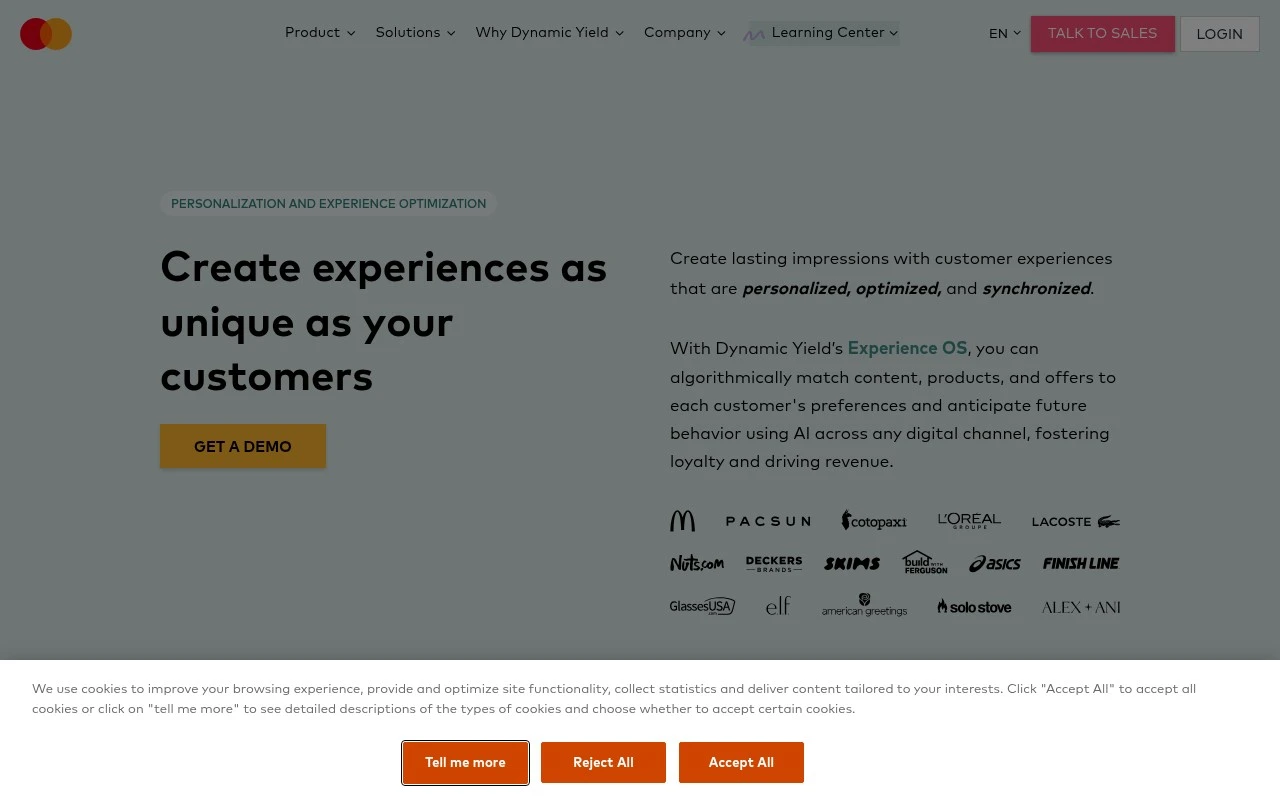
Dynamic Yield, now part of Mastercard, is a personalization platform used by larger digital businesses to adapt customer experiences in real time. It combines recommendation engines, segmentation, targeting, and experimentation tools so teams can test and deliver different experiences to different users across digital channels.

FYAI Score

7.8 / 10

Based on 157 reviews

Pricing:

Paid only

Best for:

Enterprise ecommerce and product teams optimizing on-site experiences

Score Breakdown

  • Ease of use8.4 / 10
  • Features7.3 / 10
  • Pricing7.0 / 10
  • Integrations8.0 / 10
  • Support8.2 / 10

PRODUCT PREVIEW

What this AI tool does

Dynamic Yield is a digital experience and personalization platform used to tailor what users see across websites, mobile apps, and other customer touchpoints. It helps teams present different content, offers, or layouts to different audiences based on behavior, context, or defined segments, with the goal of making experiences more relevant. In practice, it’s often used by product, marketing, and analytics teams to test changes and learn what improves engagement or conversion. By combining audience targeting with experimentation and measurement, dynamicyield supports an iterative approach to optimizing customer journeys while keeping results grounded in data. It can fit into existing stacks by working alongside analytics tools, tag managers, and customer data sources. This makes it useful for organizations that want a structured way to run personalization and A/B testing programs without rebuilding their front-end systems from scratch.

Use cases

Best for

Conversion Rate Optimization

Run A/B tests and targeted content variations to measure which on site experiences increase conversions.

Customer Segmentation

Dynamic Yield builds audience segments from behavioral and profile data so you can target experiences by user group.

Product Recommendations

Serve real time product recommendations using algorithms based on browsing behavior, affinities, and purchase history.

ANALYSIS

Strengths & limitations

Strengths
  • Combines personalization, recommendations, segmentation, and testing in one platform rather than treating them as separate workflows.
  • Designed for high-traffic, enterprise customer experiences where real-time targeting and experimentation matter.
  • Supports ecommerce-focused use cases such as product recommendations, personalized merchandising, and conversion optimization.
Limitations
  • Likely more complex than needed for small sites or teams that only need basic A/B testing or simple recommendations.
  • Pricing and implementation effort are typically enterprise-oriented and may require technical and analytics resources.
  • Value depends heavily on traffic volume, data quality, and the team’s ability to design, measure, and maintain personalization programs.

Evaluation

FYAI score breakdown

Our structured evaluation across five key criteria

7.8 / 10

Overall score

Based on 157 reviews

  • Ease of use8.4 / 10
  • Features7.3 / 10
  • Pricing7.0 / 10
  • Integrations8.0 / 10
  • Support8.2 / 10

What users say

Findings from public reviews, documentation and community sources.

  • Ease of use

    G2 lists Dynamic Yield at 4.5/5 across 157 reviews, and G2 quoted user feedback says “DY is an incredibly intuitive tool.” Capterra quotes a user saying one person primarily manages the account and “it has been a breeze.”

  • Features

    G2 review signal explicitly frames Dynamic Yield as a tool for starting a “personalization program,” and G2 lists 4.5/5 across 157 reviews. Dynamic Yield’s support section lists named integrations including “Algolia Integration,” “Zenloop Integration,” and “Smartling Integration.”

  • Pricing

    TrustRadius says “Dynamic Yield does not currently have any pricing plans listed.” A third-party pricing article states “the starting price is around $35,000 per year,” and Reddit sentiment includes a marketer saying they “almost fell over when it came to pricing.”

  • Integrations

    Dynamic Yield’s support section lists an “Integrations” area with “Algolia Integration,” “Zenloop Integration,” and “Smartling Integration.” An official Dynamic Yield page references a Tealium integration for real-time customer data.

  • Support

    G2 lists Dynamic Yield at 4.5/5 across 157 reviews, and G2 quoted feedback refers to “brilliant minds behind it.”

Who is this for?

Best for teams starting a personalization program, G2 review evidence explicitly frames Dynamic Yield as a tool for starting a “personalization program,” and Dynamic Yield’s support section lists integrations such as Algolia, Zenloop, and Smartling. Less suited to buyers who need published package pricing, TrustRadius says “Dynamic Yield does not currently have any pricing plans listed,” and a third-party pricing article states “the starting price is around $35,000 per year.”

PRODUCT PREVIEW

Feature highlights

Real-time personalization

Adapt content and offers instantly based on user behavior and context.

Product recommendations

Serve tailored items to boost AOV, conversion, and repeat purchases.

A/B testing & insights

Run experiments and measure impact to scale what works faster.

COMPARE

Discover curated alternatives worth comparing

Compare similar AI tools based on features, pricing and use cases

7.5/ 10Based on 12.890 reviews

Zoominfo

Lead GenerationCRM & Segmentation
Find and enrich B2B leads with firmographic and contact data
Best for:
Sales teams
Pricing
Paid only

8.6/ 10Based on 6.982 reviews

Zoho CRM

Sales & OutreachAnalytics & Reporting
AI assists CRM tasks: rewrite emails, detect anomalies, predict
Best for:
Sales teams
Pricing
Freemium

8.0/ 10Based on 1.041 reviews

Zoho Campaigns

Lead GenerationCRM & Segmentation
Create, automate, and analyze email and SMS marketing campaigns
Best for:
Marketing teams
Pricing
Freemium

See why leading retailers choose dynamic yield to turn browsing into buying. Deliver experiences that feel 1:1 and lift conversion across every touchpoint.

FAQ

Frequently asked
questions

Everything you need to know about this AI tool,
its features, pricing, use cases, and limitations.

What types of teams and use cases is dynamic yield a good fit for?
dynamic yield tends to fit e-commerce and retail teams that need real-time personalization across web, mobile, email, and in-app experiences. It’s most useful when you have enough traffic and product/content variation to justify segmentation, recommendations, and continuous testing. If your priority is simple pop-ups or basic email automation, lighter tools may be easier and cheaper.
Does dynamic yield offer a free plan, and what are the limitations of paid tiers?
dynamic yield is typically sold via paid, enterprise-style contracts rather than a self-serve free plan. Costs and access are usually tied to traffic volume, modules (e.g., recommendations, testing, personalization), and support levels. If you need predictable month-to-month pricing or a freemium trial workflow, you may prefer tools with transparent, self-serve plans.
How does dynamic yield compare with alternatives like Optimizely, Adobe Target, or Bloomreach?
Compared with Optimizely, dynamic yield is often chosen when personalization and product recommendations are central, not just experimentation. Versus Adobe Target, it can be simpler to deploy for commerce-focused teams, but Adobe may fit better if you’re already deep in the Adobe stack. Against Bloomreach, dynamic yield is more focused on experience personalization/testing, while Bloomreach often leans more into search/merchandising and broader commerce experience features.
How quickly can you implement dynamic yield, and what onboarding effort should you expect?
The platform can feel complex at the start, particularly around data setup and governance across teams. Pricing is commonly geared toward mid-market to enterprise budgets, which can be hard to justify for smaller sites or low traffic volumes. Some users also report slower support response times during busy periods, so internal expertise matters.
What should you check regarding data privacy, security, and compliance when evaluating dynamic yield?
Confirm how dynamic yield collects identifiers (cookies, device IDs), where data is processed/stored, and what controls exist for consent and opt-out flows. Review available agreements and documentation for GDPR/CCPA support, data retention, and subprocessors, especially if you operate in regulated regions. Also validate role-based access, audit logs, and whether PII is required or can be avoided via pseudonymous IDs.