Curated ToolThis tool is part of our curated AI directory. We only include tools that meet our standards for relevance, usability and real-world value.

Drip

Drip is an email and SMS marketing automation platform for ecommerce brands, offering customer segmentation, behavior-based workflows, and revenue attribution tied to online store activity.
Sales & OutreachCRM & Segmentation

FYAI Score

8.2 / 10

Based on 479 reviews

Pricing:

Paid

Best for:

Ecommerce brands running lifecycle email with lean marketing teams

Score Breakdown

  • Ease of use8.2 / 10
  • Features7.4 / 10
  • Pricing8.6 / 10
  • Integrations8.0 / 10
  • Support9.3 / 10

PRODUCT PREVIEW

What this AI tool does

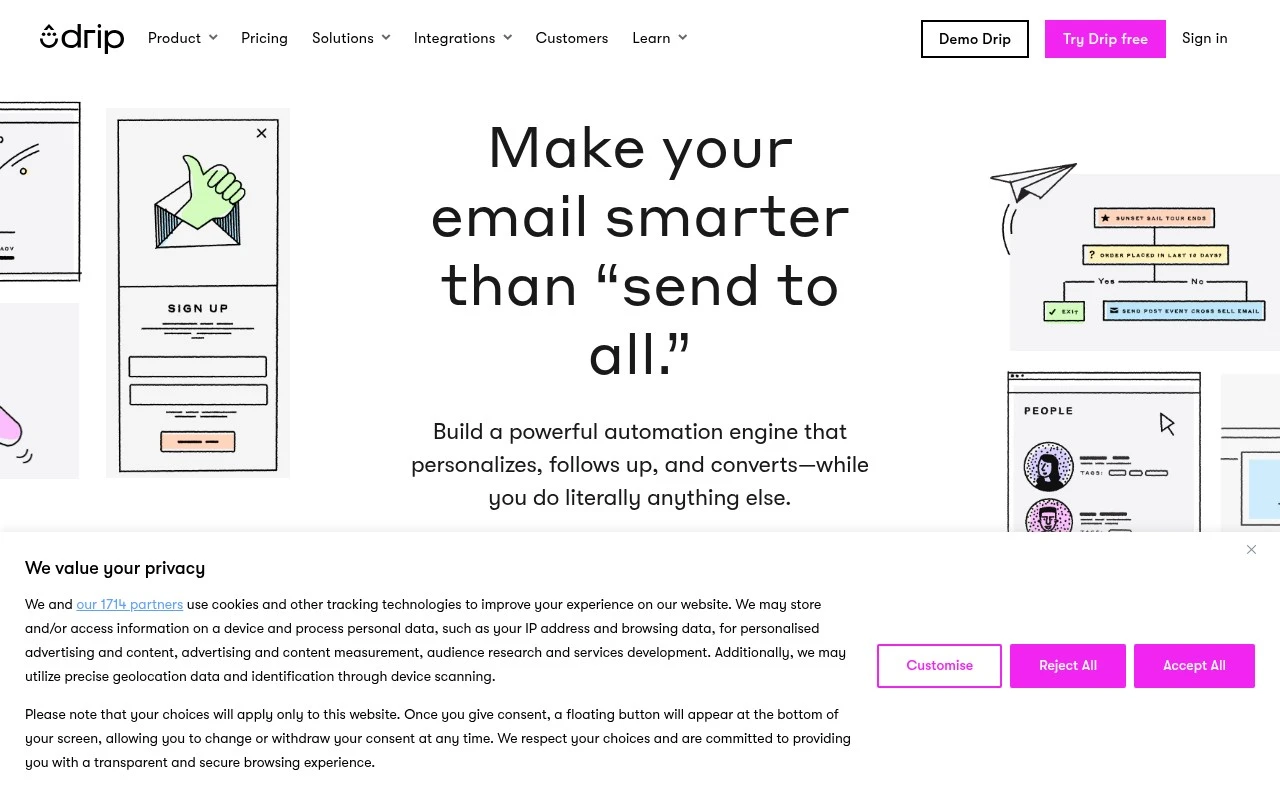
Drip is an ecommerce email marketing and marketing automation platform for online stores that need to turn customer behavior into targeted, automated messages. Drip is built for brands that sell online and want lifecycle email programs, segmentation, and customer reactivation without operating a large marketing operations team. Instead of presenting itself as a broad enterprise suite, the platform focuses on the day-to-day needs of ecommerce teams. Its value is in connecting store activity, customer data, and email workflows so that messages can respond to what shoppers actually do, such as browsing, buying, abandoning a cart, or becoming inactive. Commerce data is central to how the tool works. Drip connects with ecommerce and related platforms, imports customer and order information, and uses that data to make marketing automation more practical for lean teams. The result is a system where emails can be tied to purchase history, engagement patterns, product interest, and customer status rather than only to static mailing lists. Automated workflows are the heart of the experience. Teams can build sequences for welcomes, post-purchase follow-up, abandoned carts, replenishment reminders, win-back flows, and customer reactivation. Drip is best at helping ecommerce marketers create behavior-based email journeys that feel more relevant than one-size-fits-all newsletters. Customer segmentation gives the platform much of its power. A store can group subscribers by behavior, value, engagement, buying frequency, or other commerce signals, then send messages that match each group’s context. This makes it useful for small teams that want more sophistication than a basic email blast tool but do not want to depend on a dedicated automation specialist. Campaign creation is designed to be accessible. Ecommerce-ready templates, visual workflow tools, and guided setup make it easier to create an email campaign, refine the audience, and launch without starting from scratch. The emphasis is less on endless enterprise configuration and more on practical paths to revenue-focused messaging. For teams moving from another email system, migration support is part of the product story. Drip highlights help with importing contacts, preserving useful customer data, and getting core automations running so brands are not left to rebuild everything alone. Responsive support also matters because the target user is often a founder, marketer, or small ecommerce team member wearing several roles. Drip is for ecommerce businesses that have outgrown basic email tools but still need a focused, manageable platform. Its strongest fit is a store that wants better customer segmentation, more automated lifecycle communication, and clearer use of behavioral data without adopting a heavy enterprise marketing stack. In that sense, the platform’s character is practical and commerce-specific, built around helping online retailers send the right message to the right customer at the right moment.

Use cases

Best for

Marketing Automation

Use Drip to build ecommerce email automations triggered by purchases, browsing events, and customer attributes synced from your store.

Customer Segmentation

Import ecommerce customer data and create segments based on behavior, purchase history, and engagement to target specific audiences.

Create Email Campaign

Create an email campaign using ecommerce-ready templates, personalization fields, and scheduled sends to your selected segments.

ANALYSIS

Strengths & limitations

Strengths
  • Ecommerce-ready templates and workflows fit online sellers because teams can launch customer lifecycle emails around store behavior without building everything from scratch.
  • Behavioral segmentation from customer and order data fits lean B2C teams because they can personalize campaigns without needing a dedicated marketing automation specialist.
  • Migration help and ecommerce-focused support fit small teams moving from another email platform because onboarding is less dependent on in-house technical resources.

Limitations
  • Less suitable for broad enterprise marketing automation because its core scope is ecommerce email workflows rather than complex multi-department campaign operations.
  • Less suitable for teams that do not sell through online commerce, booking, or learning platforms because its strongest automation value depends on connected customer and transaction data.
  • Less suitable for very early-stage teams looking for a free marketing tool because Drip is a paid platform and costs are part of adopting it.

Evaluation

FYAI score breakdown

Our structured evaluation across five key criteria

8.2 / 10

Overall score

Based on 479 reviews

  • Ease of use8.2 / 10
  • Features7.4 / 10
  • Pricing8.6 / 10
  • Integrations8.0 / 10
  • Support9.3 / 10

What users say

Findings from public reviews, documentation and community sources.

  • Ease of use

    G2 summarizes 479 reviews with users praising Drip's "intuitive interface" and calling it "User friendly." Drip's FAQ describes setup as connecting a store, importing a list, and activating campaigns/workflows with templates.

  • Features

    Drip's website lists "smart segmentation and automation," abandoned-cart/post-purchase/win-back workflows, dynamic segments, and ecommerce personalization from browsing and purchase data.

  • Pricing

    Drip's pricing page says pricing is "based on your list size and send volume," starts at "$39" for "1-2,500 people," includes "Unlimited email sends," and offers a "14-day free trial. No credit card required." Drip's pricing page does not show a permanent free tier.

  • Integrations

    Drip states it offers "50+ integrations including Shopify, BigCommerce, WooCommerce." Drip's pricing page includes "Open API access" and "One click integrations" with stores and marketing tools.

  • Support

    Drip claims a "97.3%" customer satisfaction score, "live chat in under 2 min," and email responses in "less than 1.6 hours." G2's review summary mentions "Quick customer support in the chat," and Drip describes support access as tiered depending on plan/list size.

Who is this for?

Best for ecommerce teams that want store-based lifecycle email automation, Drip's website lists abandoned-cart/post-purchase/win-back workflows and ecommerce personalization from browsing and purchase data. Less suited to users who need a permanently free email tool, Drip's pricing page starts at "$39" for "1-2,500 people" and shows a "14-day free trial. No credit card required."

PRODUCT PREVIEW

Feature highlights

Behavioral Segments

Target shoppers by browsing, purchases, and engagement in real time.

Automated Workflows

Build welcome, cart, and post-purchase flows with visual automation.

Commerce Data Sync

Connect your store to import customer and order data for personalization.

COMPARE

Discover curated alternatives worth comparing

Compare similar AI tools based on features, pricing and use cases

7.5/ 10Based on 12,890 reviews

Zoominfo

Lead GenerationCRM & Segmentation
Finds prospects, enriches accounts, and flags buyer signals
Best for:
Sales teams
Pricing
Paid only

8.6/ 10Based on 6,982 reviews

Zoho CRM

Sales & OutreachAnalytics & Reporting
Rewrites emails, detects anomalies, and builds CRM modules
Best for:
Sales teams
Pricing
Freemium

8.0/ 10Based on 1,041 reviews

Zoho Campaigns

Lead GenerationCRM & Segmentation
Builds email and SMS campaigns, automates and analyzes results
Best for:
Marketing teams
Pricing
Freemium

Turn more shoppers into repeat customers with smarter, more personal email. Join eCommerce brands using Drip to grow revenue with every send.

FAQ

Frequently asked
questions

Everything you need to know about this AI tool,
its features, pricing, use cases, and limitations.

Is Drip a good fit for my ecommerce business?
Drip is best suited to B2C teams that sell products, services, courses, bookings, or digital goods online. It focuses on ecommerce email marketing, including welcome flows, abandoned cart emails, post-purchase follow-ups, win-back campaigns, targeted promotions, and segmentation based on shopper behavior, purchase history, engagement, and spend.
Is Drip free or do I need a paid plan?
Drip is a paid email marketing and automation platform. Its cost is tied to factors such as active people and email volume, so teams should expect pricing to increase as their contact list and sending needs grow. Check drip.com for the current plan details before budgeting.
How does Drip compare with other email marketing tools?
Drip is more focused on ecommerce automation than a general-purpose email newsletter or CRM platform. It is a strong fit when store data, purchase behavior, abandoned carts, post-purchase messaging, and customer segmentation matter. Teams needing broader sales CRM features or non-commerce marketing workflows may prefer a different platform.
How long does it take to set up Drip?
Drip’s main trade-off is that it is built primarily for ecommerce email automation rather than broad CRM or all-purpose marketing use. Costs can rise with active contacts and email volume, and buyers looking specifically for generative AI-native marketing features should evaluate whether Drip’s automation-led approach matches that requirement.
What should I check about data privacy and compliance before using Drip?
Teams should review Drip’s current privacy, security, data processing, and compliance documentation before connecting customer and store data. Key checks include how contact data, purchase activity, browsing behavior, consent status, unsubscribes, and integrations are handled, especially for businesses subject to GDPR, CCPA, or sector-specific requirements.