Curated ToolThis tool is part of our curated AI directory. We only include tools that meet our standards for relevance, usability and real-world value.

Demandbase

Analyzes B2B account signals to prioritize ABM and measure pipeline

Lead GenerationCRM & Segmentation
Demandbase is a B2B account-based marketing and go-to-market platform. It helps teams turn account and buying-group signals into prioritized actions, so marketing, sales, advertising, revenue operations, and customer success can focus on the accounts most likely to convert, expand, or require attention. The platform emphasizes AI-assisted signal analysis, account prioritization, coordinated execution, and pipeline measurement.

FYAI Score

7.9 / 10

Based on 1.989 reviews

Pricing:

Enterprise

Best for:

B2B revenue teams running account-based go-to-market

Score Breakdown

  • Ease of use7.7 / 10
  • Features8.3 / 10
  • Pricing7.4 / 10
  • Integrations8.6 / 10
  • Support7.6 / 10

PRODUCT PREVIEW

What this AI tool does

Demandbase is a B2B marketing and sales platform designed to help teams focus on the right accounts and tailor outreach based on company-level signals. It’s commonly used in account-based marketing (ABM) programs where understanding which organizations are showing intent—and how they engage across channels—can guide prioritization and messaging. In practice, the tool brings together firmographic data, engagement activity, and intent insights to support targeting, personalization, and measurement. Marketing teams may use it to refine audience segments and align campaigns to specific accounts, while sales teams can use the same account context to inform prospecting and follow-up. For organizations evaluating ABM tools, demandbase is typically considered when there’s a need to coordinate marketing and sales around shared account lists and to track how account engagement changes over time. It’s best suited to teams that want a structured way to manage account targeting and reporting without relying on disconnected data sources.

Use cases

Best for

Predictive Analysis

Demandbase analyzes account and buying group intent signals to predict which accounts are most likely to convert or expand.

Customer Segmentation

It segments target accounts by firmographics, intent, engagement, and pipeline stage to build prioritized account lists.

Marketing Automation

It triggers coordinated ads and sales plays from account signals and syncs audiences and outcomes to CRM and MAP tools.

ANALYSIS

Strengths & limitations

Strengths
  • Connects account, buying-group, engagement, and performance data around shared pipeline priorities.
  • Supports cross-functional use across marketing, sales, advertising, revenue operations, and customer success.
  • Focuses on both new pipeline creation and expansion opportunities within existing customer accounts.
Limitations
  • Best suited to B2B account-based go-to-market motions, not general-purpose marketing or sales management.
  • Its usefulness depends on having enough reliable account, engagement, and buying-signal data to analyze and act on.
  • The provided official page does not give detailed pricing, implementation requirements, or integration coverage.

Evaluation

FYAI score breakdown

Our structured evaluation across five key criteria

7.9 / 10

Overall score

Based on 1.989 reviews

  • Ease of use7.7 / 10
  • Features8.3 / 10
  • Pricing7.4 / 10
  • Integrations8.6 / 10
  • Support7.6 / 10

What users say

Findings from public reviews, documentation and community sources.

  • Ease of use

    G2's review snippet says, "The UI is pretty easy to navigate," and G2 shows Demandbase at 4.4/5 across 1,989 verified reviews.

  • Features

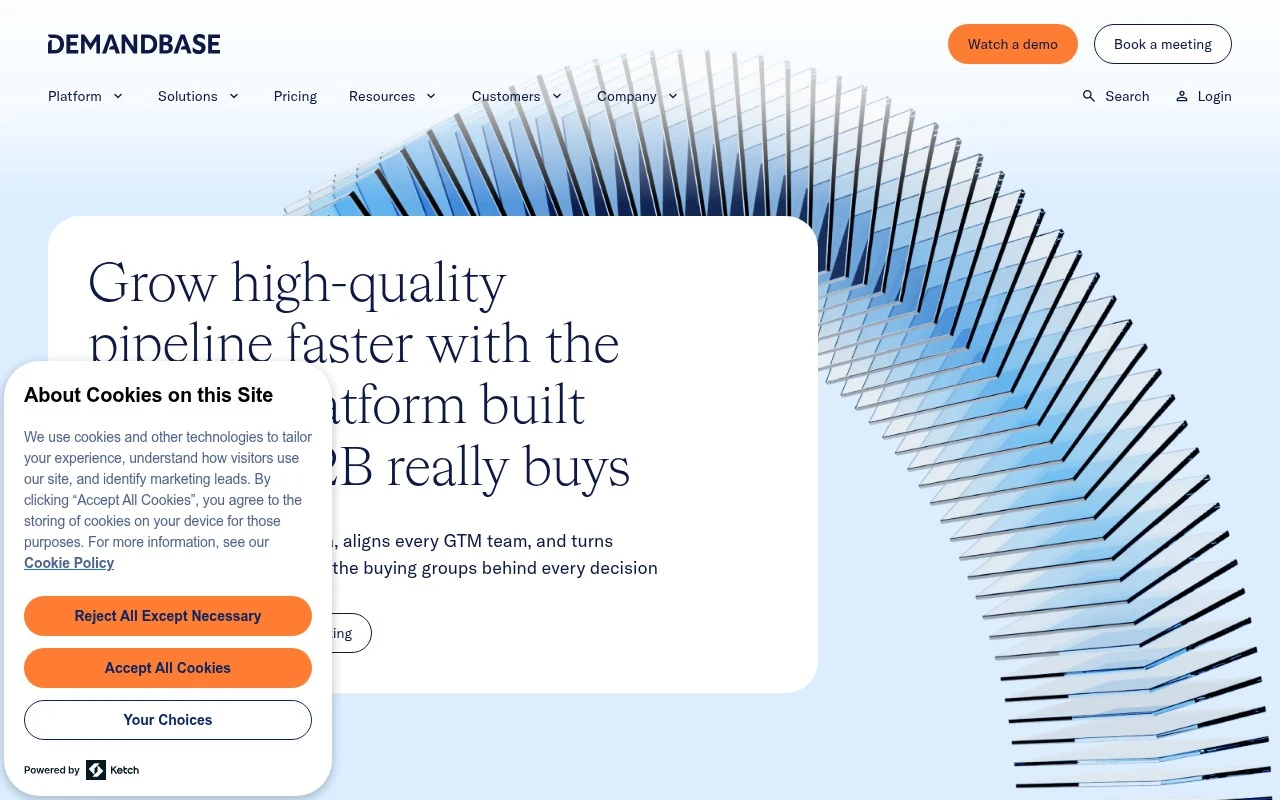
    The Demandbase homepage describes an account-based GTM platform spanning Marketing, Sales, Advertising, and Revenue Operations. The Demandbase homepage says its AI can "analyze signals, accounts, and buying group activity" and activate coordinated programs.

  • Pricing

    The Demandbase pricing page says users must "Fill out the form" for a customized plan. The Demandbase pricing page references a "clear platform fee" plus a "flat fee per user."

  • Integrations

    The Demandbase Marketplace says users can "discover, connect, and activate pre-built integrations." Demandbase support materials reference CRM, MAS, Facebook/Meta, Google Ads, and a broader integrations reference list.

  • Support

    G2's Demandbase seller page lists Demandbase at 4.4/5 across 1,989 verified reviews.

Who is this for?

Best for enterprise teams running account-based GTM programs, the Demandbase homepage describes a platform spanning Marketing, Sales, Advertising, and Revenue Operations, with AI used to "analyze signals, accounts, and buying group activity." Less suited to buyers who need public self-serve pricing, the Demandbase pricing page says users must "Fill out the form" for a customized plan with a "clear platform fee" plus a "flat fee per user."

PRODUCT PREVIEW

Feature highlights

Intent Signal Insights

Unify intent and engagement signals to spot in-market accounts.

Account Prioritization

AI ranks accounts and buying groups so teams act on the best ones.

Pipeline Measurement

Track account impact across ads, sales, and revenue outcomes.

COMPARE

Discover curated alternatives worth comparing

Compare similar AI tools based on features, pricing and use cases

7.5/ 10Based on 12.890 reviews

Zoominfo

Lead GenerationCRM & Segmentation
Find and enrich B2B leads with firmographic and contact data
Best for:
Sales teams
Pricing
Paid only

8.6/ 10Based on 6.982 reviews

Zoho CRM

Sales & OutreachAnalytics & Reporting
AI assists CRM tasks: rewrite emails, detect anomalies, predict
Best for:
Sales teams
Pricing
Freemium

8.0/ 10Based on 1.041 reviews

Zoho Campaigns

Lead GenerationCRM & Segmentation
Create, automate, and analyze email and SMS marketing campaigns
Best for:
Marketing teams
Pricing
Freemium

See why B2B teams choose Demandbase to focus on the right accounts, align sales and marketing, and turn intent into pipeline faster.

FAQ

Frequently asked
questions

Everything you need to know about this AI tool,
its features, pricing, use cases, and limitations.

When is Demandbase a good fit, and when should I consider a lighter ABM tool?
Demandbase is best for B2B teams running account-based programs across many target accounts and channels, especially when you need account identification, intent, and measurement in one workflow. It tends to fit mid-market to enterprise orgs with defined ICPs, sales alignment, and enough traffic/data to power segmentation. If you only need basic firmographic targeting or small-scale LinkedIn-centric ABM, a simpler platform may be easier to justify.
Does Demandbase offer a free plan, and what should I expect in paid tiers?
Demandbase is typically sold via paid contracts rather than a self-serve free plan, and pricing is usually quote-based. Access to core capabilities (account identification, intent, advertising, and advanced analytics) is generally packaged and may scale by modules, data volume, or account limits. If you need a low-commitment trial, confirm what’s available through sales and what data/connectors are included.
How does Demandbase compare with 6sense, RollWorks, or Terminus for ABM?
Demandbase is often compared on the strength of its account identification, intent-driven targeting, and measurement across the account journey. Versus lighter options like RollWorks, it can offer deeper analytics and broader enterprise workflows but may require more setup and budget. Against peers like 6sense or Terminus, differences usually come down to data coverage, UI/workflow preferences, and how well each integrates with your CRM/MAP and ad stack—testing with your own accounts is key.
How quickly can I get Demandbase running, and what onboarding effort is typical?
Cost and operational overhead are the biggest factors—Demandbase can be hard to justify for small teams without dedicated ABM ownership. Performance is sensitive to data quality and clear account definitions, so weak CRM structure can limit results and reporting accuracy. Some users also find the platform’s breadth means a steeper learning curve compared with point solutions.
What should I check about data privacy, security, and compliance with Demandbase?
Confirm what first-party and third-party data Demandbase uses for account identification and intent, and how it supports consent requirements for your regions. Review data retention, subprocessors, and where data is processed/stored, especially if you have GDPR/UK GDPR or other cross-border constraints. If you’re syncing CRM data, validate role-based access controls, auditability, and whether your legal team needs a DPA and security documentation (e.g., SOC 2) before rollout.