Curated ToolThis tool is part of our curated AI directory. We only include tools that meet our standards for relevance, usability and real-world value.

ConvertKit

ConvertKit is an email marketing platform for creators that helps users build email lists, create landing pages and sign-up forms, send newsletters, and manage automated subscriber sequences.
Lead GenerationMarketing Automation

FYAI Score

7.7 / 10

Based on 234 reviews

Pricing:

Freemium

Best for:

Creators building newsletters, funnels, and paid offers from one platform

Score Breakdown

  • Ease of use7.2 / 10
  • Features7.6 / 10
  • Pricing8.5 / 10
  • Integrations7.4 / 10
  • Support7.7 / 10

PRODUCT PREVIEW

What this AI tool does

ConvertKit is a creator-first email marketing platform, now known in many contexts as Kit, for writers, podcasters, educators, coaches, musicians, and independent businesses that want to grow an audience they can reach directly. ConvertKit is best at connecting email list growth, newsletter publishing, marketing automation, and creator monetization in a single workflow built around subscribers rather than anonymous contacts. For creators, the central promise is ownership of the audience relationship. Instead of depending entirely on social feeds, search rankings, or platform algorithms, users can invite people onto an email list, understand what they care about, and communicate with them consistently through newsletters, sequences, and targeted broadcasts. Audience growth is treated as part of the publishing process, not a separate technical project. The platform helps users create opt-in forms, build landing page experiences, and organise lead capture around free downloads, waitlists, courses, events, or newsletter signups. This makes it especially useful for people who are turning attention into a long-term subscriber base. Automation gives the product much of its practical depth. A creator can welcome new subscribers, deliver a lead magnet, tag people by interest, and move them through an email journey based on what they click, buy, or sign up for. Customer segmentation is central to this approach, allowing the same audience to receive more relevant messages without forcing the creator to manage multiple disconnected lists. Monetization is a major part of the ConvertKit identity. The platform is designed not only to send email, but to help creators earn from the trust they build with their subscribers. Digital products, paid newsletters, subscriptions, recommendations, and sponsorship opportunities all fit into the broader idea that an email audience can become a sustainable creator business. The writing and campaign experience is intentionally simple compared with many enterprise marketing suites. Users can create email campaign flows, send a newsletter, or set up a sequence without needing a large marketing team or complex design process. The emphasis is on clear communication, deliverability, and practical automation rather than heavy corporate campaign management. Compared with general email tools, ConvertKit is more opinionated about who it serves. It is not primarily built for large ecommerce catalogues, sales-led B2B pipelines, or broad CRM operations. ConvertKit is for people whose business is built around content, expertise, community, and direct audience trust. In practice, the tool sits between a newsletter platform, a no-code marketing automation system, and a lightweight commerce layer for creators. That combination is what gives it a distinct character: it helps a person publish, learn from subscriber behaviour, deepen relationships, and turn those relationships into revenue without leaving the same operating system.

Use cases

Best for

Create Email Campaign

Build and send a ConvertKit email campaign using templates, subscriber tags, and scheduled broadcasts to your list.

Customer Segmentation

Segment subscribers by tags, custom fields, and link clicks to target newsletters to specific audiences.

Marketing Automation

Automate email sequences with visual rules that trigger on signups, purchases, or tag changes and send timed emails.

ANALYSIS

Strengths & limitations

Strengths
  • Best suited to creators and creator-led businesses because its email, newsletter, automation, and monetization features are built around growing a direct audience relationship.
  • Strong fit for newsletter writers, educators, authors, podcasters, and online entrepreneurs because subscriber growth, recommendations, and audience value are central to the platform.
  • Freemium pricing lowers the barrier to starting an email list, which suits creators who want to test newsletters and basic audience building before committing to paid usage.

Limitations
  • Less suitable for teams seeking a dedicated AI marketing tool because its core product is email marketing automation and creator monetization rather than standalone AI campaign generation.
  • Less suitable for businesses that need a broad all-in-one marketing suite because its strongest fit is creator-focused email, newsletters, and audience monetization rather than full CRM, ads, or social media operations.
  • Costs can become a bigger planning factor as a creator’s subscriber base and required features grow because the freemium model typically places more advanced or higher-volume usage on paid plans.

Evaluation

FYAI score breakdown

Our structured evaluation across five key criteria

7.7 / 10

Overall score

Based on 234 reviews

  • Ease of use7.2 / 10
  • Features7.6 / 10
  • Pricing8.5 / 10
  • Integrations7.4 / 10
  • Support7.7 / 10

What users say

Findings from public reviews, documentation and community sources.

  • Ease of use

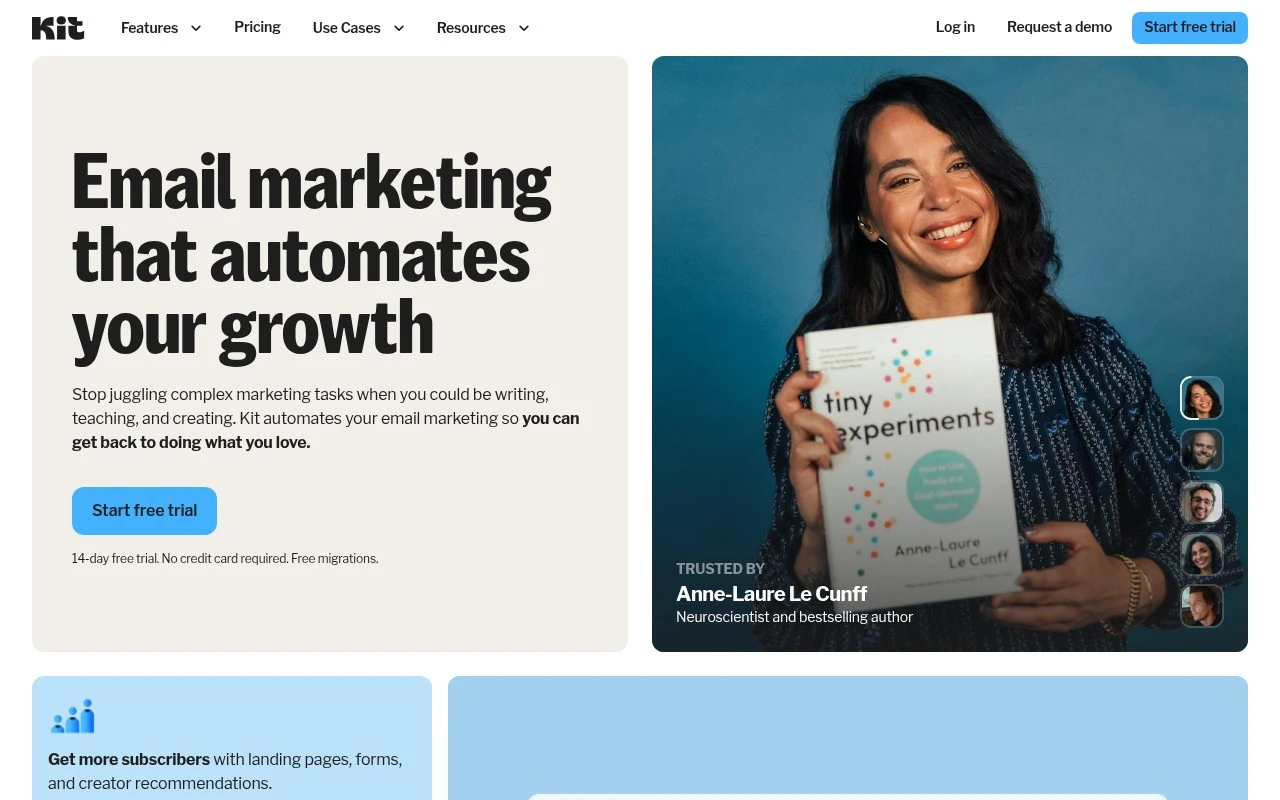
    Kit positions onboarding around a creator workflow with a “14-day free trial,” “No credit card required,” and “Free migrations.” A Reddit user described using Kit for “simple funnels,” while another Reddit comment reported strong frustration after recent issues.

  • Features

    The Kit pricing page lists unlimited landing pages/forms and broadcasts, tagging/segmentation, unlimited visual automations and sequences, and A/B testing. The Kit pricing page also lists digital products/subscriptions, SMS marketing, analytics, and a referral system.

  • Pricing

    The Kit pricing page lists a free Newsletter plan for 1,000 subscribers, Creator at $33/mo, and Pro at $66/mo. The Kit pricing page also lists a “14-day free trial,” “No credit card required,” and annual billing savings.

  • Integrations

    The Kit pricing page lists “Apps & integrations” on the Creator plan and “Facebook custom audiences” on Pro. The Kit homepage says users can “connect your creator tools directly to Kit.”

  • Support

    The Kit pricing page says paid plans include “24/7 email & chat support,” and Pro adds “24/7 priority email & chat support.” Trustpilot lists ConvertKit at 1.9/5 across 67 reviews and includes a support-escalation complaint.

Who is this for?

Best for creators who want email capture, broadcasts, segmentation, and automations in one marketing tool, the Kit pricing page lists unlimited landing pages/forms and broadcasts, tagging/segmentation, and unlimited visual automations and sequences. Best for trying a subscriber-based plan before paying, the Kit pricing page lists a free Newsletter plan for 1,000 subscribers plus a “14-day free trial” with “No credit card required.” Less suited to teams that depend on consistently strong public support sentiment. Trustpilot lists ConvertKit at 1.9/5 across 67 reviews and includes a support-escalation complaint.

PRODUCT PREVIEW

Feature highlights

Creator automations

Trigger emails by tags, clicks, and purchases to nurture subscribers.

Segmentation & tagging

Target the right subscribers with tags, segments, and personalization.

Built-in monetization

Sell digital products, subscriptions, and sponsorships to your list.

COMPARE

Discover curated alternatives worth comparing

Compare similar AI tools based on features, pricing and use cases

7.5/ 10Based on 12,890 reviews

Zoominfo

Lead GenerationCRM & Segmentation
Finds prospects, enriches accounts, and flags buyer signals
Best for:
Sales teams
Pricing
Paid only

8.6/ 10Based on 6,982 reviews

Zoho CRM

Sales & OutreachAnalytics & Reporting
Rewrites emails, detects anomalies, and builds CRM modules
Best for:
Sales teams
Pricing
Freemium

8.0/ 10Based on 1,041 reviews

Zoho Campaigns

Lead GenerationCRM & Segmentation
Builds email and SMS campaigns, automates and analyzes results
Best for:
Marketing teams
Pricing
Freemium

Join creators growing loyal audiences with ConvertKit. Start turning subscribers into customers with emails that feel personal and drive consistent sales.

FAQ

Frequently asked
questions

Everything you need to know about this AI tool,
its features, pricing, use cases, and limitations.

Who is ConvertKit best suited for?
ConvertKit is best suited for creators and creator-led businesses that rely on email to grow and monetize an audience. It fits authors, newsletter writers, educators, podcasters, and online entrepreneurs who need landing pages, forms, newsletters, automated email campaigns, and creator-focused monetization tools.
Does ConvertKit have a free plan, and when would I need to pay?
ConvertKit uses a freemium pricing model, so users can start for free and upgrade when they need more capacity or advanced capabilities. Buyers should review ConvertKit’s current pricing page to compare plan limits, subscriber allowances, automation access, and monetization features before choosing a paid plan.
How does ConvertKit compare with other email marketing platforms?
ConvertKit is more creator-focused than many broad email marketing platforms. Its strengths are audience capture, newsletters, creator recommendations, email automation, and monetization workflows. Teams that need deeper CRM, sales pipeline, enterprise reporting, or complex multi-department marketing operations may want to compare it with broader marketing suites.
How quickly can I get started with ConvertKit?
ConvertKit’s main trade-off is that it is built primarily for creator email marketing rather than broad enterprise marketing operations. It may be less suitable for teams that require advanced CRM functionality, complex sales workflows, highly detailed analytics, or a platform that is clearly positioned as AI-native.
What should I check about ConvertKit privacy and compliance before using it?
Teams evaluating ConvertKit should confirm its current privacy, security, and compliance documentation before importing subscriber data. Important checks include data processing terms, consent management, unsubscribe handling, data export options, retention practices, regional compliance needs, and whether its controls match your organisation’s email marketing obligations.