Curated ToolThis tool is part of our curated AI directory. We only include tools that meet our standards for relevance, usability and real-world value.

Convert

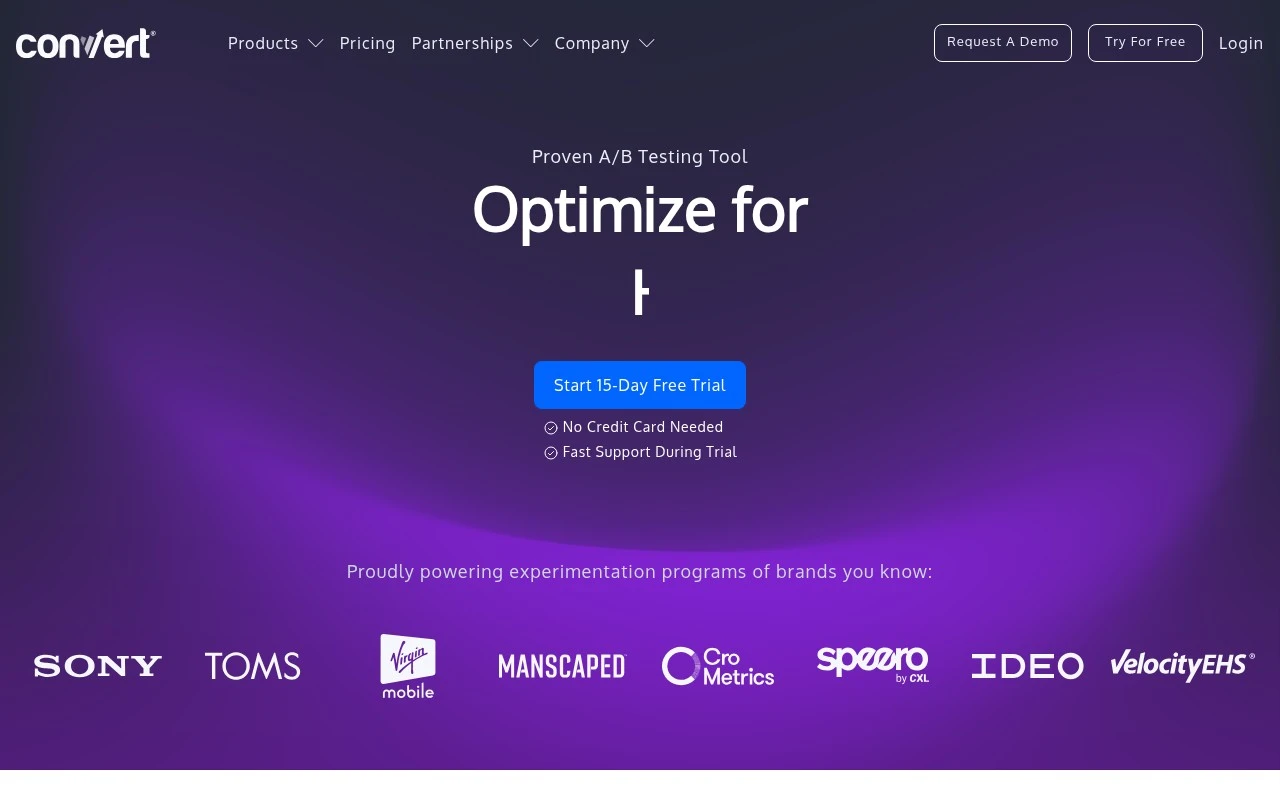
Convert is a conversion rate optimization platform for running A/B, split URL, and multivariate tests, with features for website personalization and experiment reporting.
Conversion Optimization

FYAI Score

8.8 / 10

Based on 445 reviews

Pricing:

Paid

Best for:

Growth and product teams running privacy-first A/B tests

Score Breakdown

  • Ease of use8.4 / 10
  • Features9.1 / 10
  • Pricing8.6 / 10
  • Integrations8.4 / 10
  • Support9.4 / 10

PRODUCT PREVIEW

What this AI tool does

Convert is a privacy-focused A/B testing and experimentation platform for growth, product, marketing, and optimization teams that want to improve websites and digital products through controlled tests. Also branded as Convert Experiences, it sits in the conversion rate optimization category, but its positioning is more specific than simply running headline or button-color tests. Convert is built for teams that need experimentation, personalization, targeting, and measurement while keeping data protection and implementation quality at the centre of the workflow. For growth teams, the core story is disciplined experimentation without turning the website into a patchwork of fragile scripts. The platform supports client-side tests for fast website experimentation, while also extending into full-stack experimentation and feature flags for teams that want to test product logic, releases, or backend-driven experiences. Convert is best at helping privacy-conscious teams run reliable experiments across marketing sites, ecommerce funnels, and product experiences without giving up control over how tests are delivered and measured. Privacy is one of the clearest parts of its identity. Convert emphasizes first-party cookies, GDPR and ePrivacy-oriented design, and German data storage, which makes it especially relevant for organizations that operate in stricter compliance environments or serve European users. Rather than treating privacy as a checkbox, the platform uses it as a differentiator for teams comparing experimentation tools that may rely more heavily on third-party tracking or less transparent data handling. Experiment setup is designed to serve both non-technical optimizers and technical teams. Marketers can use visual editing and targeting options to launch website tests, while developers can work with APIs, code-based experiments, full-stack use cases, and feature flags. This balance matters because conversion rate optimization often starts with simple page changes, then grows into deeper questions about pricing flows, onboarding paths, checkout logic, product messaging, and audience-specific experiences. Personalization extends the platform beyond classic A/B testing. Teams can show different experiences to different segments using targeting based on behavior, traffic source, geography, device, cookies, or other available conditions. In that sense, Convert is not only a testing tool, but also a way to operationalize what a team learns, turning winning ideas into more relevant experiences for specific visitors. Measurement is handled through goals, integrations, and experiment reporting that help teams connect changes to outcomes. The value is not just in declaring a winner, but in giving optimization teams a repeatable process for deciding what to test, who should see it, and how success should be defined. Integrations with analytics, tag management, ecommerce, customer data, and marketing systems help it fit into existing stacks rather than forcing teams to rebuild their measurement workflow from scratch. Compared with broader digital experience suites, the platform feels more focused and specialist. A thoughtful Convert review will usually highlight its privacy posture, flicker-free rendering, support quality, and experimentation depth rather than describing it as an all-in-one marketing cloud. That focus can appeal to teams that already have analytics, CMS, and product tools in place, but need a dedicated experimentation layer that behaves predictably and respects user data. When evaluating Convert pricing, teams should think less in terms of a simple testing widget and more in terms of the cost of a governed experimentation program. The platform is most relevant when testing velocity, data protection, and implementation reliability are important enough to justify a dedicated tool. Smaller teams may use it to professionalize website optimization, while larger teams can use it as a controlled environment for experiments across channels, audiences, and product surfaces. In practice, Convert is for organizations that want experimentation to be evidence-based, privacy-aware, and technically dependable. It is especially well suited to ecommerce brands, SaaS companies, agencies, and optimization teams that need to run tests without compromising compliance or site experience. Its character is pragmatic rather than flashy, combining A/B testing, personalization, feature experimentation, and responsive support into a platform built for serious conversion rate optimization work.

Use cases

Best for

Website A/B Testing

Convert runs A/B, split, and Shopify tests with audience targeting and goal tracking on your website.

Server-Side Experiments

Run full-stack experiments via APIs using feature flags and controlled rollouts to assign variants in your backend.

Experimentation Program Management

Manage experiments with statistical reporting, collision prevention, integrations, and onboarding and support workflows.

ANALYSIS

Strengths & limitations

Strengths
  • Best suited to privacy-conscious experimentation teams because it uses first-party cookies, GDPR and ePrivacy-oriented design, and German data storage.
  • Strong fit for CRO, ecommerce, SaaS, and product teams because it supports client-side tests, personalization, advanced targeting, goals, full-stack experimentation, feature flags, APIs, and integrations in one platform.
  • Useful for teams that need controlled experimentation workflows because its remote MCP server can help automate parts of testing without turning Convert into an AI content-generation tool.

Limitations
  • Less suitable for teams looking for an AI content or creative generation tool because Convert is focused on experimentation workflows rather than producing marketing assets.
  • Less suitable for very small websites or early-stage teams because a paid experimentation platform usually needs enough traffic, budget, and test volume to justify the investment.
  • Less suitable for nontechnical teams that want only simple visual edits because full-stack experiments, feature flags, APIs, and advanced targeting require implementation planning and developer involvement.

Evaluation

FYAI score breakdown

Our structured evaluation across five key criteria

8.8 / 10

Overall score

Based on 445 reviews

  • Ease of use8.4 / 10
  • Features9.1 / 10
  • Pricing8.6 / 10
  • Integrations8.4 / 10
  • Support9.4 / 10

What users say

Findings from public reviews, documentation and community sources.

  • Ease of use

    G2 includes 98 reviews, and a quoted user says Convert Experiences is “really easy to use and very intuitive” and that “the visual editor is quite good” for smaller changes.

  • Features

    Convert lists “Full-stack Experimentation,” “API,” “40+ filters,” and “Frequentist and Bayesian stats engines” among its experimentation features.

  • Pricing

    Convert pricing page shows Growth at “$399/mo” for “100K tested users/month,” Pro at “$599/mo,” annual discounts up to 25–30%, and a “15-Day Free Trial” with “No Credit Card Required.” Convert pricing page lists Enterprise as “Price on Request.”

  • Integrations

    Convert states “We Work With 90+ Of Your Favorite Tools” and highlights a “powerful API” that can run a headless version of Convert in a customer ecosystem.

  • Support

    Convert claims a “first-response time” of “7 minutes,” “fast support during trial,” and support that is “4x faster.” Convert pricing page specifies “Email and In-App Live Chat Support,” “Phone Support,” and Enterprise SLA options.

Who is this for?

Best for teams running marketing experiments on web or Shopify who want built-in testing depth. Convert lists “A/B Testing,” “Split Testing,” “Shopify Testing,” and “Full-stack Experimentation.” Less suited to teams that need fixed enterprise pricing before contacting sales, Convert pricing page lists Enterprise as “Price on Request.”

PRODUCT PREVIEW

Feature highlights

Flicker-free tests

Render variations smoothly to protect UX and data quality.

Targeting & goals

Segment audiences and measure what matters with flexible goals.

Privacy-first setup

First-party cookies and GDPR/ePrivacy-oriented design.

COMPARE

Discover curated alternatives worth comparing

Compare similar AI tools based on features, pricing and use cases

7.5/ 10Based on 12,890 reviews

Zoominfo

Lead GenerationCRM & Segmentation
Finds prospects, enriches accounts, and flags buyer signals
Best for:
Sales teams
Pricing
Paid only

8.6/ 10Based on 6,982 reviews

Zoho CRM

Sales & OutreachAnalytics & Reporting
Rewrites emails, detects anomalies, and builds CRM modules
Best for:
Sales teams
Pricing
Freemium

8.0/ 10Based on 1,041 reviews

Zoho Campaigns

Lead GenerationCRM & Segmentation
Builds email and SMS campaigns, automates and analyzes results
Best for:
Marketing teams
Pricing
Freemium

Turn guesses into growth with Convert. Launch experiments, learn what works, and lift conversions with confidence—start optimizing today.

FAQ

Frequently asked
questions

Everything you need to know about this AI tool,
its features, pricing, use cases, and limitations.

Is Convert a good fit for CRO teams running website experiments?
Convert is best suited for CRO, growth, product, ecommerce, SaaS, and agency teams that need a self-service experimentation platform. It supports website A/B tests, split tests, Shopify tests, audience targeting, goal tracking, personalization, and full-stack experiments, making it useful for validating changes before releasing them broadly.
Is Convert free or paid?
Convert is a paid experimentation platform, so teams should evaluate it as a budgeted CRO tool rather than a free testing option. Buyers should review convert.com for current pricing and plan details, especially if traffic volume, advanced targeting, full-stack experimentation, or support requirements affect the best fit.
How does Convert compare with other A/B testing tools?
Convert competes as a specialized A/B testing and experimentation platform with both client-side and full-stack capabilities. Compared with broader marketing suites, it is more focused on experimentation workflows, feature flags, rollouts, statistics, targeting, and privacy-conscious data handling. The right choice depends on budget, traffic, technical resources, and testing maturity.
How much work does it take to set up Convert?
Convert is specialized for experimentation and conversion testing, not for general marketing automation, content generation, or all-in-one analytics. Teams still need to design experiments, manage implementation, configure tracking, and interpret results. Its paid positioning may also be a trade-off for very small teams or sites with limited testing volume.
How does Convert handle privacy and compliance for experimentation data?
Convert emphasizes privacy-focused experimentation with first-party cookies, German data storage, and alignment with GDPR, TTDSG, and BDSG requirements. This makes it relevant for teams that need controlled testing workflows and data handling safeguards. Buyers should still review their own legal, consent, and data-processing requirements before deployment.