Curated ToolThis tool is part of our curated AI directory. We only include tools that meet our standards for relevance, usability and real-world value.

Constructor

Constructor is an AI-powered product discovery platform for ecommerce retailers, providing personalized site search, browse experiences, and product recommendations based on shopper behavior and catalog data.
Conversion Optimization

FYAI Score

8.7 / 10

Based on 58 reviews

Pricing:

Paid only

Best for:

Ecommerce teams optimizing search, browse, and recommendations for revenue

Score Breakdown

  • Ease of use8.4 / 10
  • Features9.3 / 10
  • Pricing7.6 / 10
  • Integrations8.8 / 10
  • Support9.3 / 10

PRODUCT PREVIEW

What this AI tool does

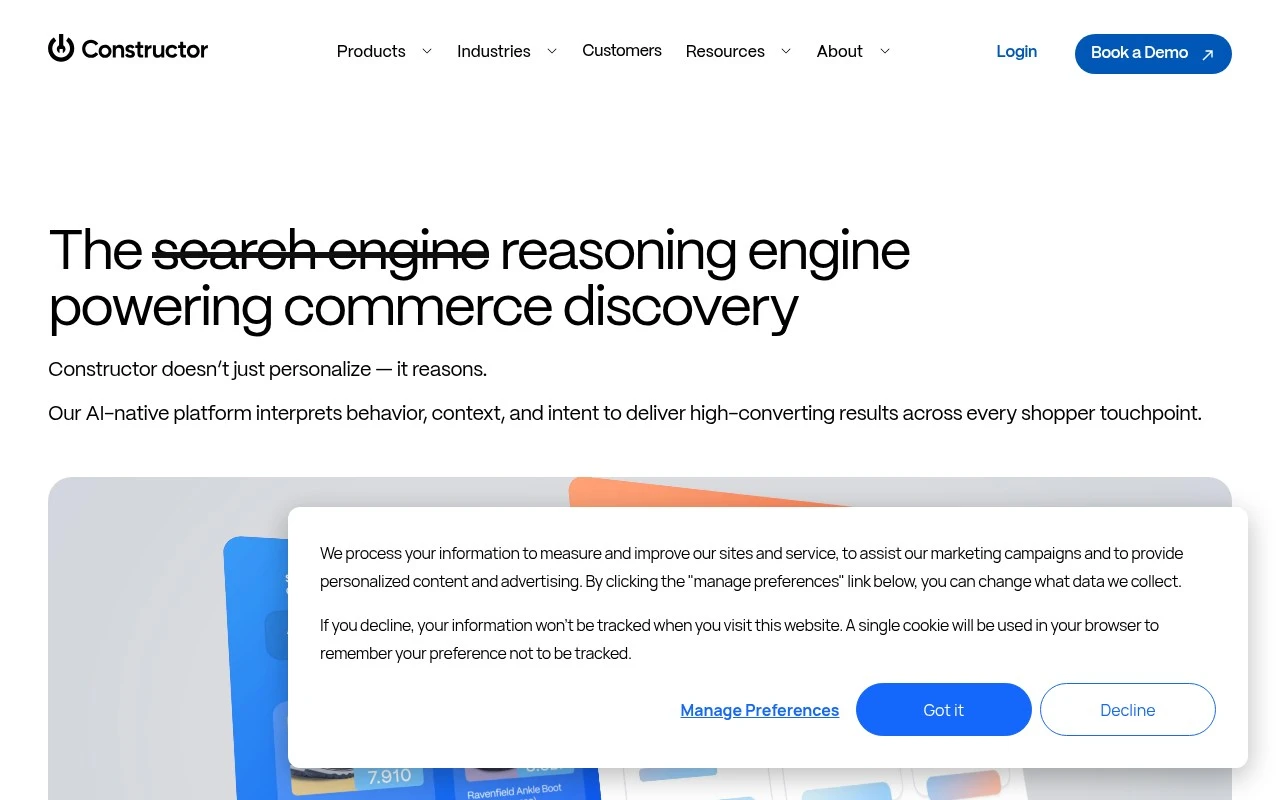
Constructor is an AI-native search and product discovery platform for ecommerce teams that want every shopper interaction to be optimized around revenue, relevance, and customer intent. Constructor is built for retailers, marketplaces, and digital commerce brands that need more than generic site search, especially when search, browse, product recommendations, and merchandising decisions directly affect conversion rate optimization. For commerce teams, the central promise is that product discovery should learn from how shoppers actually behave. The platform combines catalog data with behavioral signals, context, and intent to decide which products to surface, how to rank them, and when to personalize the experience. This makes it particularly relevant for businesses with large catalogs, frequent inventory changes, and diverse shopper journeys. Search is one of the core entry points, but the product story goes beyond matching keywords to items. It is designed to understand ecommerce intent, such as when a shopper searches for a category, an attribute, a problem to solve, or a product type expressed in everyday language. Instead of treating search as a static retrieval task, the platform uses performance feedback to improve which results are likely to lead to engagement, add-to-cart activity, and purchases. Personalization is where Constructor most clearly differs from general-purpose search tools. Constructor uses shopper behavior and context to adapt results, browse pages, collections, and recommendations for each visitor or segment. That matters because two shoppers may use the same query but have different preferences, price sensitivities, brand affinities, or purchase histories. Product recommendations are part of the same discovery layer rather than a disconnected widget. The platform can support recommendation experiences across product detail pages, carts, category pages, homepages, and other commerce touchpoints, using AI to decide what is most relevant in context. For retailers focused on average order value, repeat engagement, and conversion rate optimization, this makes recommendations a strategic part of the customer journey rather than a simple cross-sell module. Merchandising teams also get a role in shaping outcomes without manually controlling every result. Business rules, campaign goals, inventory needs, retail media placements, and curated collections can be incorporated while the AI continues to optimize for shopper relevance. This balance is important for ecommerce organizations that need automation but still want commercial control over promotions, margins, supplier commitments, or seasonal priorities. Shopping-agent experiences extend the platform into a newer pattern of ecommerce interaction. Instead of only relying on traditional search boxes and category navigation, shoppers can be guided through more conversational or intent-led discovery flows. Constructor is positioned to support these AI shopping experiences using the same underlying understanding of catalog data, shopper signals, and ecommerce performance. Operationally, the platform is aimed at organizations that treat product discovery as a measurable growth function. A Constructor review should therefore look not only at interface quality, but also at how well the system improves relevance, revenue per visitor, conversion, zero-result rates, and merchandising efficiency. Teams evaluating Constructor pricing will usually want to compare it against the value of better discovery across search, browse, recommendations, and retail media, rather than against a narrow site-search replacement. As a category, Constructor fits best in mid-market and enterprise ecommerce environments where product discovery has enough traffic, catalog complexity, and commercial impact to justify specialized AI infrastructure. It is less about adding a simple search bar and more about building an adaptive discovery engine across the store. Constructor is best understood as an ecommerce product discovery platform for teams that want AI to connect shopper intent with business outcomes at scale.

Use cases

Best for

Product Recommendations

Constructor generates personalized product recommendations using shopper behavior, intent signals, and catalog data across search and browse.

Conversion Rate Optimization

Optimizes conversion by ranking and merchandising products using real time behavior signals, context, and ecommerce KPI based tuning.

ANALYSIS

Strengths & limitations

Strengths
  • Purpose-built for ecommerce product discovery, Constructor is a strong fit for retailers that want search, browse, and recommendations optimized around commerce KPIs rather than generic site-search relevance.
  • Personalization is central to the platform, so teams can use shopper behavior, context, intent signals, and catalog data to tailor product rankings and recommendations.
  • Constructor covers multiple discovery surfaces in one platform, including search, browse, recommendations, retail media placements, collections, and shopping-agent experiences.

Limitations
  • Less suitable for non-commerce websites because the platform is designed around product catalogs, merchandising workflows, and ecommerce conversion outcomes.
  • Paid-only pricing makes Constructor a better fit for retailers with budget for a commercial product discovery platform than for small teams seeking a free or lightweight search tool.
  • Implementation can require technical and data work because the platform depends on catalog data, shopper behavior signals, and integration with ecommerce discovery workflows.

Evaluation

FYAI score breakdown

Our structured evaluation across five key criteria

8.7 / 10

Overall score

Based on 58 reviews

  • Ease of use8.4 / 10
  • Features9.3 / 10
  • Pricing7.6 / 10
  • Integrations8.8 / 10
  • Support9.3 / 10

What users say

Findings from public reviews, documentation and community sources.

  • Ease of use

    G2 summarizes 58 reviews at 4.8/5 and says users praise Constructor for its “intuitive design.” Constructor’s own customer quote says “the system is easy to use.”

  • Features

    Constructor’s site lists AI Shopping Agents, Product Insights Agent, Answer Engine Assistants, and Attribute Enrichment as part of its product-discovery suite. Constructor’s site also states it is a Leader in Gartner, Forrester, and IDC analyst evaluations.

  • Pricing

    G2’s pricing page states that “Constructor offers 6 pricing editions, starting at $0.” Detailed pricing is handled through tiers/demo-led evaluation rather than being fully transparent on the main site.

  • Integrations

    Constructor describes itself as “API-first, headless, composable, and platform-agnostic” and says it “integrates easily with your existing technology stack.” Constructor’s docs and marketplace listings reference integration workflows and client libraries.

  • Support

    G2 summarizes 58 reviews at 4.8/5 and specifically notes praise for Constructor’s “responsive support team.” Constructor’s own customer quote says the team is “always happy to talk us through it” and “delightful to work with.”

Who is this for?

Best for enterprise ecommerce teams building product discovery experiences, Constructor’s site lists Search & Browse, Recommendations, Retail Media, and AI Shopping Agents in its product-discovery suite. Less suited to teams that need fully transparent self-serve pricing before a demo, G2’s pricing page states that “Constructor offers 6 pricing editions, starting at $0,” while detailed pricing is handled through tiers/demo-led evaluation rather than being fully transparent on the main site.

PRODUCT PREVIEW

Feature highlights

AI Search & Browse

Personalize results using intent, context, and real shopper behavior.

Smart Recommendations

Serve relevant products across PDPs, PLPs, and collections.

KPI-Driven Tuning

Optimize discovery for conversion, AOV, and revenue with controls.

COMPARE

Discover curated alternatives worth comparing

Compare similar AI tools based on features, pricing and use cases

7.5/ 10Based on 12,890 reviews

Zoominfo

Lead GenerationCRM & Segmentation
Finds prospects, enriches accounts, and flags buyer signals
Best for:
Sales teams
Pricing
Paid only

8.6/ 10Based on 6,982 reviews

Zoho CRM

Sales & OutreachAnalytics & Reporting
Rewrites emails, detects anomalies, and builds CRM modules
Best for:
Sales teams
Pricing
Freemium

8.0/ 10Based on 1,041 reviews

Zoho Campaigns

Lead GenerationCRM & Segmentation
Builds email and SMS campaigns, automates and analyzes results
Best for:
Marketing teams
Pricing
Freemium

See how Constructor turns product discovery into higher conversions and happier shoppers. Join leading retailers improving search experiences across every touchpoint.

FAQ

Frequently asked
questions

Everything you need to know about this AI tool,
its features, pricing, use cases, and limitations.

Who is Constructor best suited for?
Constructor is best suited for retailers, ecommerce brands, marketplaces, and commerce teams that need AI-powered product discovery across search, browse, recommendations, and shopping assistant experiences. It is aimed at teams managing product catalogs, shopper behavior data, merchandising rules, and conversion-focused discovery journeys rather than general business search.
Is Constructor free or paid?
Constructor is a paid ecommerce product discovery platform. Buyers should expect pricing to depend on commercial factors such as catalog size, traffic volume, implementation scope, and the discovery surfaces being used. Teams evaluating Constructor should confirm current pricing, contract terms, and usage limits directly with Constructor.
How does Constructor compare with other product recommendation tools?
Constructor differs from many recommendation tools by focusing on broader ecommerce product discovery, including search, category browse, recommendations, retail media, collections, email, SMS, mobile, and shopping agents. The right choice depends on whether a team needs point-solution recommendations or a more integrated discovery layer across commerce touchpoints.
How much work does it take to set up Constructor?
Constructor is not designed as a general-purpose AI assistant or broad enterprise search platform outside ecommerce product discovery. Some capabilities, such as Answer Engine Assistants and Merchant Intelligence Agent, are labeled beta. Teams should also expect the strongest personalization results when they can provide sufficient catalog, behavioral, and integration data.
What should buyers check about Constructor’s data privacy and compliance?
Buyers should evaluate how Constructor handles catalog data, shopper behavior data, personalization signals, retention policies, access controls, and compliance requirements relevant to their markets. Ecommerce teams should confirm current security documentation, data processing terms, and any required certifications directly with Constructor before connecting production commerce systems.