Curated ToolThis tool is part of our curated AI directory. We only include tools that meet our standards for relevance, usability and real-world value.

Clay

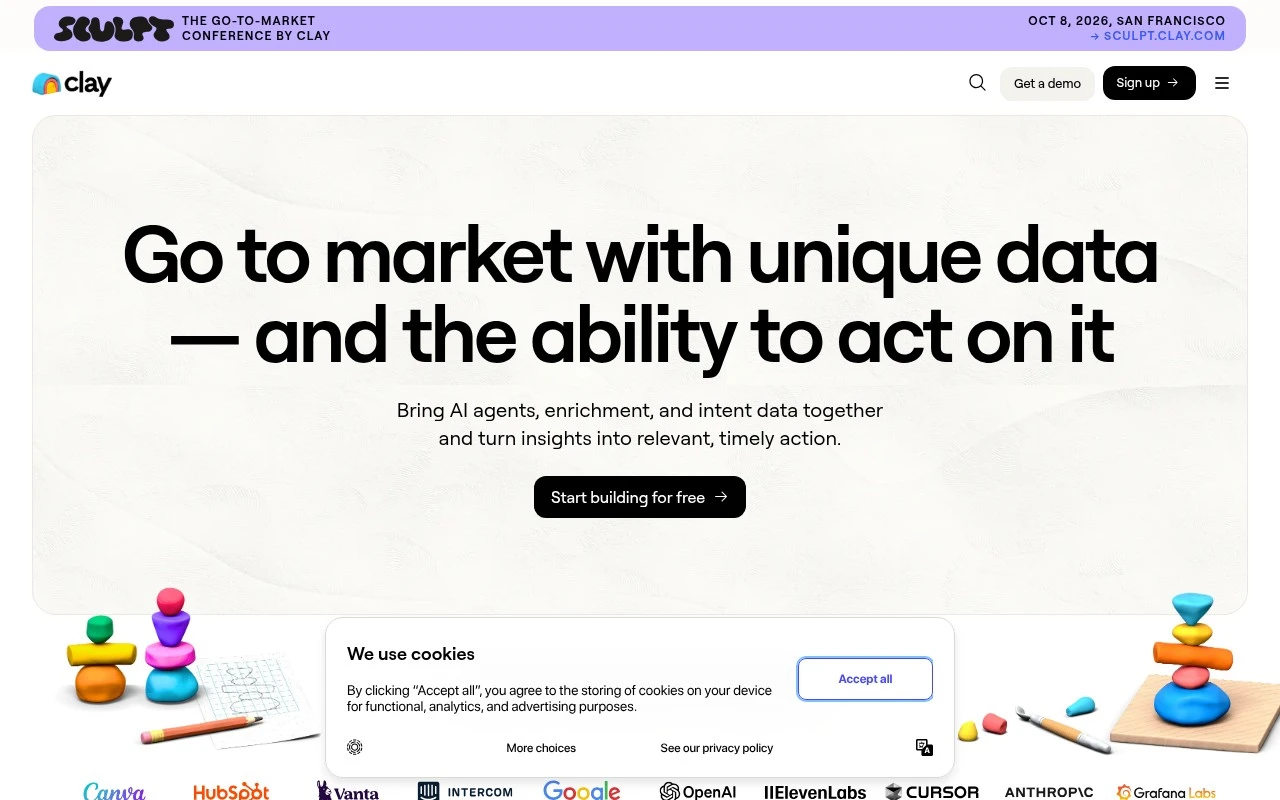
Clay is a go-to-market data enrichment and prospecting platform that helps teams build lead lists, enrich company and contact records, and automate personalized outbound workflows using connected data sources and AI.
Lead GenerationMarketing Automation

FYAI Score

8.0 / 10

Based on 226 reviews

Pricing:

Freemium

Best for:

Revenue ops and growth teams building scalable GTM workflows

Score Breakdown

  • Ease of use7.0 / 10
  • Features8.9 / 10
  • Pricing7.1 / 10
  • Integrations9.3 / 10
  • Support8.2 / 10

PRODUCT PREVIEW

What this AI tool does

Clay is a GTM infrastructure platform for revenue teams that need to turn fragmented company, contact, and intent data into AI-assisted sales and marketing workflows. It brings first-party data, third-party enrichment, external data providers, and workflow automation into one workspace so go-to-market teams can build more precise prospecting, routing, and audience strategies. Clay is especially useful for teams that want more control than a standard CRM or marketing automation tool provides, without having to build a custom internal data system from scratch. For revenue teams, Clay is best known for helping identify and enrich the right accounts and contacts before outreach begins. Sales, growth, and operations teams can use it to source target companies, find relevant people, add missing attributes, and verify records using a wide range of connected data sources. Instead of relying on one database, the platform lets teams combine multiple providers and their own internal context to create a more complete view of each prospect or customer. At the center of the product is a flexible table-based workspace that behaves like a spreadsheet, a data pipeline, and an automation builder at the same time. Users can create workflows that pull in firmographic data, job titles, technologies used, funding events, hiring activity, web signals, and other inputs that matter to a sales motion. AI assistance helps transform that data into practical outputs, such as account summaries, personalization snippets, qualification logic, or next-step recommendations. Signal monitoring is one of the areas where the platform becomes more than a static enrichment tool. Teams can track buying signals, career changes, company growth, new executive hires, category intent, or other events that suggest timing and relevance. When those signals appear, workflows can update records, trigger CRM automation, notify reps, or feed outbound campaigns with more timely context. Inbound teams can use Clay to improve lead scoring, routing, and qualification before a human touches the record. A form submission or new signup can be enriched, matched to an account, evaluated against ideal customer profile rules, and routed to the right owner based on territory, company fit, role, or buying potential. This makes it useful for revenue operations teams that need cleaner data and more consistent handoffs across sales and marketing systems. Audience workflows extend the platform into paid media and lifecycle marketing. Customer segmentation can be built from enriched account attributes, behavioral data, CRM fields, and external signals, then synced into channels such as LinkedIn, Meta, and Google. That allows teams to move from broad campaign audiences toward targeted account lists, suppression lists, reactivation segments, or lookalike inputs based on richer business data. The platform’s character is closer to a programmable GTM data layer than a single-purpose sales tool. Clay connects the work that often sits across spreadsheets, enrichment vendors, CRMs, marketing automation platforms, and manual research processes. Integration automation is central to that value, because the tool is designed to move data between systems while giving operations teams room to define their own logic. For organizations with complex go-to-market motions, Clay is a way to operationalize data strategy rather than simply store more records. It helps teams decide which accounts matter, what context is useful, when to act, and where that intelligence should appear in the revenue stack. Clay is for sales, marketing, growth, and RevOps teams that want to build repeatable AI-assisted workflows around targeting, enrichment, scoring, routing, and activation.

Use cases

Best for

Workflow Automation

Clay automates GTM workflows by enriching records, scoring leads, and routing them to CRM and outreach tools via synced tables.

Customer Segmentation

It segments customers by combining first-party CRM data with firmographic and intent enrichment, then filtering and scoring accounts in tables.

Marketing Automation

It automates marketing activation by syncing enriched audiences to LinkedIn, Meta, and Google for targeted ads and retargeting.

ANALYSIS

Strengths & limitations

Strengths
  • Best suited to GTM and revenue operations teams that need to combine first-party CRM data with many third-party enrichment sources in one workflow.
  • Useful for sales and marketing teams that want AI-assisted account research, contact enrichment, data formatting, and signal monitoring without building every process from scratch.
  • Strong fit for teams running targeted outbound, lead routing, scoring, and ad audience workflows because enriched data can trigger actions across multiple GTM channels.

Limitations
  • Less suitable for very small teams that only need a simple prospecting list or email tool because Clay is built as a broader GTM workflow and data infrastructure platform.
  • The freemium model can become limiting for production use because higher-volume enrichment, automation, and team workflows typically require paid capacity.
  • Teams handling sensitive customer or prospect data need strong data governance because Clay workflows can connect multiple external providers, CRMs, and advertising platforms.

Evaluation

FYAI score breakdown

Our structured evaluation across five key criteria

8.0 / 10

Overall score

Based on 226 reviews

  • Ease of use7.0 / 10
  • Features8.9 / 10
  • Pricing7.1 / 10
  • Integrations9.3 / 10
  • Support8.2 / 10

What users say

Findings from public reviews, documentation and community sources.

  • Ease of use

    A Reddit user testing Clay said it was “pretty hard to navigate,” with “lots of hidden logic” and “not super intuitive.”

  • Features

    Clay’s site lists AI company/person research, “Waterfall” enrichment across multiple data providers, signals and intent tracking, and a “Data marketplace” with “200+ providers.”

  • Pricing

    A Reddit thread asks whether Clay is “worth the price,” and a user in the thread said they were “feeling mixed” and that “Pricing stacks ...”.

  • Integrations

    Clay’s site lists a “Data marketplace” to buy data from “200+ providers,” ad audience sync to “Linkedin, Meta, and Google,” Salesforce-focused functionality, and an “Agent plugin” with “API and CLI.”

  • Support

    Clay’s site lists “University,” “Support docs,” “Cohort live classes,” “Clay community,” and “Slack.”

Who is this for?

Best for GTM and marketing teams that need prospecting workflows across multiple data sources, Clay’s site lists “Waterfall” enrichment across multiple data providers and a “Data marketplace” with “200+ providers.” Less suited to users who need quick setup or highly intuitive navigation, a Reddit user testing Clay said it was “pretty hard to navigate,” with “lots of hidden logic” and “not super intuitive.”

PRODUCT PREVIEW

Feature highlights

Unified GTM data

Centralize first- and third-party data into clean account records.

AI enrichment flows

Enrich leads, find signals, and auto-score accounts with AI steps.

Audience sync

Push segmented audiences to ad and sales tools for activation.

COMPARE

Discover curated alternatives worth comparing

Compare similar AI tools based on features, pricing and use cases

7.5/ 10Based on 12,890 reviews

Zoominfo

Lead GenerationCRM & Segmentation
Finds prospects, enriches accounts, and flags buyer signals
Best for:
Sales teams
Pricing
Paid only

8.6/ 10Based on 6,982 reviews

Zoho CRM

Sales & OutreachAnalytics & Reporting
Rewrites emails, detects anomalies, and builds CRM modules
Best for:
Sales teams
Pricing
Freemium

8.0/ 10Based on 1,041 reviews

Zoho Campaigns

Lead GenerationCRM & Segmentation
Builds email and SMS campaigns, automates and analyzes results
Best for:
Marketing teams
Pricing
Freemium

Turn messy lead data into rich profiles and outreach that converts. See why modern GTM teams use Clay to scale personalized campaigns in hours, not weeks.

FAQ

Frequently asked
questions

Everything you need to know about this AI tool,
its features, pricing, use cases, and limitations.

Who is Clay best suited for?
Clay is best suited for GTM, revenue, sales operations, and marketing teams that need to enrich data and automate revenue workflows. It is most useful when teams are building outbound prospecting, CRM enrichment, inbound lead scoring, account research, TAM sourcing, routing, or ad audience workflows across multiple data sources.
Does Clay have a free plan, and what should teams expect from paid plans?
Clay uses a freemium pricing model, so teams can typically start with limited access before moving to paid usage. Paid plans are usually more relevant for teams that need higher-volume enrichment, more workflow automation, connected data providers, CRM syncing, or production GTM processes.
What are the best alternatives to Clay for GTM automation?
The best Clay alternative depends on whether a team needs data enrichment, prospecting, CRM automation, lead scoring, marketing automation, or integration automation. Clay stands out for combining multiple data providers and AI-assisted GTM workflows, while other tools may be stronger as dedicated CRMs, marketing automation platforms, or data infrastructure systems.
How much setup work does Clay usually require?
Clay is not a full CRM, marketing automation suite, or data warehouse, so it usually works alongside existing GTM systems rather than replacing them. Its effectiveness also depends on workflow design, connected data sources, third-party provider coverage, and the team’s ability to monitor and maintain automated enrichment and activation logic.
What should buyers consider about data privacy and compliance with Clay?
Buyers should evaluate how Clay handles CRM, lead, account, and contact data before connecting production systems. Important checks include data source permissions, third-party enrichment providers, user access controls, retention policies, regional privacy requirements, consent rules, and how enriched data will be synced into sales, marketing, and advertising platforms.