Curated ToolThis tool is part of our curated AI directory. We only include tools that meet our standards for relevance, usability and real-world value.

Barilliance

Barilliance is an e-commerce personalization platform that uses behavioral data to deliver product recommendations, personalized site experiences, and triggered email campaigns for online retailers.
Sales & OutreachConversion Optimization

FYAI Score

7.8 / 10

Based on 18 reviews + FYAI product analysis

Pricing:

Enterprise

Best for:

Ecommerce teams improving product discovery and conversion rates

Score Breakdown

  • Ease of use8.0 / 10
  • Features7.3 / 10
  • Pricing8.0 / 10
  • Integrations7.1 / 10
  • Support8.6 / 10

PRODUCT PREVIEW

What this AI tool does

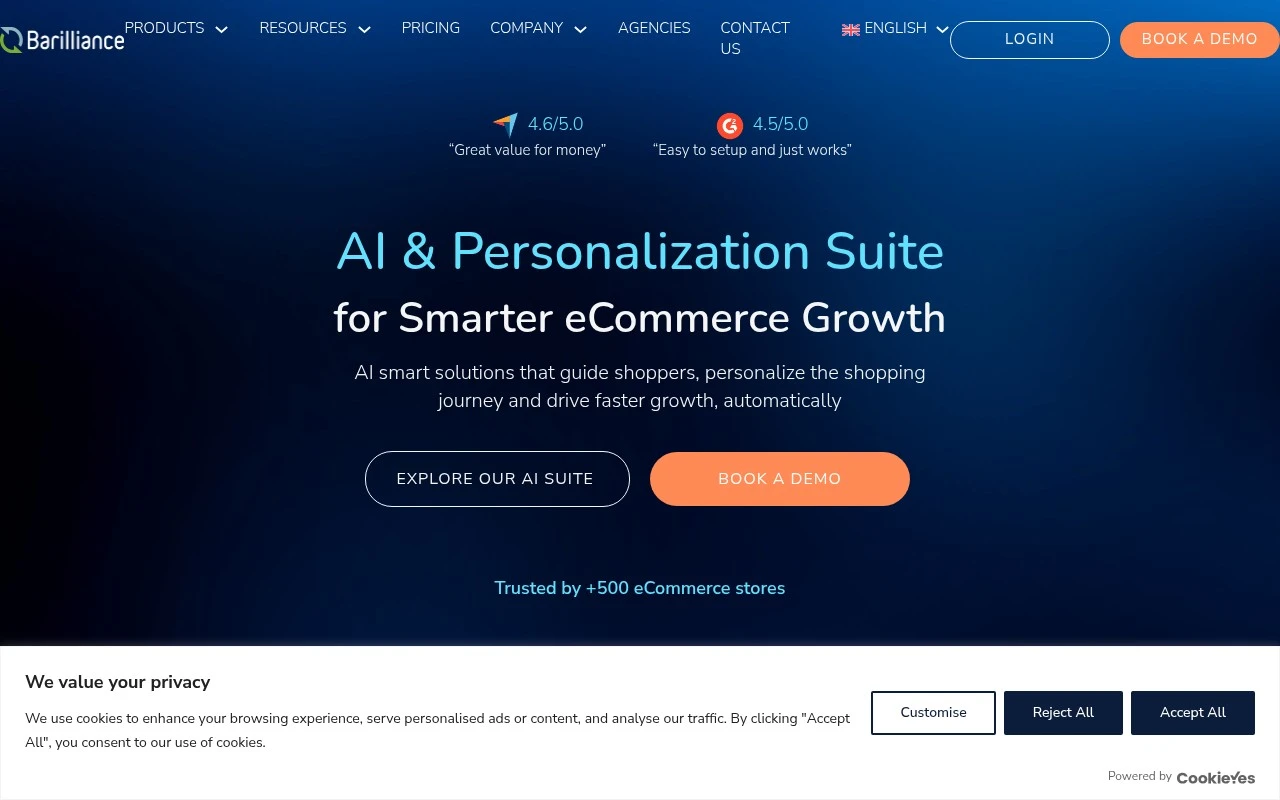
Barilliance is an AI personalization and conversion rate optimization suite for ecommerce stores that want to guide shoppers toward the right products, answer buying questions, and recover revenue after visitors leave. Barilliance is best suited to online retailers that need more than generic product recommendations, especially stores where hesitation, choice overload, or unclear product fit can stop a purchase. For shoppers, the platform is designed to make an online store feel more helpful and less anonymous. Instead of leaving visitors to browse static category pages, it can surface relevant products, show timely messages, answer product-specific questions, and help customers narrow options through an AI product finder experience. At the center of the product story is personalization across the buying journey. Product recommendations are not treated as a single widget, but as part of a broader system that can respond to behavior, intent, context, and stage in the funnel. That makes the tool relevant for stores that want to improve discovery, average order value, and conversion without rebuilding their ecommerce experience from scratch. The AI product expert gives Barilliance a more consultative role than traditional merchandising software. When shoppers have questions about sizing, compatibility, ingredients, features, or use cases, the assistant is intended to reduce uncertainty at the point where doubt often becomes abandonment. For retailers with complex catalogs, this can be especially valuable because product detail pages rarely answer every customer question in the way a sales associate would. Another important layer is guided selling through quizzes and product finders. Rather than relying only on search terms or filters, a store can ask customers about preferences, needs, or constraints, then steer them toward suitable items. This positions the platform as a bridge between ecommerce personalization and the kind of interactive advice customers might expect in a physical retail environment. Personalized website experiences extend the same logic beyond recommendations. Returning visitors, new shoppers, high-intent customers, and hesitant browsers can be treated differently, with content and prompts shaped around what they appear to need next. Social proof notifications add another behavioral layer by showing signals such as popularity or recent activity, which can help reassure visitors when they are comparing options. Cart abandonment is also part of the wider conversion strategy. Barilliance supports post-visit recovery through emails that can bring shoppers back to items they viewed or left behind. This matters because the platform is not only focused on what happens during a session, but also on how retailers continue the conversation after a shopper exits. For ecommerce teams, Barilliance is positioned as a practical personalization platform rather than a broad marketing cloud. It is most relevant to marketers, merchandisers, and growth teams that want to run more relevant on-site experiences while tying those experiences to measurable sales outcomes. A fair Barilliance review would likely focus on how well its AI assistance, product recommendations, and recovery workflows fit the retailer’s catalog complexity, traffic volume, and merchandising strategy. When evaluating the tool, retailers will usually compare Barilliance pricing against the potential lift from improved conversion, better product discovery, and recovered carts. The value case is strongest where customer choice is difficult, product education matters, or existing onsite search and filtering are not enough to move visitors confidently toward purchase. Overall, Barilliance is a personalization suite built around a clear ecommerce problem: shoppers often leave because they are unsure, overwhelmed, or not shown the right thing at the right time. By combining AI product guidance, recommendations, website personalization, social proof, and abandonment recovery, the platform aims to make each shopping journey feel more relevant and more likely to convert.

Use cases

Best for

Product Recommendations

Barilliance shows personalized product recommendations on pages using shopper behavior and product data to surface relevant items.

Conversion Rate Optimization

Barilliance improves conversion rate optimization with on-site personalization, social proof popups, and cart abandonment emails based on behavior.

ANALYSIS

Strengths & limitations

Strengths
  • Well suited to ecommerce teams because it combines product Q&A, guided product discovery, recommendations, personalization, social proof, and cart recovery in one conversion-focused suite.
  • Strong fit for retailers with large or complex catalogs because AI product guidance and finder quizzes can reduce shopper uncertainty and help customers reach relevant products faster.
  • Useful for teams optimizing both on-site and post-visit journeys because it supports real-time website personalization alongside cart abandonment email campaigns.

Limitations
  • Less suitable for non-ecommerce marketing teams because its capabilities are centered on online retail product discovery, merchandising, and shopper conversion workflows.
  • Custom pricing can be a drawback for smaller stores because budgeting and vendor comparison require a sales-led quote rather than a public self-serve plan.
  • Implementation may be heavier for lean teams because personalization, recommendations, and AI product guidance work best with clean product data, tracking, and ongoing optimization.

Evaluation

FYAI score breakdown

Our structured evaluation across five key criteria

7.8 / 10

Overall score

Based on 18 reviews + FYAI product analysis

  • Ease of use8.0 / 10
  • Features7.3 / 10
  • Pricing8.0 / 10
  • Integrations7.1 / 10
  • Support8.6 / 10

What users say

Findings from public reviews, documentation and community sources.

  • Ease of use

    G2 review signals describe Barilliance as having a “Quick and easy setup,” Software Advice quotes a user saying the software is “user friendly,” and the Barilliance pricing page states “Fast setup” and “No code required.”

  • Features

    The Barilliance home page lists “AI Product Expert,” “AI Product Finder,” “Product Recommendations,” and “Website Personalization,” and also describes cart abandonment emails and live notifications.

  • Pricing

    The Barilliance pricing page states “Month to Month,” “No long term contracts,” “Fixed Tiered Pricing,” and “A La Cart,” with starting prices of “$250” for Onsite Personalization, Product Recommendations, and Live! Plans. The Barilliance pricing page also says final pricing is provided through “a personalized pricing offer.”

  • Integrations

    The ActiveCampaign app page says Barilliance can “Integrate dynamic content and advanced product recommendations with ActiveCampaign emails.”

  • Support

    The Barilliance pricing page states that all plans include “Dedicated human technical support” and “Personal onboarding assistance,” and the FAQ says Barilliance provides onboarding assistance and resources “from day one.”

Who is this for?

Best for ecommerce teams that want onsite personalization and recovery workflows, the Barilliance home page lists “Product Recommendations” and “Website Personalization” and describes cart abandonment emails. Best for teams without heavy setup resources, the pricing page states “Fast setup” and “No code required.” Less suited to teams prioritizing a broad documented marketing-integration marketplace, because the integration fact provided is centered on ActiveCampaign emails.

PRODUCT PREVIEW

Feature highlights

AI Product Expert

Answer product questions instantly to reduce uncertainty and lift sales.

Product Finder Quiz

Guide shoppers to the right items with an AI-powered finder flow.

Personalized Upsell

Serve tailored recommendations and emails to increase conversions.

COMPARE

Discover curated alternatives worth comparing

Compare similar AI tools based on features, pricing and use cases

7.5/ 10Based on 12,890 reviews

Zoominfo

Lead GenerationCRM & Segmentation
Finds prospects, enriches accounts, and flags buyer signals
Best for:
Sales teams
Pricing
Paid only

8.6/ 10Based on 6,982 reviews

Zoho CRM

Sales & OutreachAnalytics & Reporting
Rewrites emails, detects anomalies, and builds CRM modules
Best for:
Sales teams
Pricing
Freemium

8.0/ 10Based on 1,041 reviews

Zoho Campaigns

Lead GenerationCRM & Segmentation
Builds email and SMS campaigns, automates and analyzes results
Best for:
Marketing teams
Pricing
Freemium

Turn shopper data into higher conversions with Barilliance. Start personalizing every visit today and watch revenue lift with less manual work.

FAQ

Frequently asked
questions

Everything you need to know about this AI tool,
its features, pricing, use cases, and limitations.

Who is Barilliance best suited for?
Barilliance is best suited for ecommerce retailers that want to improve product discovery, personalization, and shopper conversion on their online stores. It fits teams focused on guided product finding, AI product Q&A, personalized recommendations, popups, offers, abandonment emails, social proof, and increasing average order value.
Does Barilliance have a free plan, and how does its pricing work?
Barilliance uses custom pricing rather than a standard self-serve free plan model. Retailers should contact Barilliance through barilliance.com to confirm current pricing, package scope, implementation requirements, usage limits, and which features are included for their store size and ecommerce setup.
How does Barilliance compare with other ecommerce personalization tools?
Barilliance stands out by combining multiple ecommerce conversion features in one platform, including product recommendations, AI product Q&A, guided product finding, personalization, social proof, and abandonment emails. Compared with narrower tools, it may reduce the need for separate point solutions, but the best fit depends on budget, stack, and merchandising needs.
How much work is needed to set up Barilliance on an online store?
Barilliance is mainly designed for ecommerce stores, so it is not a general-purpose AI assistant or broad personalization platform for non-commerce websites. Its results will also depend on catalog quality, site traffic, shopper behavior signals, implementation depth, and how well teams configure product discovery and conversion workflows.
What should retailers check about data privacy before using Barilliance?
Retailers should review how Barilliance collects, processes, stores, and uses shopper behavior, product, email, and personalization data. Before implementation, teams should confirm cookie consent requirements, data retention terms, cross-border transfer practices, processor agreements, security controls, and compliance alignment with regulations that apply to their markets.