Curated ToolThis tool is part of our curated AI directory. We only include tools that meet our standards for relevance, usability and real-world value.

AWeber

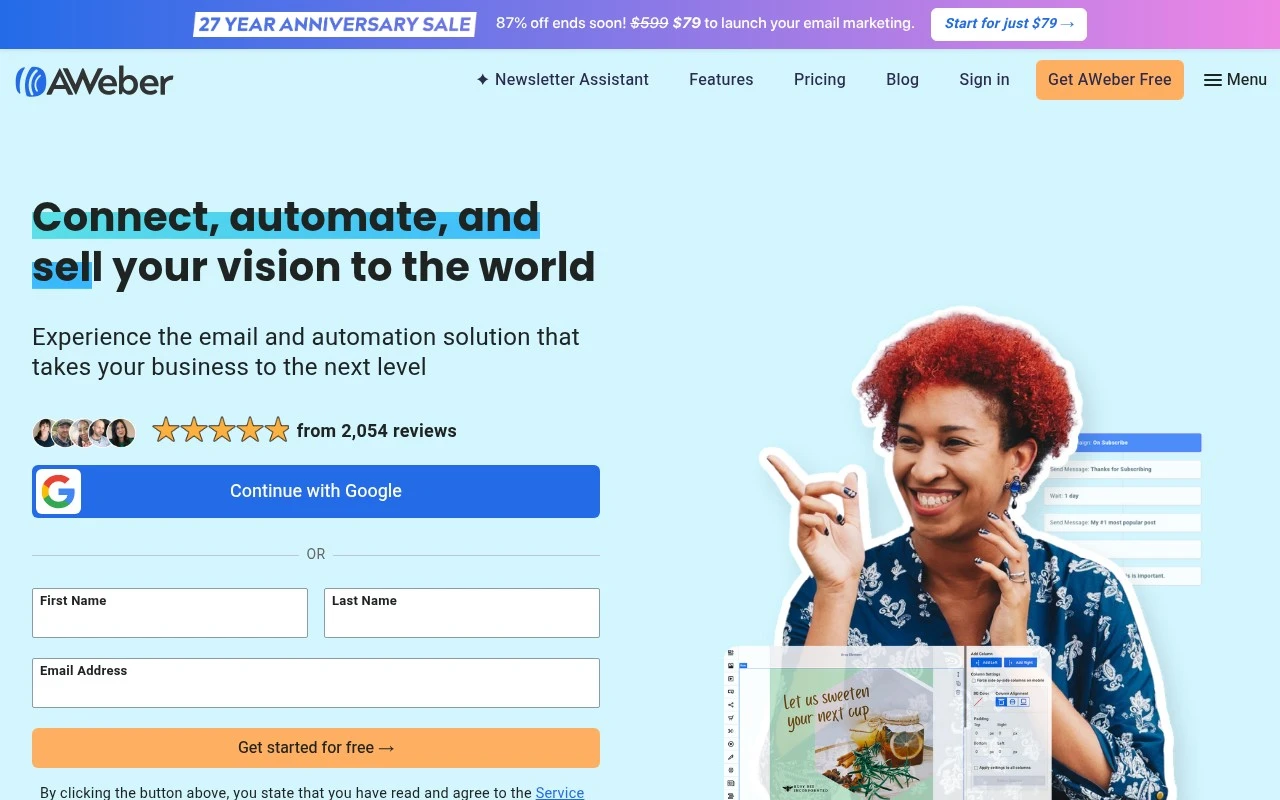
AWeber is an email marketing platform that lets businesses create newsletters, landing pages, and signup forms, manage subscriber lists, and send automated email campaigns.
Marketing AutomationEmail Marketing & Deliverability

FYAI Score

8.0 / 10

Based on 649 reviews

Pricing:

Freemium

Best for:

Small businesses and creators growing permission-based email lists

Score Breakdown

  • Ease of use8.0 / 10
  • Features7.3 / 10
  • Pricing7.4 / 10
  • Integrations8.8 / 10
  • Support9.2 / 10

PRODUCT PREVIEW

What this AI tool does

AWeber is an email marketing platform for small businesses that want to grow an owned audience, send permission-based campaigns, and turn subscriber relationships into sales. AWeber is best suited to entrepreneurs, creators, ecommerce sellers, coaches, nonprofits, and local businesses that need practical email marketing and marketing automation without building a complex enterprise stack. For small teams, the value of the platform is that it brings the main pieces of email marketing into one workspace. Users can create an email campaign, capture subscribers through forms and landing pages, organize contacts, and send newsletters or automated sequences from a single account. The product is designed around repeatable communication with people who have chosen to hear from the business. Its AI capabilities add a newer layer to that workflow by helping users write, design, and automate emails in a voice that matches their brand. Rather than treating AI as a separate writing assistant, the platform positions it as part of the campaign creation process, from generating message ideas to shaping layouts and follow-up emails. This makes it useful for business owners who know what they want to say but need help turning that intent into polished email content. The broader product story is about making professional email marketing accessible to non-specialists. AWeber gives users templates, drag-and-drop design tools, audience management, sign-up forms, and automation paths so they can launch campaigns without relying on a developer or a full marketing department. That character matters because many of its users are running the business as well as the marketing. Permission-based communication is central to how the tool should be understood. AWeber is not a cold-email platform or a system for blasting purchased lead lists, it is built for businesses that collect consent, nurture subscribers, and build long-term trust through email. This distinction shapes the way the platform fits into a marketing strategy, with emphasis on audience growth, deliverability, and ongoing relationship-building. For creators and small business owners, email often acts as the most dependable channel they control. Social platforms can change their algorithms, marketplaces can change their rules, and paid ads can become expensive, but an email list remains a direct line to customers and fans. The platform supports that owned-audience approach by helping users publish updates, promote products, announce events, share educational content, and follow up with people after they subscribe. Marketing automation is where the tool moves beyond one-off newsletters. A new subscriber can receive a welcome sequence, a customer can be guided toward a related offer, and different contacts can receive different messages based on actions or interests. This gives smaller businesses a way to personalize communication at scale while keeping the setup approachable. In practice, AWeber sits in the category of dependable, small-business email marketing software with a growing AI layer. It is for people who want to communicate consistently, look professional in the inbox, and automate the parts of email marketing that would otherwise take too much time. Its strength is not just sending emails, but helping a business build a permission-based audience and keep that audience engaged over time.

Use cases

Best for

Create Email Campaign

Use Aweber to create an email campaign with templates and AI writing tools, then schedule and send it to opted-in subscribers.

Marketing Automation

Set up marketing automation by building subscriber-triggered flows that send follow-up emails based on signups, clicks, and tags.

ANALYSIS

Strengths & limitations

Strengths
  • Best suited to small businesses and creators because it combines permission-based email marketing, audience growth, and sales-focused campaigns in one platform.
  • AI-assisted writing, design, and automation help lean teams create branded emails faster without needing a dedicated copywriter or designer for every campaign.
  • The freemium model gives new or budget-conscious users a practical way to start building and testing email campaigns before committing to a paid subscription.

Limitations
  • Less suitable for sales teams focused on cold prospecting because it is built for opt-in email marketing rather than purchased-lead outreach.
  • Less suitable for organizations that need a broad all-in-one customer data or multi-channel marketing suite because its core fit is email audience building and email automation.
  • Growing lists and more advanced marketing needs can move users beyond the free tier, so budget planning matters as the audience and campaign volume increase.

Evaluation

FYAI score breakdown

Our structured evaluation across five key criteria

8.0 / 10

Overall score

Based on 649 reviews

  • Ease of use8.0 / 10
  • Features7.3 / 10
  • Pricing7.4 / 10
  • Integrations8.8 / 10
  • Support9.2 / 10

What users say

Findings from public reviews, documentation and community sources.

  • Ease of use

    G2's 649-review signal says users “consistently praise AWeber for its ease of use and automation capabilities.”

  • Features

    AWeber positions itself as “email marketing software” with AI that “writes, designs, and automates your emails in minutes.” G2 users also highlight AWeber's automation capabilities.

  • Pricing

    AWeber's pricing documentation lists AWeber Plus as starting at “$30 per month” or “$20 per month, billed annually at $240,” and other snippets reference send limits and setup/service fees.

  • Integrations

    AWeber describes connections to “social media, landing pages, shopping carts and many more integrations,” and Zapier lists AWeber as integrating with “9000 other apps.”

  • Support

    Trustpilot highlights “Aweber has exceptional support,” and a Reddit user said AWeber offered “really fantastic customer service and follow up.”

Who is this for?

Best for email marketers who want AI-assisted email creation and automation, AWeber says its AI “writes, designs, and automates your emails in minutes,” and G2 users highlight automation capabilities. Less suited to teams that need a simple flat-price decision without checking usage terms, AWeber's pricing documentation lists AWeber Plus as starting at “$30 per month” or “$20 per month, billed annually at $240,” and other snippets reference send limits and setup/service fees.

PRODUCT PREVIEW

Feature highlights

AI email writing

Draft subject lines and copy in your brand voice in minutes.

Email automation

Send welcome series and follow-ups triggered by subscriber actions.

Reports & insights

Track opens, clicks, and growth to improve every campaign.

COMPARE

Discover curated alternatives worth comparing

Compare similar AI tools based on features, pricing and use cases

7.5/ 10Based on 12,890 reviews

Zoominfo

Lead GenerationCRM & Segmentation
Finds prospects, enriches accounts, and flags buyer signals
Best for:
Sales teams
Pricing
Paid only

8.6/ 10Based on 6,982 reviews

Zoho CRM

Sales & OutreachAnalytics & Reporting
Rewrites emails, detects anomalies, and builds CRM modules
Best for:
Sales teams
Pricing
Freemium

8.0/ 10Based on 1,041 reviews

Zoho Campaigns

Lead GenerationCRM & Segmentation
Builds email and SMS campaigns, automates and analyzes results
Best for:
Marketing teams
Pricing
Freemium

Start sending emails that turn subscribers into customers. Join thousands of small businesses using Aweber to grow their audience and sales with confidence.

FAQ

Frequently asked
questions

Everything you need to know about this AI tool,
its features, pricing, use cases, and limitations.

Who is AWeber best for?
AWeber is best for small businesses, creators, independent marketers, and organizations that need permission-based email marketing. It is built around creating, designing, sending, and automating emails for opted-in subscribers, with AI assistance for writing and design while keeping messages aligned with a brand voice.
Does AWeber have a free plan, and when would I need a paid plan?
AWeber uses a freemium pricing model, so users can start with a free option and upgrade when they need more capacity or capabilities. Exact plan limits can change, so buyers should review AWeber’s current pricing page before deciding whether the free plan fits their list size and campaign needs.
How does AWeber compare with other email marketing tools?
AWeber is a strong fit when the priority is small-business email marketing with AI-assisted email creation, design, and automation. Compared with similar platforms, the right choice depends on list size, budget, automation depth, reporting needs, integrations, and whether the team needs permission-based marketing rather than cold outreach.
How quickly can I create an email campaign in AWeber?
AWeber is not suitable for cold outreach using purchased, scraped, or unsolicited lead lists. Its main trade-off is that it is focused on permission-based email marketing, so buyers should evaluate whether its automation, analytics, segmentation, integrations, and policy restrictions fit their specific marketing workflow.
What should I check before using AWeber with customer data?
AWeber should be used with opted-in subscriber data and appropriate consent practices. Teams should review its service terms, privacy commitments, unsubscribe handling, and restrictions on sensitive personal data before importing contacts or automating campaigns, especially if they operate in regulated industries or market across multiple jurisdictions.