Curated ToolThis tool is part of our curated AI directory. We only include tools that meet our standards for relevance, usability and real-world value.

Algolia

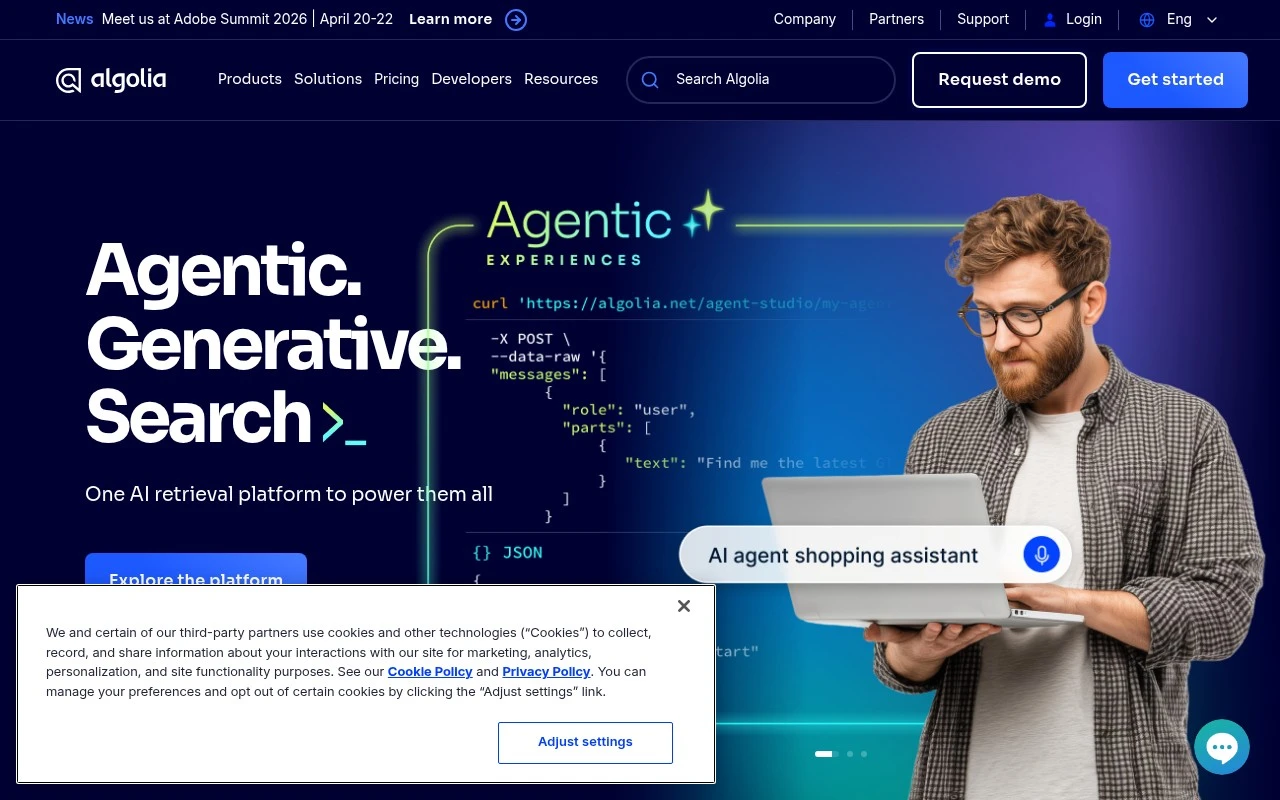
Algolia is a hosted search and discovery platform that lets developers add fast, typo-tolerant search, filtering, and recommendations to websites and applications through APIs and SDKs. It indexes content and returns ranked results in real time for use cases such as ecommerce, media, and SaaS product search.
Marketing

FYAI Score

8.9 / 10

Based on 452 reviews

Pricing:

Free trial

Best for:

Product and engineering teams building fast search and discovery

Score Breakdown

  • Ease of use8.7 / 10
  • Features9.3 / 10
  • Pricing9.0 / 10
  • Integrations9.0 / 10
  • Support8.2 / 10

PRODUCT PREVIEW

What this AI tool does

Algolia is a hosted search and AI retrieval platform for product, engineering, and digital experience teams that need fast, relevant search without building a search engine from scratch. It turns structured records, product catalogs, documentation, and content libraries into search-driven experiences that can respond quickly and adapt to user behavior. Algolia is especially strong for organizations where search is not a background utility, but a core part of how users find, compare, and act. At its core, the platform handles indexing, querying, ranking, and retrieval so teams can focus on the experience around search rather than the infrastructure beneath it. Developers send data into the index, configure relevance rules, and connect search results to websites, apps, marketplaces, or internal tools. The result is a search layer that can support autocomplete, filtering, faceting, typo tolerance, synonyms, and ranking logic across large sets of records. For ecommerce teams, Algolia is best known for product discovery experiences that help shoppers move from intent to purchase. Search results can be tuned around relevance, business goals, inventory, popularity, or behavioral signals, while product recommendations can extend discovery beyond the query box. This makes the platform useful for guided shopping, category navigation, merchandising, and personalized storefront journeys. Content-heavy products use the platform differently, often as a way to make documentation, help centers, media libraries, or SaaS knowledge bases easier to navigate. Knowledge base search benefits from fast retrieval, clear ranking, and support for natural user input, especially when customers do not know the exact title or terminology of what they need. In this context, Algolia works as an internal search and support discovery layer, reducing friction for users who would otherwise browse through static menus or long documentation trees. Modern AI applications add another layer to the story. Algolia can serve as retrieval infrastructure for generative AI systems, helping applications find relevant source material before producing an answer. In retrieval-augmented generation workflows, the platform is positioned as the search and relevance component that connects language models to trusted product data, documentation, or enterprise content. Relevance is a central theme in how the tool is used. Instead of treating search as a simple keyword match, the platform gives teams ways to shape what counts as a good result for their audience and business model. Analytics can inform ranking decisions, while personalization can adjust discovery based on signals such as past behavior, geography, preferences, or segment. Implementation is designed for teams that want control without owning every operational detail of search infrastructure. Engineers still make important choices about data modeling, indexing strategy, ranking, and user interface behavior, but the platform absorbs much of the complexity of scaling search performance and maintaining retrieval systems. That balance makes it attractive to companies that need production-grade search but do not want to dedicate a full search engineering team to the problem. The main character of Algolia is speed combined with relevance control. Algolia is for organizations that see search as a product experience, not merely a database lookup, and that want to improve discovery across commerce, content, support, and AI workflows. It sits between raw search infrastructure and fully packaged site search, giving technical teams the tools to build tailored experiences while relying on a managed platform for the hard parts of indexing, retrieval, and performance.

Use cases

Best for

Internal Search

Index internal documents and apps, then use typo tolerant search and filters to return relevant results in milliseconds.

Product Recommendations

Use Algolia Recommend to generate related and frequently bought together suggestions from click and conversion events.

Knowledge Base Search

Index help articles and docs, then use ranking rules and synonyms to surface the best answer for each query.

ANALYSIS

Strengths & limitations

Strengths
  • Best suited to teams that need hosted search infrastructure because it avoids building and operating a search engine from scratch.
  • Strong fit for ecommerce and content teams because indexing, relevance tuning, analytics, personalization, and merchandising workflows support search-driven discovery experiences.
  • Useful for AI application teams because it can provide retrieval over verified organizational data for RAG and answer experiences.

Limitations
  • Less suitable for teams that want fully self-hosted search because Algolia is a hosted platform and makes the retrieval layer dependent on an external service.
  • Less suitable for very small sites or simple catalogs because implementation, indexing, and relevance tuning can be heavier than a basic embedded search widget.
  • Free-trial pricing is less suitable for teams that need a permanently free production search layer because continued use requires moving beyond the trial.

Evaluation

FYAI score breakdown

Our structured evaluation across five key criteria

8.9 / 10

Overall score

Based on 452 reviews

  • Ease of use8.7 / 10
  • Features9.3 / 10
  • Pricing9.0 / 10
  • Integrations9.0 / 10
  • Support8.2 / 10

What users say

Findings from public reviews, documentation and community sources.

  • Ease of use

    G2 shows Algolia at 4.5/5 across 452 reviews and says users praise its “lightning-fast search capabilities and ease of integration.” Algolia’s own site positions launch as fast via API clients, partner integrations, and UI components while still requiring implementation work.

  • Features

    Algolia’s pricing page describes an AI search and product-discovery platform with keyword search, NeuralSearch, recommendations, and generative experiences. Algolia’s pricing page also references personalization, analytics, merchandising, rules, synonyms, query categorization, A/B testing, and UI components.

  • Pricing

    Algolia’s pricing page lists a free Build tier, Grow with 10K search requests/month then $0.50 per additional 1K, and Grow Plus at $1.75 per additional 1K search requests. Algolia’s pricing page says Enterprise Elevate uses request pricing and both Grow and Grow Plus list record overage pricing.

  • Integrations

    Algolia describes indexing content with “API clients or partner integrations” and launching with UI components. Algolia’s integration documentation names data connectors such as Elasticsearch and Firebase.

  • Support

    Algolia’s pricing page includes a “Support & Success” comparison area. Algolia’s pricing page says the Elevate tier includes “Access to enterprise-level Support plans” and “Professional services available.”

Who is this for?

Best for teams building marketing or product-discovery search that can implement via API clients, partner integrations, or UI components, Algolia’s own site positions launch through those paths. Best fit also includes teams that need capabilities such as NeuralSearch, recommendations, personalization, analytics, and merchandising. Less suited to teams that need fully public enterprise pricing or detailed self-serve support expectations, Algolia’s pricing page says Enterprise Elevate uses request pricing and highlights enterprise-level Support plans plus professional services for Elevate.

PRODUCT PREVIEW

Feature highlights

Instant search results

Deliver fast, relevant results across products, content, and docs.

Analytics-driven ranking

Optimize relevance with insights from queries, clicks, and conversions.

AI retrieval for RAG

Power generative AI with reliable retrieval from your indexed data.

COMPARE

Discover curated alternatives worth comparing

Compare similar AI tools based on features, pricing and use cases

7.5/ 10Based on 12,890 reviews

Zoominfo

Lead GenerationCRM & Segmentation
Finds prospects, enriches accounts, and flags buyer signals
Best for:
Sales teams
Pricing
Paid only

8.6/ 10Based on 6,982 reviews

Zoho CRM

Sales & OutreachAnalytics & Reporting
Rewrites emails, detects anomalies, and builds CRM modules
Best for:
Sales teams
Pricing
Freemium

8.0/ 10Based on 1,041 reviews

Zoho Campaigns

Lead GenerationCRM & Segmentation
Builds email and SMS campaigns, automates and analyzes results
Best for:
Marketing teams
Pricing
Freemium

Build fast, relevant search and discovery that helps users find what they need instantly. See why teams choose Algolia to turn content into confident decisions.

FAQ

Frequently asked
questions

Everything you need to know about this AI tool,
its features, pricing, use cases, and limitations.

Who is Algolia best suited for?
Algolia is best suited for product, engineering, ecommerce, merchandising, documentation, support, and AI application teams that need to build search or retrieval into a digital experience. It fits use cases such as site search, product discovery, knowledge base search, guided shopping, and RAG workflows using indexed organizational data.
Does Algolia have a free plan or paid plans?
Algolia offers a free trial model, which lets teams evaluate the platform before committing to a paid implementation. Buyers should review Algolia’s current pricing page for plan details, usage limits, and commercial terms, especially if they expect high query volume, large indexes, or advanced ecommerce and AI retrieval features.
What are the best Algolia alternatives to consider?
The best alternative to Algolia depends on whether the priority is internal search, ecommerce discovery, knowledge base search, product recommendations, or AI retrieval for RAG. Teams should compare options on indexing workflow, relevance controls, latency, merchandising features, personalization, analytics, API flexibility, implementation effort, and total cost at expected scale.
How difficult is Algolia to set up?
Algolia’s main trade-off is that it requires teams to prepare, index, and maintain their own data for search and retrieval. It is strongest as infrastructure for building search, discovery, and AI retrieval experiences, rather than as a standalone general-purpose chatbot or a simple plug-and-play tool for non-technical users.
What should teams check about Algolia data privacy and compliance?
Teams evaluating Algolia should confirm how their indexed content, product data, logs, and user interaction data are handled across storage, access control, retention, and regional requirements. Buyers in regulated environments should also review Algolia’s current security documentation, compliance certifications, subprocessors, and contractual terms before deploying it with sensitive organizational data.